




 Latest News
JANUARY 19, 2026 Current Affairs
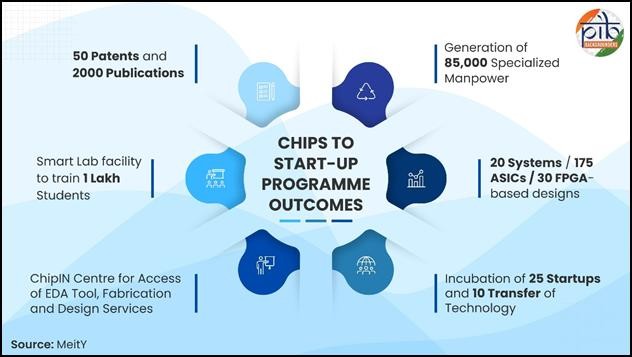
Chips to Start-up (C2S) Programme
- The Chips to Start-up (C2S) Programme is in news highlighting its tangible outcomes—56 student-designed chips fabricated, 75+ patents filed, and large-scale chip design training—showcasing India’s growing indigenous semiconductor design capability.
Chips to Start-up (C2S) Programme:
- The Chips to Start-up (C2S) Programme is a national capacity-building and innovation initiative to develop industry-ready chip design talent and strengthen India’s indigenous semiconductor design ecosystem through hands-on training, R&D, and fabrication exposure.
- Launched in: 2022
- Implemented by: the Ministry of Electronics and Information Technology (MeitY)
- Aim: To create a robust pipeline of skilled chip designers, enable hands-on chip fabrication, foster start-ups and IP creation, and support technological self-reliance in semiconductors.
Key features
- Outlay: ₹250 crore (5 years)
- Human resource targets: 200 PhDs, 7,000 M.Tech (VLSI), 8,800 M.Tech (related streams with VLSI), 69,000 B.Tech students.
- Infrastructure access: Shared EDA tools, HPC, FPGA boards, and SMART labs.
- Hands-on fabrication: Shared wafer runs via Semi-Conductor Laboratory (SCL), Mohali.
- Chip design enablement: National ChipIN Centre operated by Centre for Development of Advanced Computing (C-DAC), Bengaluru.
- Innovation outcomes: Start-up incubation, patents, IP cores, ASICs and SoCs.
- Industry collaboration: Training with global EDA and semiconductor firms.
Significance
- Builds strategic talent to address the global semiconductor skill gap.
- Democratises chip design by giving students nationwide access to advanced tools and fabrication.
- Strengthens self-reliance (Atmanirbhar Bharat) in a critical, security-sensitive sector.
Second range-wide Dolphin Survey
- The second range-wide Dolphin Survey has been launched from Bijnor, Uttar Pradesh under Project Dolphin to update population estimates, assess habitats and threats.
Project Dolphin:
- Project Dolphin is a national conservation initiative of the Government of India aimed at protecting riverine and oceanic dolphins through habitat protection, scientific monitoring, and stakeholder participation.
- Launched in: 15 August 2020
- Nodal ministry: Ministry of Environment, Forest and Climate Change (MoEFCC)
- Aim: To safeguard India’s dolphin diversity by addressing threats such as habitat degradation, pollution, by-catch, and flow alteration, while empowering local communities in conservation.
Key features:
- 10-year initiative with national coverage.
- Focus on riverine & oceanic species.
- Scientific monitoring & surveys for population and habitat status.
- Integration with river ecosystem conservation and policy action.
Second range-wide Dolphin Survey (under Project Dolphin):
- A pan-India scientific estimation exercise to assess population, distribution, habitat condition and threats to riverine and estuarine dolphins, conducted in two phases across major river systems and coastal/estuarine stretches.
Implementation & coverage
- Phase I: Main stem of the Ganga (Bijnor to Ganga Sagar) and the Indus River.
- Phase II: Brahmaputra, Ganga tributaries, Sundarbans, and Odisha.
- Coordinated by Wildlife Institute of India, with State Forest Departments and conservation partners.
- Uses standardised protocols, hydrophones for acoustic monitoring, and trained field teams.
Previous survey data (2021–23):
- ~6,327 riverine dolphins recorded nationwide.
- Highest numbers in Uttar Pradesh and Bihar, followed by West Bengal and Assam.
- Small population of Indus River Dolphin recorded in the Beas system.
BRICS Plus naval exercise
- India’s decision to skip the BRICS Plus naval exercise “Will for Peace 2026” has drawn attention as New Delhi clarified that such drills are not institutionalised BRICS activities and reflected a considered political choice amid evolving geopolitics.
BRICS Plus Naval Exercises:
- The BRICS Plus naval exercise is a host-led, non-institutionalised maritime drill involving selected BRICS members and invited partner countries, conducted outside the formal BRICS framework.
- Host nation: South Africa
- Conducted off the coast of Simon’s Town, near Cape Town.
Member participants:
- Participating navies: China, Russia, Iran, United Arab Emirates, South Africa
- Observers: Brazil, Egypt, Ethiopia, Indonesia
- Non-participants: India, Brazil (opted out of active participation)
- Aim: To conduct joint maritime operations focused on the security of key shipping lanes and maritime economic activities, projected as cooperation among Global South nations.
Key features
- Theme: “Joint Actions to Ensure the Safety of Key Shipping Lanes and Maritime Economic Activities”.
- Operations covering maritime security, counter-terrorism, anti-sea strike drills, and search & rescue.
- China-led operational coordination, with participation of sanctioned states like Russia and Iran.
- Framed as part of a broader “BRICS Plus” outreach, beyond core BRICS membership.
Significance:
- Highlights diverging visions within BRICS—economic cooperation versus security signalling.
- Raises concerns about militarisation of BRICS and perceptions of an anti-Western alignment.
- Explains India’s emphasis on strategic autonomy, separation of economic forums from military blocs, and caution in defence engagement with China.
UN Biodiversity Beyond National Jurisdiction (BBNJ) Treaty
- The UN Biodiversity Beyond National Jurisdiction (BBNJ) Treaty, also known as the High Seas Treaty, has entered into force after crossing the required 60 ratifications, creating the first legally binding global framework to protect biodiversity in international waters.
UN Biodiversity Beyond National Jurisdiction (BBNJ) Treaty:
- The BBNJ Agreement is a legally binding international treaty under the United Nations Convention on the Law of the Sea (UNCLOS) to conserve and sustainably use marine biodiversity in areas beyond national jurisdiction (the High Seas).
Origin and history:
- Negotiations began in 2008 amid growing concern over unregulated exploitation of the high seas.
- After 15 years of negotiations, the treaty was finalised in March 2023.
- It entered into force 120 days after the 60th ratification, which was achieved in September 2025.
Targets:
- Achieve the “30 by 30” goal: protect 30% of the global ocean area by 2030.
- Enable large-scale conservation across two-thirds of the ocean, which lies beyond national control.
Key features:
- Marine Protected Areas (MPAs): Enables creation of a global network of MPAs in international waters to conserve fragile and previously unregulated ecosystems.
- Environmental Impact Assessments (EIAs): Mandates prior assessment of activities that may significantly harm marine ecosystems in the high seas.
- Marine Genetic Resources (MGRs): Establishes fair and equitable sharing of benefits derived from genetic resources used in biotechnology and pharmaceuticals.
- Capacity building and technology transfer: Supports developing countries through training, access to data, scientific cooperation, and marine technologies.
- Ecosystem-based and precautionary approach: Promotes decision-making based on best available science, traditional knowledge, and the precautionary principle.
- No sovereignty claims: Reaffirms that no state can claim sovereign rights over high-seas biological resources.
80 years of the United Nations Economic and Social Council (ECOSOC)
- The United Nations Economic and Social Council (ECOSOC) will commemorate its 80th anniversary on 23 January 2026, marking eight decades of coordinating global action on development.
United Nations Economic and Social Council (ECOSOC):
- ECOSOC is one of the six principal organs of the United Nations, serving as the central forum for international economic, social and environmental policy coordination, consensus-building and follow-up to global development commitments.
- Established in: 1945 under the UN Charter
- First meeting: 23 January 1946, London
- Aim: To advance sustainable development by integrating economic growth, social inclusion and environmental protection, ensuring that no one is left behind.
Key functions:
- Policy coordination: Guides and coordinates UN development system, including specialised agencies and programmes.
- Global platform: Facilitates debate, consensus and innovative thinking on development challenges.
- SDG follow-up: Reviews progress on SDGs via the HLPF.
- Inclusive engagement: Grants consultative status to 6,500+ NGOs, enabling civil society participation.
- Institutional linkage: Oversees functional commissions, regional commissions and expert bodies.
- UN system governance: Elects executive boards of agencies like UNICEF, UNDP and UNHCR.
Significance:
- Aligns global economic, social and environmental action.
- Connects governments, civil society, youth, academia and private sector.
- Uses convening power to restore confidence in multilateral solutions.
Microscopic crustacean
- A microscopic crustacean discovered in the Kavaratti lagoon, Lakshadweep, has been formally established as a new genus and species, named Indiaphonte bijoyi.
Microscopic crustacean:
- Indiaphonte bijoyi is a microscopic crustacean (copepod) belonging to the family Laophontidae under the order Harpacticoida. It is part of meiofauna—tiny invertebrates (less than 1 mm) that live within aquatic sediments and are visible only under a microscope.
- Found in: The species was discovered in the Kavaratti lagoon, a coral-rich, shallow lagoon ecosystem known for high marine biodiversity.
- The genus name Indiaphonte honours India; the species name bijoyi honours S. Bijoy Nandan, a noted Indian marine scientist.
- Recognised as a new genus due to a unique combination of morphological traits not seen in any known Laophontidae genus.
Key crustacean group:
1. Macroscopic crustaceans:
- Crab, Lobster, Shrimp / Prawn, Krill, and Barnacle.
2. Microscopic crustaceans:
- Copepods, Cladocerans, Ostracods, and Amphipods etc.
Key characteristics
- Size: ~518–772 micrometres; females slightly larger than males.
- Body: Semi-cylindrical, dorsoventrally depressed, widest at mid-body and tapering posteriorly.
- Appendages: Antennae-like structures at the front; specialised limbs adapted for sediment life.
Significance
- Ecosystem health: Meiofaunal copepods recycle nutrients, graze on microalgae, and form the base of aquatic food webs.
- Biodiversity science: Adds a new genus to global taxonomy, underscoring India’s role in marine discovery.
First open-sea Marine Fish Farming Project in Andaman Sea
- India has launched its first open-sea marine fish farming project in the Andaman Sea, marking a major step in advancing the Blue Economy through science-led, livelihood-oriented utilisation of ocean resources.
First open-sea Marine Fish Farming Project in Andaman Sea:
- India’s first pilot open-sea aquaculture initiative involving marine finfish and seaweed farming in natural oceanic conditions using indigenously developed open-sea cages and marine technologies.
Located in
- North Bay, near Sri Vijaya Puram, Andaman Sea.
- Union Territory of Andaman & Nicobar Islands.
Implementing agencies
- Ministry of Earth Sciences (MoES) & National Institute of Ocean Technology (NIOT).
- Aim: To unlock ocean-based economic potential, generate sustainable coastal livelihoods, and build technical feasibility for scaling open-sea aquaculture under India’s Blue Economy vision.
Key features
- Open-sea finfish farming using NIOT-designed cages resilient to natural ocean conditions.
- Deep-water seaweed cultivation with seed distribution to local fishers.
- Livelihood-centric pilot integrating science, technology, and community participation.
- PPP-ready model for future scale-up based on feasibility and field experience.
- Strengthens marine food security, employment, and coastal resilience.
Andaman Sea:
- The Andaman Sea is a marginal sea of the northeastern Indian Ocean, historically significant for trade and strategically important for maritime connectivity and regional ecology.
- Located in: The Andaman Sea is located in the north-eastern Indian Ocean, adjoining South-East Asia.
- Bordering: Irrawaddy River delta, Myanmar and Thailand, Sumatra (Indonesia) and the Strait of Malacca.
Key features:
- Large marginal sea (~7.98 lakh sq km): The Andaman Sea forms a vast part of the north-eastern Indian Ocean, providing significant space for ocean circulation, sediment deposition, and marine resource utilisation.
- Andaman–Nicobar Ridge (active subduction zone): It lies along a tectonically active boundary where the Indian Plate subducts beneath the Burma microplate, shaping the region’s seismic and volcanic characteristics.
- Deep submarine valleys (>4,400 m): The sea contains deep oceanic trenches and valleys formed by tectonic movement, making parts of it among the deepest zones in the eastern Indian Ocean.
- Shallow northern continental shelf: Extensive sediment deposition from the Irrawaddy River has created a relatively shallow seabed in the north, influencing salinity, turbidity, and marine habitats.
Lok Sabha Speaker Can Act Unilaterally to Constitute Inquiry Committee
- The Supreme Court dismissed Justice Yashwant Varma’s plea challenging the legality of the Lok Sabha Speaker’s 3-member inquiry committee under the Judges (Inquiry) Act, 1968.
Background of the Case
- Accidental Discovery: A fire at Delhi High Court judge Yashwant Varma’s residence led to the accidental discovery of alleged unaccounted-for cash.
- Simultaneous Motions: Removal motions against Justice Varma were introduced in Lok Sabha and Rajya Sabha on the same day.
- Divergent Decisions: Lok Sabha Speaker admitted the motion, while Rajya Sabha Deputy Chairman rejected the identical motion.
- Unilateral Action: Despite Rajya Sabha rejection, the Lok Sabha Speaker constituted a three-member Inquiry Committee under the Judges (Inquiry) Act, 1968.
Grounds Raised by Justice Varma
- Joint Requirement: Simultaneous motions in both Houses require a joint inquiry committee; the Speaker cannot act unilaterally.
- Mutual Dependence: Rejection of the motion by the Rajya Sabha automatically invalidates the Lok Sabha’s admission of the motion.
- Authority Issue: Deputy Chairman lacks the statutory power to reject motions; only the Chairman can exercise such authority.
Rulings by the Supreme Court
- House Autonomy: Rejection by one House does not bar the other from proceeding under the Judges (Inquiry) Act, 1968.
- Section 3(2) mandates a joint committee only when both Houses admit the removal motions.
- Treating one House’s rejection as binding would create an unconstitutional veto.
- Constitutional Power: Deputy Chairman is empowered under Article 91 to discharge the Chairman’s statutory duties during a vacancy.
- Final Holding: Lok Sabha Speaker’s unilateral constitution of the Inquiry Committee was legally valid.
About Judges (Inquiry) Act, 1968
- Core Purpose: The Act lays down the procedure to investigate proven misbehaviour or incapacity of Supreme Court and High Court judges.
- Removal Articles: It operationalises the removal of Supreme Court judges under Article 124(4) and of High Court judges under Article 218.
- Motion Threshold: A removal motion needs signatures of 100 Lok Sabha members or 50 Rajya Sabha members to be introduced.
- Admission Power: The Speaker or Chairman may admit or refuse the motion after examining available material; the decision can be challenged only under Article 32 or for gross illegality.
- Committee Setup: Once admitted, the Speaker or Chairman constitutes a three-member judicial inquiry committee, comprising
- A Supreme Court judge or Chief Justice of India
- A High Court Chief Justice and
- A distinguished jurist nominated by the Speaker/Chairman
- Inquiry Powers: The committee functions as a civil court, with the authority to summon witnesses and record evidence; it reports its findings to the Speaker or Chairman.
- Reporting Step: If charges are proved, the committee’s report is laid before the House(s) where the motion is pending.
- Voting Rule: Each House must pass the motion in the same session by a special majority of the total membership and two-thirds of those present and voting.
- Final Order: After parliamentary approval, an address is sent to the President, who then issues the removal order.
- Past Outcome: No judge in India has been removed so far through the full statutory process.
Gaza Board of Peace
- US President Donald Trump invited PM Narendra Modi to join a proposed Gaza “Board of Peace”, launched as part of the second phase of the Israel–Hamas ceasefire.
What is Trump’s “Board of Peace”?
- A proposed international body aimed at bringing lasting peace and stability in Gaza through a new transition framework, beyond short-term ceasefire management.
- It is projected as a platform not just for Gaza but potentially for wider conflict-resolution, since it is framed as a “bold new approach” to resolve global conflict.
Core Mandates of the Board
- Governance Transition: The Board is meant to guide Gaza’s transition towards stable, lawful governance after the war, reducing institutional vacuum risks.
- Funding Coordination: It is expected to coordinate international funding and channel reconstruction resources in an organised manner, rebuilding sustained multi-year financing.
Structure & Membership Design
- Heads-Only Top Tier: The top level is proposed to include only heads of state, signalling high political authority in decision-making.
- Trump-Led Framework: It is projected as being led under Trump’s leadership, indicating a US-driven architecture rather than a neutral multilateral body.
Why the Invite Matters for India?
- West Asia Leverage: India has high stakes in West Asia due to energy dependence, diaspora security and trade routes, so Gaza stability matters directly.
- Global Standing Boost: The invite signals India’s acceptability as a responsible stakeholder, and it strengthens India’s profile as a “consensus builder” rather than a bloc-aligned power.
- Diplomatic Balancing Test: Joining requires careful calibration between India’s ties with Israel and strong relations with Arab states and Iran.
Key Concerns About the Board
- Multilateral Legitimacy Risk: A US-led peace mechanism can be viewed as bypassing established UN processes and frameworks, reducing acceptability among several stakeholders.
- Representation Gap: If Gaza’s political representatives and regional actors are not meaningfully included, outcomes may lack local legitimacy.
- Scope Creep Risk: The claim that it may address wider “global conflicts” risks mission expansion beyond Gaza’s practical needs dilute focus and delaying deliverables.
18th India–Japan Strategic Dialogue
- India and Japan concluded their 18th Strategic Dialogue in New Delhi, co-chaired by the Indian External Affairs Minister and his Japanese counterpart.
Key Outcomes
- AI Cooperation: Concurred to establish the “Japan–India AI Strategic Dialogue” under the Japan–India AI Cooperation Initiative (JAI).
- Japan will invite 500 highly skilled Indian AI professionals by 2030 to strengthen joint research.
- Economic Security: Agreed to establish a Private-Sector Dialogue on Economic Security in early 2026, focusing on semiconductors, critical minerals, ICT, clean energy, and pharmaceuticals.
- Critical Minerals: Decided to convene a Joint Working Group (JWG) on Critical Minerals to build resilient supply chains and reduce dependence on single-source imports.
- Defence Technology: Discussed the transfer of Unified Complex Radio Antenna (UNICORN) technology for the Indian Navy, marking progress in defence technology cooperation.
- Diplomatic Milestone: Designated 2027 as the 75thAnniversary of the Establishment of Diplomatic Relations between Japan and India, highlighting the long-standing bilateral ties.
About India-Japan Relations
- Partnership Status: India and Japan elevated bilateral ties to a Special Strategic Partnership in 2014.
- Strategic Frameworks: Cooperation rests on the Joint Declaration on Security Cooperation (2008) and the Acquisition and Cross-Servicing Agreement (ACSA, 2020) for logistics support.
- Defence Engagement: The 2+2 Ministerial Dialogue anchors security talks, complemented by regular military drills like JIMEX, Dharma Guardian, and Veer Guardian.
- Trade Relations: The 2011 CEPA liberalised trade; bilateral trade reached about USD 25.15 billion (FY 2024–25), with a trade deficit favouring Japan.
- Investments: Japan is India’s 5th-largest FDI source, with investment of around USD 43 billion (2024).
- Building on a JPY 5 trillion target set in 2022, the ‘Joint Vision for the Next Decade’ (2025) aims for an additional JPY 10 trillion in private investment.
- Development Cooperation: Japan has been India’s largest Official Development Assistance (ODA) donor since 1958; flagship projects include the Mumbai–Ahmedabad High-Speed Rail (MAHSR).
- Technology Linkages: Collaboration spans AI, semiconductors, ISRO–JAXA LUPEX mission, and the Clean Energy Partnership (2022).
- Demographic Alignment: To balance Japan’s ageing population and India’s youth bulge, both sides agreed to facilitate the mobility of 500,000 skilled Indian workers over five years.
Significance of India–Japan Relations
- Indo-Pacific Stability: India and Japan anchor the Quad to uphold a Free and Open Indo-Pacific (FOIP) and a rules-based order, countering China’s regional assertiveness.
- Global Governance: Both countries coordinate in forums like the G20, G4, and the UN to advocate reforms reflecting contemporary power realities.
- Derisking Global Economy: The Supply Chain Resilience Initiative (SCRI), a trilateral framework with Australia, diversifies supply chains to reduce over-reliance on a single country.
- Africa Engagement: Joint efforts for African development through the Asia-Africa Growth Corridor (AAGC) and the Japan–India Cooperation Initiative for Sustainable Economic Development in Africa.
- Regional Connectivity: Through the Act East Forum, Japan partners in developing India’s Northeast, strengthening industrial linkages and cross-border connectivity with Bangladesh.
Tax Residency Certificate (TRC)
- The Supreme Court ruled that possession of a Tax Residency Certificate alone does not preclude scrutiny where tax avoidance allegations exist.
- About TRC: A Tax Residency Certificate (TRC) is an official document issued by a tax authority certifying residence for a specific financial year.
- Purpose: Its primary purpose is to prevent double taxation of income earned in multiple countries.
- Treaty Benefit: A TRC allows taxpayers to claim benefits under applicable Double Taxation Avoidance Agreements (DTAAs) between countries.
- Indian Criteria: In India, tax residency generally requires meeting the criteria under Section 6 of the Income Tax Act, 1961, including a 182-day stay in a financial year.
- DTAAs are bilateral or multilateral treaties that prevent the same income from being taxed by both the source country (where the income originates) and the resident country (where the taxpayer resides).
Royle’s pika (Ochotona roylei)
- Rising temperatures and changing monsoon patterns are threatening the Royle’s pika’s survival by disrupting its specialised alpine habitat.
About Royle’s pika (Ochotona roylei)
- Royle’s pika, also known as the Himalayan mouse-hare, is a small, high-altitude mammal in the order Lagomorpha (the same order as rabbits and hares).
- Physical Traits: It has a greyish-brown body, a slightly arched head, and a distinctive chestnut-coloured head; in winter, its coat becomes duller.
- Habitat Preference: It inhabits talus slopes, alpine meadows, and open rhododendron or conifer forests at elevations between 2,400 and 5,200 metres.
- Geographic Range: Royle’s pika is endemic to the Himalayas across India, Nepal, Pakistan, and Tibet. In India, it is recorded in Jammu and Kashmir, Himachal Pradesh, Uttarakhand, and Sikkim.
- Nesting: Unlike burrowing pikas, it nests in natural crevices formed between rocks and boulders.
- Winter Activity: The species does not hibernate; It continues to forage under the snow layers.
- Diet Pattern: Royle’s pika is herbivorous, feeding on grasses, herbs, mosses, and lichens in alpine zones.
- Ecological Role: It acts as an indicator species for climate change due to its high sensitivity to temperature rise.
- Key Threats: Habitat fragmentation, climate change, population bottlenecks, invasive species, etc.
- Conservation Status: IUCN: Least Concern; WPA: Schedule I
POSTED ON 19-01-2026 BY ADMIN
Next previous  General Studies
Political Science and International Relations
Some Reference Essays
List of previous year essay topics (1997-2019)

IAS GOOGLE is googled by the team of Raja Sir’s Cracking IAS Academy. Sources include The Hindu, Indian Express, pib.nic.in, Down To Earth, Economic Times, Vigyan Prasar, AIR and the like. IAS GOOGLE has been prepared in pace with emerging UPSC Trends.