



 Latest News
MARCH 27, 2026 Current Affairs
Gruh Sugam Portal
- The National Housing Bank (NHB) has launched the Gruh Sugam portal, a specialized digital lending platform designed for Defense, Paramilitary, and Government personnel.
About Gruh Sugam Portal:
- It is a dedicated digital bridge between government employees and lending institutions. The portal functions as an aggregator where employees can register their home loan requirements, receive multiple competitive offers from banks, and complete the application process digitally through their respective administrative units.
Organisation Involved:
- The project is spearheaded by the National Housing Bank (NHB), which is the apex regulatory body for housing finance in India under the Government of India.
Aim:
- The primary objective is to foster financial inclusion and affordable home ownership for Defense and Government personnel.
- It specifically targets the challenges faced by soldiers and officials posted in remote or high-altitude areas who find it difficult to physically coordinate with financial institutions for documentation and approvals.
Key Features:
- Administrative Unit Integration: Personnel can apply for loans directly through their office/unit’s digital interface, eliminating the need to visit banks.
- Unified Digital Marketplace: Provides a transparent platform where users can discover and compare the best-suited loan offers from various registered banks.
- Minimal Data Entry: Applicants can register their requests with basic data, which is then securely relayed to multiple lending institutions for bidding.
- Seamless Operations: Integrated directly with the NHB and major lending institutions to ensure high processing efficiency and faster disbursement.
- Support & Protection: Features an online chat facility for real-time query resolution and a dedicated grievance redressal mechanism for consumer protection.
Significance:
- It provides banking at the doorstep for soldiers in border areas, ensuring their families can secure housing while they are on duty.
- Accelerates the adoption of digital lending in the public sector, reducing the paper trail and bureaucratic delays in loan processing.
- By allowing users to compare offers, it forces banks to offer competitive interest rates, making housing more affordable.
PRISM-SG Portal
Source: PIB
- Union Ministers have launched the PRISM-SG portal to digitize the approval and inspection processes for Steel Girders in Road Over Bridges (ROBs).
About PRISM-SG Portal:
- The PRISM-SG Portal (Portal for Rail-Road Inspection & Stages Management – Steel Girders) is a dedicated digital platform designed to streamline the complex technical approvals required for the construction of bridges where highways and railways intersect.
- Launched In: The portal was officially launched on March 25, 2026, in New Delhi.
Aim:
- The primary objective is to enhance inter-agency coordination and eliminate bottlenecks in the construction of Road Over Bridges (ROBs).
- By digitizing technical scrutiny, the government aims to ensure the structural integrity of bridges while drastically reducing the time lost in manual paperwork and physical inspections.
Key Features:
- Digital Submission & Scrutiny: Enables contractors and fabricators to submit QAPs and welding specifications online, allowing railway officials to review and raise queries digitally.
- Real-Time Monitoring: Offers a dashboard for stakeholders to track the exact status of approvals and fabrication stages in real-time.
- Automated Scheduling: Facilitates the online scheduling of physical inspections and the immediate uploading of inspection reports, photographs, and test results.
- Audit Trail: Maintains a complete, unalterable digital record of every approval and inspection, ensuring high levels of accountability and transparency.
- Integration with RRCAS: Complements the existing RRCAS portal (used for GAD and Structural Drawings) to provide a 360-degree digital approval ecosystem for bridge projects.
Significance:
- Reducing the approval cycle by 70% (from 1 year to ~100 days) ensures that highway projects are not stalled at railway crossings.
- Faster approvals lead to fewer project overruns, saving the exchequer and private contractors significant capital.
- By removing the offline mode, it eliminates the possibility of corruption or administrative lethargy in the inspection process.
AI Tokens
- The AI industry is shifting its economic focus toward tokenomics, where the cost per token has become the primary metric for global competition.
About AI Tokens:
- Tokens are the smallest units of data that a Large Language Model (LLM) processes. While humans read words, AI models break text down into tokens. A token can be a single character, a whole word, or even a part of a word (like the ing in running).
How It Works?
- Tokenization: When you enter a prompt, the tokenizer slices the text into tokens.
- Numerical Conversion: Each token is converted into a unique numerical ID (vector) that the model can understand.
- Processing: The AI predicts the next most likely token in a sequence based on mathematical patterns learned during training.
- Detokenization: The predicted numerical tokens are converted back into human-readable text for the final response.
Key Characteristics
- Language Variability: Different languages require different numbers of tokens; for example, complex scripts or rare languages often use more tokens per word than English.
- Context Window: Every AI model has a context window limit (e.g., 128k tokens), which defines how much information it can remember or process at one time.
- Statelessness: Models generally process tokens in chunks; they don’t know who you are unless the previous tokens of the conversation are re-sent to the model.
- Granularity: Tokens allow models to understand the relationship between different parts of words, enabling them to handle spelling, grammar, and even coding languages effectively.
Significance:
- Tokens are the utility meter for AI. Most providers (OpenAI, Google, DeepSeek) charge developers based on Input Tokens (what you send) and Output Tokens (what the AI generates).
- China’s lead in pricing per token makes its models highly attractive for AI Agents—automated systems that run thousands of background tasks and consume millions of tokens daily.
Trade Marks Act, 1999
- The Delhi High Court is hearing a trademark dispute where Novo Nordisk alleged infringement of its brand Ozempic by Dr. Reddy’s Laboratories through the similar name Olymviq.
About Trade Marks Act, 1999:
- The Trade Marks Act, 1999 is India’s principal legislation governing the registration, protection, and enforcement of trademarks.
- It replaced the 1958 Act to align with the TRIPS Agreement and modern intellectual property standards.
Aim:
- To protect brand identity and commercial interests of businesses
- To prevent consumer confusion and deception, especially critical in pharmaceuticals where errors can be life-threatening
- Organisation Involved: Administered by the Controller General of Patents, Designs and Trade Marks.
Key Features:
- Deceptive Similarity Test: Prohibits marks that are identical or likely to confuse consumers, even if differences exist in spelling or design.
- Phonetic & Visual Assessment: Courts assess both how a trademark sounds and appears, since similarity in pronunciation alone can mislead users.
- Higher Threshold for Medicines: As per Cadila Healthcare Ltd v Cadila Pharmaceuticals Ltd, even minor similarity is barred due to potential health risks.
- Non-Proprietary Names (INN) Protection (Section 13): Prevents exclusive rights over generic drug names, ensuring essential medicines remain universally identifiable.
- Well-Known Trademark Protection: Famous brands receive extended protection across sectors to prevent dilution or unfair advantage by imitators.
Infringement vs Passing Off:
- Statutory Remedy: Available for registered trademarks with defined legal protection.
- Common Law Remedy: Protects unregistered marks based on reputation and goodwill.
Significance:
- Consumer Safety: Reduces risk of wrong drug dispensing, especially in India’s multilingual and low-awareness settings.
- Encourages Innovation: Secures brand reputation and returns on R&D investment, promoting continued pharmaceutical innovation.
Nasha Mukt Vidyalaya Initiative
Source: PIB
- The Ministry of Education has issued a comprehensive 3-year Action Plan for the Nasha Mukt Vidyalaya initiative to eliminate substance abuse in schools.
About Nasha Mukt Vidyalaya Initiative:
- Nasha Mukt Vidyalaya (Drug-Free Schools) is a specialized initiative under the broader Nasha Mukt Bharat Abhiyan (NMBA) designed to transform educational institutions into a primary defense against drug addiction.
Aim:
- The initiative aims to curb the rising incidence of substance abuse among youth by using schools as a key platform for behavioral change, early intervention, and sustained awareness.
Key Features:
- Drug-Free Zones: Mandatory declaration of the area within a 500-metre radius of every school as a drug-free zone.
- Mandatory Reporting: School heads and nodal teachers are required to report any drug-related violations within the protected zone to local police and authorities.
- Peer-Led Initiatives: Active engagement of students through peer-led programs to foster a culture of mutual support and prevention.
- Capacity Building: Systematic training of teachers and school heads to recognize early signs of abuse and manage sensitization programs.
- Integrated Monitoring: A clearly defined reporting framework at the school, district, and state levels to track progress and ensure measurable outcomes.
Significance:
- By targeting the school environment, the plan addresses substance abuse at a critical age, preventing long-term addiction patterns.
- The roadmap aligns multiple government departments, from education to law enforcement, ensuring a unified fight against narcotics.
Special Additional Excise Duty (SAED) Rate Reduced for Petrol and Diesel
- Union Government has reduced Special Additional Excise Duty (SAED) on petrol and diesel amid rising global crude prices.
- Rate Cut: SAED on petrol was reduced to ₹3/litre from ₹13, and on diesel to zero from ₹10 per litre.
- Objective: Both cuts aim to absorb the impact of global crude prices crossing $100 per barrel and prevent sharp retail fuel price spikes.
- OMC Relief: The reduced rate helps Oil Marketing Companies (OMCs) maintain stable retail prices without additional financial strain.
- Export Duties: Conversely, the government raised export duties on diesel and ATF (Jet Fuel) to ensure the domestic supply remains stable.
About Special Additional Excise Duty (SAED)
- SAED is an indirect tax levied by the Central Government, primarily on petroleum products.
- Legal Basis: It is levied under Section 147 of the Finance Act, 2002, and covers goods listed in the Fourth Schedule of the Central Excise Act, 1944.
- Review Cycle: Ministry of Finance reviews and revises SAED rates every two weeks based on average international crude oil prices.
- Windfall Tax: The government often applies SAED as a windfall tax on supernormal profits earned by producers during global crude price surges.
- Consumer Shield: By reducing SAED when international prices are high, the government helps OMCs avoid passing price hikes to consumers.
- Export Disincentive: Higher SAED on exports discourages companies from selling fuel abroad when the domestic shortage risk is elevated.
- Revenue Sharing: SAED revenue is not shared with state governments.
Current Fuel Stock Landscape of India
- Capacity: India has a total petroleum storage capacity covering 74 days of national consumption.
- Actual Stock: Current stock cover is 60 days, comprising crude oil, refined petroleum products, and strategic reserves.
- Cooking Gas: India has 30 days’ assured LPG supply of 800,000 metric tonnes currently en route from the United States, Russia, and Australia.
Electro-Tech Sector in India
- A report by the World Economic Forum (WEF) highlights that India is transforming into an ‘electro-tech’ manufacturing hub by bypassing the traditional fossil-fuel-heavy industrial path
India’s Progress in the Electro-Tech Sector
- Manufacturing Boom: India’s electronics sector has grown sixfold to $130 billion over the last decade.
- Solar Capacity: Solar module capacity has reached 120 GW, while solar cell capacity stands at 18 GW.
- Electric Mobility: Electric three-wheelers account for nearly 60% of the domestic market, while passenger EVs are approaching 5% of total sales.
- Cost Competitiveness: With per-capita electricity consumption reaching 1,500 kWh, combined solar-plus-storage costs roughly half that of new coal power.
- Electrification Share: Electricity currently accounts for nearly 20% of India’s final energy consumption.
- Fossil Dependence: Road oil demand stands at just 96 litres per capita, half of China’s at a comparable developmental stage.
Significance of the Electro-Tech Sector for India
- Efficiency Advantage: Solar, wind, EVs, & heat pumps are three times more efficient than fossil fuels, which waste two-thirds of energy as heat.
- Economic Logic: Unlike oil and gas, electro-tech follows an increasing-returns model where manufacturing scale drives costs down rather than up.
- Geopolitical Gain: The electricity transition can help India achieve energy independence and cut its fossil fuel import bill worth 3.6% of GDP (2024).
- Industrialisation Path: India can bypass the “burn first, clean up later” path by prioritising low-cost solar and batteries.
Bottlenecks in the Indian Electro-Tech Sector
- Upstream Dependency: India sources over 90% of its solar wafers and polysilicon from external markets, leaving upstream supply vulnerable to import disruptions.
- Logistics Inefficiency: Transport and port delays push India’s logistics costs to 8% of GDP, nearly double that of global competitors.
- Grid Integration: Rapidly rising renewable energy is outstripping grid stability, risking power curtailment without large-scale investment in smart grid balancing.
- Raw Materials: India lacks domestic mining and processing capacity for critical minerals like lithium and cobalt, leaving battery manufacturing vulnerable to global supply shocks.
- Human Capital Gap: A projected shortfall of 300,000 specialised engineers by 2027 threatens the shift from basic to advanced electro-tech production.
Govt. Initiatives for Electro-Tech Sector
- Electronics Incentives: PLI Scheme for Large-Scale Electronics Manufacturing offers incentives on incremental sales to help transition from assembly to high-value component production.
- Component Subsidies: SPECS provides a capital subsidy to offset the high cost of setting up specialised manufacturing plants.
- Battery Localisation: ACC Battery Storage Programme incentivises domestic production of advanced chemistry cells to secure the EV and renewable energy supply chain.
- Semicon Fab: The Modified Semicon Fab Programme covers 50% of project costs to establish sovereign semiconductor fabrication and display manufacturing units.
- Mobility Transition: The PM E-DRIVE scheme provides demand-side subsidies to accelerate the adoption of electric three-wheelers, buses, trucks and charging infrastructure.
- Research Capital: Anusandhan National Research Foundation (ANRF) provides long-term, low-interest funding to bridge the gap between laboratory research and commercial electro-tech production.
Thailand Seizes Illegal E-Waste Shipment
- Thailand has seized 284 tonnes of illegally imported e-waste and plans to return it to the United States.
- Mislabeling: Waste was falsely declared as “scrap metal from Haiti” to bypass customs checks.
- Violation of Basel Convention: Shipment contained toxic circuit board scrap, violating international rules on hazardous waste movement.
- Thailand has been a target for global e-waste dumping, especially after restrictions by China.
E-Waste
- E-waste refers to discarded electronic devices like computers, phones, TVs, and circuit boards.
- Toxic Nature: Contains hazardous materials such as lead, mercury, and cadmium.
- Environmental Impact: Improper disposal leads to soil, water, and air pollution, affecting ecosystems and human health.
- Global Concern: Rising due to rapid tech use; often exported to developing countries, raising issues of illegal dumping and waste colonialism.
Basel Convention
- Adopted in 1989 (in force from 1992) to regulate transboundary movement of hazardous waste and protect human health and the environment. India ratified the Basel Convention in 1992.
- Prior Informed Consent: Exporting countries must obtain consent from importing countries before sending hazardous waste.
- Environmentally Sound Management: Ensures waste is handled, transported, and disposed of safely to minimise environmental damage.
- E-Waste Trade: E-waste is classified as hazardous waste, and its illegal export is prohibited.
- Amendment in 2019 prohibited the export of hazardous waste from OECD/EU countries to non-OECD countries for disposal.
ICIMOD Report on Glacier Ice Loss in Hindu Kush Himalayas
- International Centre for Integrated Mountain Development (ICIMOD) released reports highlighting rapid glacier ice loss in the Hindu Kush Himalaya (HKH) region.
- HKH is a 3,500-km-long mountain system spanning 8 countries from Afghanistan to Myanmar. It is called the “Third Pole” for holding the largest volume of ice and snow outside the polar regions.
- ICIMOD is a Kathmandu-based regional intergovernmental knowledge and learning centre serving 8 HKH member countries. It was established in 1983 to promote sustainable mountain development.
Key Findings of the Reports
- Mass Loss: The rate of glacier mass loss in the Hindu Kush-Himalaya (HKH) region has doubled since 2000; since 1975, glaciers have lost up to 27 metres of ice thickness.
- Areal Loss: The HKH lost 12% of its total glacier area and 9% of its ice reserves during 1990-2020.
- Small Glaciers: Losses are most acute for glaciers smaller than 0.5 sq km, which make up three-quarters of the region’s glaciers.
- Fastest Retreat: Eastern and Central HKH experienced the fastest retreat; eastern Hengduan Shan mountains recorded area losses of up to 33%.
- Basin Losses: Ganga and Brahmaputra basins lost 21% and 16% of glacier area. Despite holding the largest absolute number of glaciers, the Indus basin lost roughly 6% of its area.
The Padma River
- A tragic accident at the Dauladia terminal in Bangladesh resulted in at least 16 deaths after a passenger bus plunged into the Padma River while boarding a ferry.
About The Padma River:
- The Padma is the main channel of the Ganges (Ganga) river in Bangladesh. It flows southeast for approximately 120 kilometers until it joins the Meghna River near the Bay of Bengal. It is known for its massive width, shifting channels, and high discharge rates.
Origin:
- The river enters Bangladesh from India near Chapai Nawabganj. It originates where the main branch of the Ganges bifurcates (splits) at the Farakka Barrage in the Murshidabad district of West Bengal, India.
- Tributaries (Feeding into the Padma): The Mahananda River is a major tributary that joins the Padma in northwestern Bangladesh.
- Distributaries: Several important rivers branch off from the Padma, including the Ariyal Khan, Madhumati, and the Bhairab.
- Major Confluence: The Padma is a major tributary of the Meghna River system; the two join at Chandpur before flowing into the sea.
Key Geological Features:
- Braided Character: The Padma is a classic braided river, characterized by multiple shifting channels and chars (temporary sandy islands) created by high sediment loads.
- High Erosion Rate: It is notorious for its bank erosion, which frequently displaces coastal communities and alters the geography of the surrounding districts.
- Massive Discharge: During the monsoon season, the Padma carries a staggering volume of water, often exceeding 75,000 cubic meters per second.
- The Padma Bridge: A feat of modern engineering, the 6.15 km multipurpose bridge spans the river, connecting the southwest of the country to the capital, Dhaka.
Significance:
- It supports the livelihoods of millions through fishing and providing water for the irrigation of the fertile deltaic plains.
- Despite the new bridge, ferry terminals like Dauladia and Paturia remain critical for the movement of heavy vehicles and goods between the capital and the southwestern districts.
Social Media Addiction Trial in USA
- A jury in the USA has found Meta and YouTube guilty of designing addictive platforms.
- Meta has 3.5+ billion users, while 90% of US teenagers use YouTube, indicating widespread influence.
- Case focused on platform design (how apps are built) rather than user-generated content.
Key Findings of the Jury
- Addictive Design: Platforms used features such as endless scrolling and algorithmic feeds to deliberately increase user addiction.
- Negligence in Design: Meta and YouTube were found negligent for failing to warn users about risks.
- Liability: Jury awarded $6 million in damages, with Meta bearing ~70% and YouTube ~30% liability.
- Jury avoided immunity under Section 230 by treating social media as a product subject to liability laws.
- Section 230 of the US Communications Decency Act, 1996 protects online platforms from liability for content posted by users.
Significance of the Judgement
- Landmark Judgment: First major ruling holding social media companies liable for addictive design.
- Policy Shift: Focus shifting from content regulation to accountability for platform design.
- Global Impact: Likely to shape debates on digital regulation, including India’s emerging framework on algorithmic accountability and user safety.
India to Receive Two More Units of S-400 Air Defence System
- India is scheduled to receive the remaining two units of the S-400 air defence system from Russia this year.
- Deal: A $5.43 billion deal was signed with Russia in 2018 for five squadrons of the S-400 system; so far, three units have been inducted into the Indian Air Force.
- About: S-400 Triumf is a Russian-made mobile, long-range surface-to-air missile system, designated ‘Sudarshan’ in the Indian Armed Forces.
- Range: It can track targets up to 600 km away and engage them at ranges of up to 400 km.
- Capacity: The system can simultaneously track up to 300 targets and engage 36-80 targets, guiding up to 160 missiles in flight.
- Speed: It can intercept targets at up to Mach 14 (4.8 km/s).
- Missile Tiers: The system deploys four missile types for layered defence: very long (400 km), long (250 km), medium (120 km), and short (40 km) range.
- Radar Suite: Its integrated radar suite detects targets across all altitudes, from low-flying cruise missiles to high-altitude stealth aircraft.
- Launch Method: S-400 uses a cold launch method; a gas generator ejects the missile vertically to ~30 metres before the main engine ignites.
- 360° Engagement: The cold launch method allows the system to fire in any direction immediately, without rotating the launch vehicle.
Oil Tanker Attacked in Black Sea
- A drone attack hit an oil tanker carrying Russian crude near the Black Sea, close to the Bosphorus Strait, raising concerns over maritime security.
- The region is affected by the Russia–Ukraine war, leading to frequent naval and drone attacks.
Black Sea
- Location: Black Sea is a semi-enclosed inland sea and a marginal sea of the Atlantic Ocean located between Eastern Europe and Asia.
- Bordering Countries: Russia, Ukraine, Turkey, Romania, Bulgaria, and Georgia.
- Connectivity: Connected to the Mediterranean Sea through the Bosphorus Strait, Sea of Marmara, and Dardanelles. It is also connected to the Sea of Azov by the Strait of Kerch.
- Major Rivers: Drained by important rivers like the Danube, Dnieper, and Dniester, forming a large basin.
- Meromictic Sea: Largest water body in the world with a meromictic (non-mixing) basin; the movement of water between the lower and upper layers of the Sea is rare.
- Economic Importance: Crucial for trade, grain & energy transport, especially from Eastern Europe.
- Strategic Position: Acts as a bridge between Europe, Central Asia, and the Middle East.
- Geopolitical Chokepoint: Russia’s Black Sea Fleet (Sevastopol), Caspian oil pipelines, and post-2014 militarisation make it one of the world’s most contested maritime spaces.
QS World University Rankings by Subject 2026
- IIM Kozhikode has entered the global top 100 in the ‘QS World University Rankings by Subject 2026’.
- These rankings are published annually by Quacquarelli Symonds, a UK-based global higher education analytics organisation.
- Metrics: Assessment uses five indicators—academic reputation, employer reputation, citations per paper, H-index, and international research network.
Key Highlights of India’s Performance
- Global Rank: India is fourth worldwide in new entries and overall institution count, following the US, China, and the UK.
- Top Performers: IIT-ISM Dhanbad & IIM Ahmedabad achieved India’s highest individual global ranks.
- Engineering: IIT Delhi leads in Engineering and Technology with numerous top-50 rankings.
- Diversification: Indian institutions have entered the rankings in Marketing for the first time, signalling expansion beyond STEM disciplines.
Amrabad Tiger Reserve (ATR)
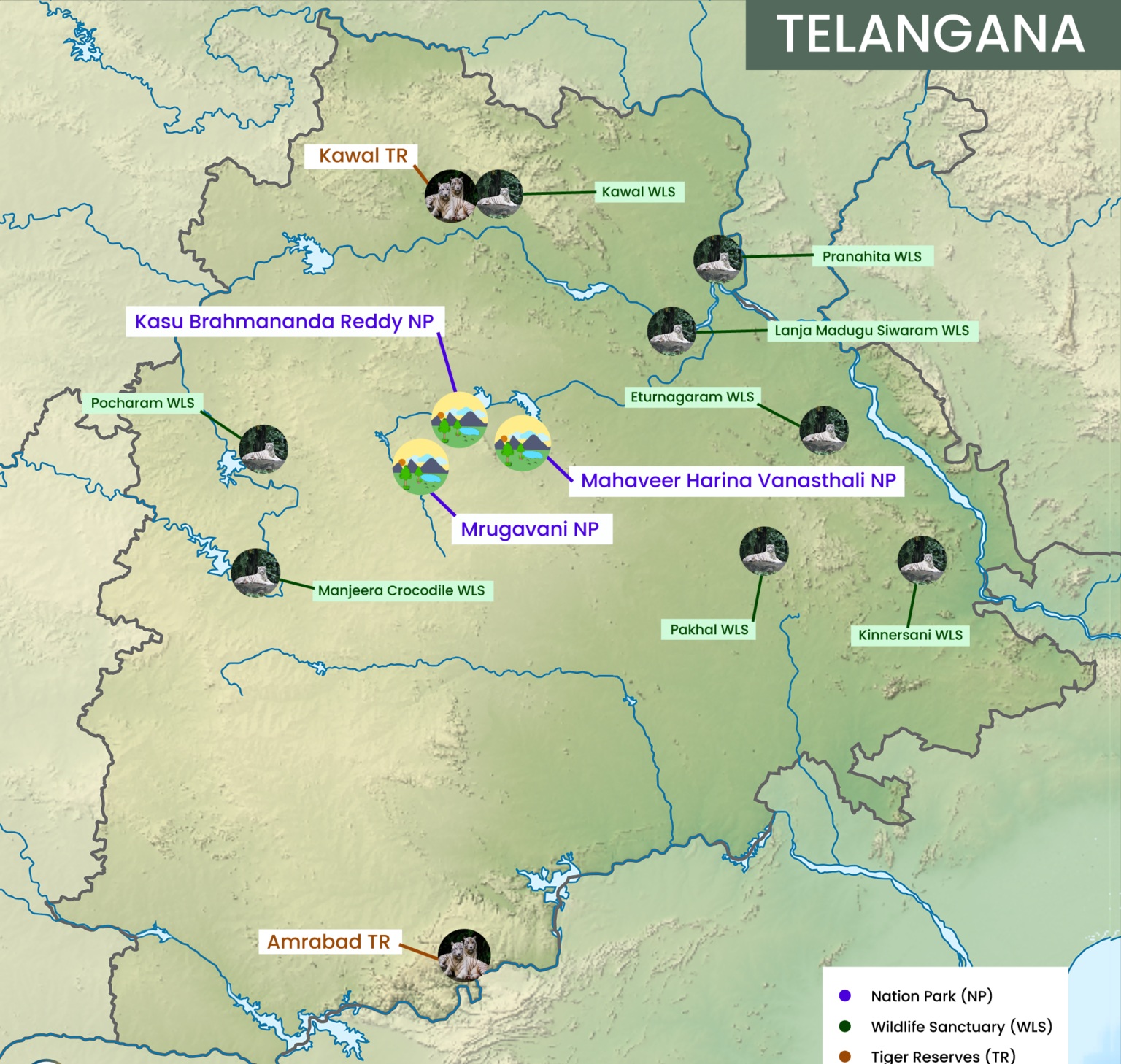
- Telangana government launched a voluntary relocation and rehabilitation project for tribal families inside the Amrabad Tiger Reserve (ATR).
- Size Rank: ATR is India’s second-largest tiger reserve by core area and the sixth-largest overall.
- Location: ATR spans 2,611 sq km across the Nallamala Hills in the Eastern Ghats, and was originally part of Nagarjunasagar-Srisailam Tiger Reserve.
- Geology: The terrain features high plateaus and deep gorges cut into ancient sedimentary rocks.
- Vegetation: It is primarily a Southern Tropical Dry Deciduous forest, dominated by Anjan, Teak, Bamboo, and Indian Kino.
- Hydrology: ATR is a critical catchment area for the Krishna River, which flows through a deep gorge along its southern boundary.
- Key Fauna: Bengal Tiger, Leopard, Sloth Bear, Dhole, Chousingha, Yellow-throated Bulbul.
- Tribes: Chenchus, a Particularly Vulnerable Tribal Group (PVTG), live within the tiger reserve.
CALM-Brain
- CALM-Brain is India’s first digital repository of psychiatric disorder data.
- It stands for Comprehensive Data Repository on Brain Structure & Function in Psychiatric Disorders.
- Developed By: National Institute of Mental Health and Neurosciences (NIMHANS) and the National Centre for Biological Sciences (NCBS)-TIFR under the Rohini Nilekani Centre for Brain and Mind (CBM).
- Objective: To improve understanding, diagnosis, and treatment of neuropsychiatric disorders using large-scale data.
- Open-source: Built on Indian patient data and will be open-access for researchers and clinicians.
- Types of Data: Includes clinical, neuroimaging, behavioural, and genetic data, along with a stem cell biorepository.
- Disorders Covered: Focuses on five major disorders: addiction, bipolar disorder, dementia, OCD, and schizophrenia.
- Significance: Aims to identify biomarkers and biological mechanisms, enabling early diagnosis and personalised treatment.
Hudsonian Godwit (Limosa haemastica)
- Hudsonian Godwit has been proposed for inclusion in Appendix I of the Convention on the Conservation of Migratory Species of Wild Animals (CMS).
- It is a large, long-distance migratory shorebird belonging to the sandpiper family.
- Migration: Godwit migrates 30,000 km annually, completing single non-stop stretches of up to 11,000 km.
- Appearance: It has long, dark legs and a notably long, slightly upturned pinkish bill with a dark tip.
- Habitat Preference: The species breeds in remote sub-Arctic and Boreal wetlands. It’s winter on shallow coastal intertidal mudflats, lagoons, and flooded fields.
- Distribution: The godwit is a New World bird, breeding in the North American Arctic (Alaska and Canada) and wintering in South America.
- Diet: It is primarily an invertivore but relies on carbohydrate-rich plant tubers during migratory flights.
- Ecological Role: The species serves as an indicator for the health of globally connected wetland networks.
- Key Threats: Climate change, shifting Arctic seasons, expanding aquaculture, and hunting.
- Conservation status: IUCN: Vulnerable
POSTED ON 27-03-2026 BY ADMIN
Next previous  General Studies
Political Science and International Relations
Some Reference Essays
List of previous year essay topics (1997-2019)

IAS GOOGLE is googled by the team of Raja Sir’s Cracking IAS Academy. Sources include The Hindu, Indian Express, pib.nic.in, Down To Earth, Economic Times, Vigyan Prasar, AIR and the like. IAS GOOGLE has been prepared in pace with emerging UPSC Trends.