|
Basel Pillar 3 Disclosure Framework
why is news ?
RBI issues revised Basel Pillar 3 disclosure framework for commercial, small finance and payments banks.
Pillar 3 is part of the 3-pillar structure used across the Basel II, Basel III, and Basel IV banking regulatory frameworks developed by the Basel Committee on Banking Supervision (BCBS) as international banking standards to enhance capital adequacy, stress testing, and market liquidity risk management.
|
Pillar
|
Focus
|
Details
|
|
Pillar 1
|
Minimum Capital Requirements
|
Sets out regulatory capital rules for credit, market, and operational risks (e.g., CRAR, Tier 1/Tier 2 capital rules).
|
|
Pillar 2
|
Supervisory Review Process
|
Provides a framework for central banks/supervisors to evaluate internal risk assessment strategies and hold additional capital if needed.
|
|
Pillar 3
|
Market Discipline
|
Promotes market transparency through standard public disclosures, allowing investors and depositors to assess a bank's risk profile.
|
|
|
Broad Peak in the Karakoram Range
why in news ?
A massive avalanche struck a 10-member international climbing expedition on the slopes of Broad Peak in the Karakoram range.
- Broad Peak (historically called Falchan Kangri in the local Balti language) is the 12th-highest mountain in the world, standing at an elevation of 8,051 meters (26,414 feet) above sea level.
- Location: Situated in the Karakoram mountain range on the border between Gilgit-Baltistan (Pakistan) and Xinjiang (China).
- Proximity: Lies in the Gasherbrum massif, approximately 8 kilometers (5 miles) southeast of K2.
History & Climbing Milestones:
- Origin of Name: Named in 1892 by British explorer Sir Martin Conway, who likened its broad, 1.5-kilometer-long summit ridge to the Breithorn in the Swiss Alps.
- First Ascent (1957): First summitted between June 8–9, 1957, by a four-man Austrian expedition (Fritz Wintersteller, Marcus Schmuck, Kurt Diemberger, and Hermann Buhl) without supplementary oxygen or high-altitude porters.
Key Features:
- Elongated 1.5-km Summit Ridge: Unlike sharp pyramidal peaks like K2, Broad Peak features a broad, nearly flat crest extending over 1.5 km in length, making its exact summit difficult to discern from afar.
- Multiple 8,000-Meter Sub-Summits: The mountain features five distinct peaks, three of which exceed 8,000 meters—Main Summit (8,051 m), Rocky Summit (8,028 m), and Broad Peak Central (8,011 m).
- Plutonic Granite & Tectonic Uplift: Formed by the active collision of the Indo-Australian and Eurasian tectonic plates, the mountain consists of massive plutonic granite blocks and metamorphic rock layers.
- Glacial Feeder Systems: Flanked by massive ice rivers, its snowpack directly feeds into the Godwin-Austen Glacier and the broader Baltoro Glacier.
- High Avalanche & Wind Risk: Due to its exposed, wide ridge structure, the upper slopes between Camp 2 and Camp 3 are prone to sudden slab avalanches and high-velocity wind funnels.
Significance:
- Broad Peak is one of the world’s 14 eight-thousanders, making it a key milestone for mountaineers pursuing all 14 peaks.
- Located in the Central Karakoram National Park, it is an important site for studying the Karakoram Anomaly, where some glaciers remain relatively stable despite global warming.
|
|
Samudra Manthan Offshore Exploration Scheme
Overview: Central Sector Scheme under the Ministry of Petroleum & Natural Gas approved through FY31 with an outlay of ₹84,084 crore.
Key Highlights:
- Objective: Drilling infrastructure for ultra-deepwater and frontier basins; targets 600 MMTOE (Metric Tonnes of Oil Equivalent) in hydrocarbon reserves.
- Infrastructure: Establishes a dedicated Oil and Gas Manufacturing and Services Zone for indigenous production.
- Data & Risk Reduction: Focuses on 3D seismic survey data acquisition to de-risk exploration.
- India's Offshore Potential: Offshore basins hold ~31% of India's crude/natural gas, alongside 71 GW offshore wind potential and 100 GW+ floating solar potential.
|
|
Ceuta: Spain's Enclave in North Africa
At least 34 people died trying to cross from Morocco into Spain’s Ceuta enclave.
- Location: Spanish autonomous city on Africa's north coast, bordering Morocco near the Strait of Gibraltar.
- Political Status: Part of Spain and the European Union, but claimed by Morocco.
- EU–Africa Border: Along with Melilla, forms the EU's only land border with Africa
|
|
India–Maldives Digital Payment Corridor
Context: The Maldives Monetary Authority (MMA) launched the Favara–UPI Cross-Border Payment Corridor, enabling real-time remittances from the Maldives to India.
The Favara–UPI Cross-Border Payment Corridor: What It Is?
- A real-time cross-border payment corridor integrating the Maldives’ Favara Instant Payment System with India’s Unified Payments Interface (UPI), enabling seamless person-to-person (P2P) fund transfers.
- Nations Involved: India and Maldives.
- Aim: To facilitate secure, instant, and low-cost cross-border digital payments, strengthen bilateral financial connectivity, and deepen economic cooperation.
Key Features:
- Real-Time P2P Transfers: Enables individuals in the Maldives to send funds instantly from MVR to UPI-enabled INR bank accounts in India.
- Initial Banking Partners: Launched with Bank of Maldives Plc and Maldives Islamic Bank Plc through their mobile banking applications.
- Permitted Remittance Categories: Supports family-maintenance and gift-related remittances under the Maldives’ foreign remittance framework.
- Institutional Collaboration: Implemented through cooperation among the MMA, RBI, NPCI International Payments Limited (NIPL), and participating financial institutions.
- Future Expansion: Upcoming phases will introduce QR-based merchant payments and additional cross-border digital payment services.
- UPI Accepted Countries (9): Cambodia, Singapore, United Arab Emirates, France, Mauritius, Nepal, Bhutan, Qatar and Sri Lanka – enabling Indian travellers to make seamless payments abroad through UPI.
Significance:
- Enhances digital financial integration, remittances, and people-to-people connectivity between the two countries.
- Expands India’s Digital Public Infrastructure (DPI) footprint and reinforces UPI as a leading global cross-border payment system.
|
|
Flash Floods in India
Overview: Rapid-onset flood events occurring within 6 hours of heavy rainfall, heavily impacting regional infrastructure.
- Status in India: ~75% of events happen during the Southwest Monsoon (June–Sept). Major hotspots include Himalayan river basins (Brahmaputra, Ganga), the West Coast, and Central India.
- Key Drivers & Way Forward: Driven by intense precipitation, steep slopes, urban encroachment, and saturated soil. Requires real-time forecasting (Doppler radars, AWS), floodplain zoning, and nature-based solutions.
|
|
Government e-Marketplace (GeM) Platform
GeM launched the 10-day celebrations leading up to its 10th Foundation Day.
- Overview: A 100% government-owned Section 8 company under the Ministry of Commerce & Industry.
- Function: Facilitates a paperless, cashless, and contactless platform for end-to-end procurement of goods and services by central/state ministries, PSUs, and cooperatives.
- Performance: Surpassed ₹18.4 lakh crore in cumulative Gross Merchandise Value (GMV).
- Initiatives: Platforms like ‘Womaniya’ (women-led MSEs), ‘SWAYATT’ (startups/youth), and ‘Saras Collection’ (rural SHGs).
- Recent Reforms: Union Budget 2026-27 proposed linking GeM with the Trade Receivables Discounting System (TReDS).
|
|
Himalayan Chandra Telescope Completes 25 Years
Himalayan Chandra Telescope has successfully completed 25 years of operation.
- Location: Indian Astronomical Observatory (IAO), Hanle, Ladakh, at 4,500 m on Mt. Saraswati.
- Namesake: Named after Nobel Laureate Subramanyan Chandrasekhar.
- Remote Operation: Operated in real time from the Indian Institute of Astrophysics (IIA), Hosakote (Bengaluru) via a dedicated satellite link.
- Favourable Climate: Cold desert site with minimal light pollution and 250+ clear night sky annually.
- Spectrum: Observes in the optical and near-infrared wavelengths.
|
|
Expansion of India's Social Security Coverage
Context: The Union Minister of Labour & Employment announced that India's social protection systems now cover over 68% of the population (~101 crore citizens), up from 19% in 2015, as recognized by the International Labour Organization (ILO).
Significance:
- Poverty Reduction & Economic Stability: Acts as a safety net against health crises, sudden job losses, and economic shocks.
- Formalisation of Workforce: Extends institutional support across unorganised, organized, gig, and platform workers.
- SDG Targets: Accelerates progress towards SDG 1 (No Poverty), SDG 3 (Good Health and Well-being), SDG 8 (Decent Work & Economic Growth), and SDG 10 (Reduced Inequalities).
Key Government Initiatives:
- e-Shram Portal & DPI: Digital Public Infrastructure facilitating registration and delivery of benefits to unorganized workers.
- Labour Codes: Aims to universalise social security coverage and simplify labor law compliance.
- Ayushman Bharat PM-JAY: World's largest health assurance scheme providing coverage to vulnerable families.
- Atal Pension Yojana (APY) & PM-SYM: Contributory pension schemes targeting unorganized sector workers for post-retirement income security.
|
|
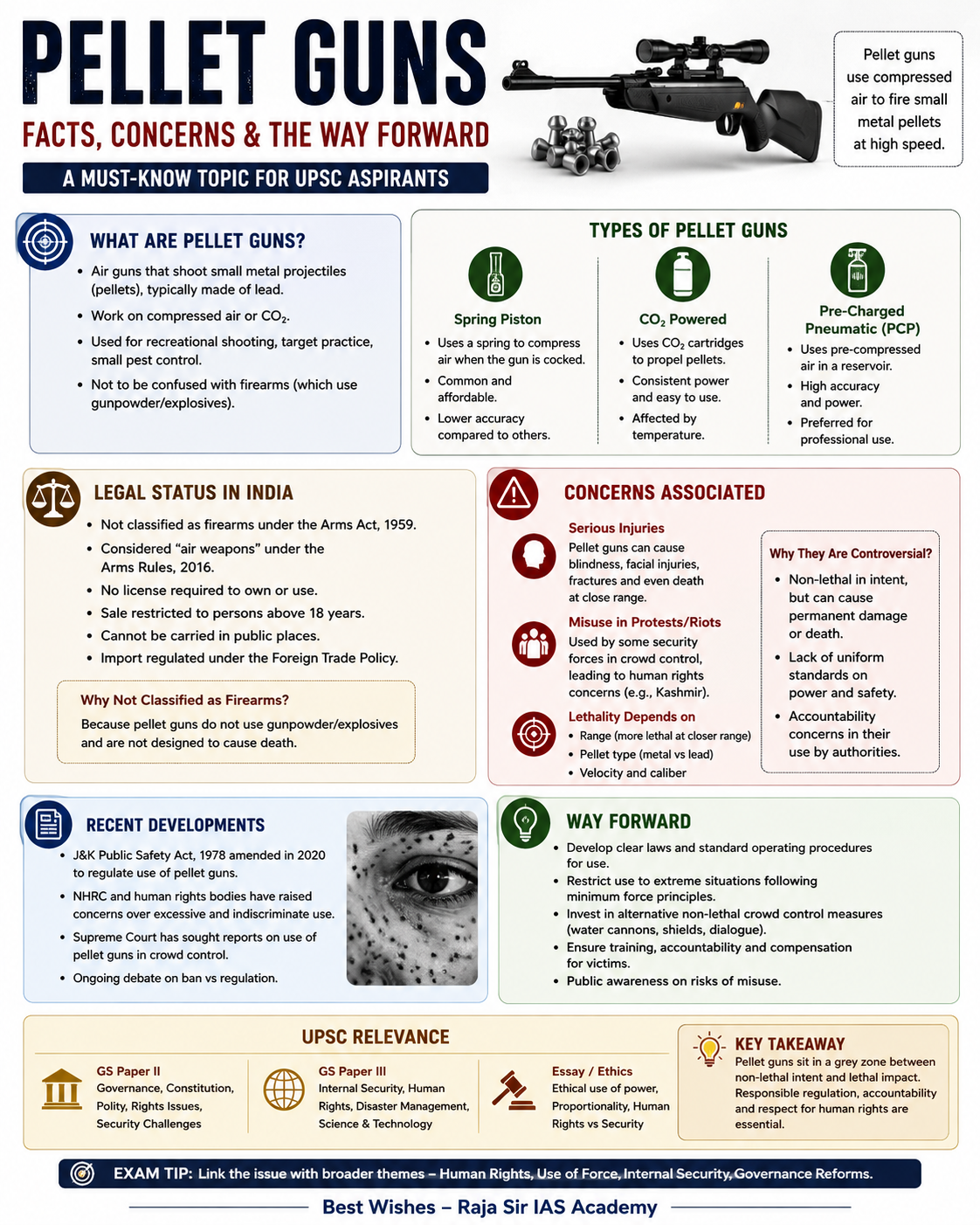
Pellet Guns for Crowd Control
Context: A Supreme Court Bench led by CJI Surya Kant declined a blanket ban on pellet guns, holding that they may be used in exceptional circumstances for crowd control. The ruling followed allegations of pellet use against NEET-UG paper leak protesters at Delhi’s Jantar Mantar.
Pellet Guns in India: What It Is?
Pellet guns are 12-bore pump-action shotguns classified as less-lethal kinetic projectile weapons intended for crowd control and dispersal. Instead of a single bullet, each cartridge releases an expanding cloud of hundreds of tiny spherical metal, rubber, or plastic pellets.
Introduced In:
- Year of Induction: 2010 by the Union Government as a non-lethal alternative for crowd control following violent unrest in Jammu and Kashmir.
- First Deployment: First used by the Jammu & Kashmir Police in Sopore in August 2010, and subsequently adopted by the Central Reserve Police Force (CRPF) and Rapid Action Force (RAF).
Key Features:
- Wide Dispersion Area: A single 12-bore cartridge fires approximately 500 pellets, which spread out across a wide radius upon exiting the barrel.
- Graded Non-Lethal Classification: Designed to incapacitate violent mobs from a distance without causing immediate fatalities, bridging the gap between tear gas and live ammunition.
- Variable Ammunition Composition: Can fire lead/metallic, rubber, or plastic pellets depending on operational requirements and force escalation protocols.
- High Kinetic Energy at Close Range: Though labeled less-lethal, pellets retain severe penetrating power when fired at close quarters or above waist height.
Standard Operating Procedures (SOPs) for Deployment:
- Rarest of Rare / Exceptional Use: Pellet guns must be deployed strictly as a last resort when all other non-lethal options (water cannons, lathi charge, PAVA chilli shells, and tear smoke) fail to disperse a violent assembly.
- Graded Escalation of Force: Law enforcement must strictly follow a hierarchy of force, progressing through rubber/plastic pellets before considering metallic options.
- Aiming Below the Waist: Personnel are mandated, as far as practicable, to aim exclusively at the lower limbs (below the waist) to prevent injuries to vital organs, head, or eyes.
- Proportionality and Necessity: Force must remain strictly proportional to the threat posed, used only when necessary, and halted immediately once the crowd disperses or ceases violence.
- Mandatory Post-Event Care: Operating procedures require immediate medical assistance and hospitalization to be provided to any injured individuals following deployment.
Key Implications:
- Risk of Permanent Disability & Ocular Trauma: Due to wide pellet spray, victims often suffer life-altering injuries—most notably permanent blindness, ocular trauma, and internal organ damage when hit above the waist.
- Human Rights & Legal Scrutiny: International bodies (like the UN) and civil rights groups highlight that metallic pellet guns violate international standards on less-lethal weapons due to their indiscriminate nature.
- Collateral Damage to Bystanders: The uncontrollable scatter pattern makes it difficult to isolate violent agitators from peaceful protesters or innocent bystanders, raising serious concerns under Article 21 (Right to Life and Personal Liberty).
|
|
Continuation of PM-KISAN Scheme
The Union Cabinet gives nod to continuation of the Pradhan Mantri Kisan Samman Nidhi (PM-KISAN) Scheme from 2026-27 to 2030-31.
- Launch: Launched in 2019, to provide assured income support to landholding farmer families.
- Type: Central Sector Scheme (100% funded by the Government of India).
- Financial Assistance:
- ₹6,000 per year per eligible farmer family.
- Paid in three equal installments through Direct Benefit Transfer (DBT).
- Beneficiaries: All eligible landholding farmer families (comprising husband, wife, and minor children), identified by State/UT administrations.
- Exclusion Categories: Institutional landholders, government officials/employees, higher pensioners, income tax payers, and specified professionals are not eligible.
- Key Achievements:
- ₹4.47 lakh crore transferred directly into farmers’ bank accounts.
- 1 out of every 4 beneficiaries is a woman farmer.
- 92% of beneficiaries reported using the assistance for agricultural activities and investment.
- 85% confirmed improvement in agricultural income and reduced dependence on informal credit.
|
|
Protein Language Models in Biotechnology
Scientists have developed a new generative AI framework termed Raygun built on the top of Protein Language Model to miniaturise proteins.
- "Alphabet" of Life: Proteins are like sentences written using a biological alphabet of 20 amino acids.
- Learning the "Grammar": Like ChatGPT learns from books, Protein Language Models learn the hidden rules of biology by analyzing millions of protein sequences.
- Understanding the "Gist": The AI converts amino acids into numerical representations to predict a protein's structure and function.
- A Tool for Rewriting: The AI identifies essential and non-essential regions, enabling scientists to redesign or shrink proteins while preserving their function.
- Examples: ProtGPT2, ProGen etc.
|
|
Growth of Rural Non-Farm Employment
Context: Highlighted the structural shift and rising trend of Rural Non-Farm Employment in India since 2012.
Key Drivers:
- Distress Push: Decreasing farm size, land fragmentation, and stagnant agricultural productivity.
- Prosperity Pull: Demand generated by agricultural growth leading to rural trade, manufacturing, and services.
- Construction Sector: The largest single absorber of non-farm rural labor.
- Supporting Schemes: DAY-NRLM, DDU-GKY, National Rural Economic Transformation Project (NRETP), and ONDC enablement.
|
|
National Offshore Exploration Scheme (Samudra Manthan)
Context: The Union Cabinet, chaired by Prime Minister of India, approved ‘Samudra Manthan’ (National Offshore Exploration Scheme). Operating as a Central Sector Scheme under the Ministry of Petroleum & Natural Gas, it carries a financial outlay of ₹84,084 crore for implementation through FY 2030–31 to unlock India’s vast offshore hydrocarbon potential.
What It Is?
Samudra Manthan is a comprehensive national initiative designed to de-risk and accelerate domestic offshore oil and gas exploration. It provides public financial backing across the upstream exploration value chain—spanning seismic data collection, deepwater exploratory drilling, frontier basin research, and common evacuation infrastructure.
|
Attribute
|
Details
|
|
Ministry
|
Ministry of Petroleum & Natural Gas, Government of India
|
|
Scheme Classification
|
Central Sector Scheme (100% centrally funded)
|
|
Implementation Timeline
|
Up to FY 2030–31
|
|
Total Outlay
|
₹84,084 crore
|
- Aim: To strengthen India’s energy security, boost domestic oil and natural gas production, reduce heavy reliance on crude oil imports, and establish an indigenous, globally competitive ecosystem for offshore energy technologies.
Key Features:
- Strategic Allocation for High-Risk Deepwater Drilling: Earmarks ₹43,200 crore to subsidize deepwater and ultra-deepwater exploratory drilling, covering up to 50% of the drilling cost (or up to ₹650–₹675 crore per well) to offset high capital risks.
- Comprehensive Data Acquisition: Allocates ₹28,534 crore for large-scale acquisition, processing, and interpretation of high-quality seismic data—specifically targeting previously unexplored frontier basins and former no-go offshore zones.
- Common Production and Evacuation Hubs: Earmarks ₹10,000 crore to build shared offshore production and pipeline evacuation infrastructure, enabling faster commercialization of deepwater discoveries.
- Manufacturing & Services Zones: Directs ₹2,000 crore toward setting up dedicated Oil & Gas Manufacturing and Services Zones to promote indigenous equipment production under Make in India.
- Digital Governance & Capacity Building: Integrates advanced digital program management, capacity-building frameworks, and technology adoption protocols via the National Data Repository (NDR) to streamline stakeholder engagement and global outreach.
Significance:
- Aims to add over 600 MMTOE of reserves, reducing crude oil imports and strengthening India’s energy security.
- Co-funds costly deepwater wells, lowering investment risks and attracting exploration in KG, Cauvery, Mahanadi, and Andaman basins.
|
|
Towards a Humane Education System
Context: Following youth-led protests for education reform, a commentary argued that India’s high-stakes admission system should be replaced with a more humane, multi-dimensional evaluation model that safeguards student well-being.
What it is?
Restoring dignity to India’s academic journey means shifting from a high-stakes, one-size-fits-all filtration system toward holistic competency-based evaluation. Instead of relying exclusively on high-pressure competitive exams that test speed and memorization, a humane education model balances academic aptitude with critical reasoning, co-curricular projects, mental health safeguards, and structured career counseling.
Key Issues in the Current Examination & Admission Culture:
- Flaws of Centralized Single-Shot Exams: Centralized testing agencies (such as the National Testing Agency) operate under the assumption that a single exam model can fairly evaluate students across diverse regions, languages, and socio-economic backgrounds.
- Exploitative Coaching Ecosystem: The dominance of commercial coaching centers creates educational inequality, displaces formal schooling, and strains family finances through high debt.
- Severe Psychological and Emotional Toll: Treating single-shot competitive entrance tests as the sole measure of student worth creates a high-pressure environment linked to rising student suicides.
- Logistical Vulnerabilities & Paper Leaks: Centralized nationwide exams create massive logistical risks, where single breaches or paper leaks disrupt millions of applicants simultaneously.
Implications of the Lack of a Humane Education System:
- Severe Mental Health Crises and Student Suicides: Treating single-shot competitive examinations as the sole determinant of a student’s worth creates an environment of intense fear and debt, directly contributing to alarming rates of psychological distress and student suicides.
- Reductionist Definition of Merit and Intelligence: The over-reliance on high-stakes, rank-based filtration evaluates speed and memory rather than critical reasoning, ethical judgment, communication, or practical problem-solving capabilities.
- Exploitative Commercialization and Financial Strain: The absence of a holistic admission process fosters a predatory coaching industry that displaces formal schooling, forces low-income parents into unaffordable loans, and widens educational inequality.
- Demographic Inequity via Centralized Flaws: A one-size-fits-all centralized testing model (such as the National Testing Agency) disproportionately disadvantages students from varied regional, linguistic, rural, and socio-economic background.
- Overemphasis on Traditional Professions and Skill Mismatch: A rigid testing culture creates blind dependence on a few high-pressure professional tracks, discouraging youth from exploring emerging sectors and alternative career choices aligned with their genuine aptitudes.
Key Recommendations for Comprehensive Reforms:
- Implementing Multi-Dimensional Competency Assessments: Combine moderated school performance, discipline-specific aptitude, analytical writing, structured interviews, and practical scenario-based tasks. Evaluate verifiable project portfolios, internships, community work, and co-curricular achievements alongside written testing.
- Decentralizing Admissions & Assessment Design: Allow individual universities or institutional clusters to design and conduct their own entrance assessments within broad University Grants Commission (UGC) guidelines. Schedule decentralized examinations across the academic calendar to avoid nationwide disruption from a single test failure.
- Institutionalizing Exam Security and Anti-Leak Safeguards: Adopt encrypted digital paper transmission, multi-layered question banks with algorithmic randomization, and strict vetting/rotation of paper setters. Implement secure printing protocols, biometric candidate verification, time-staggered papers, and post-exam forensic reviews to prevent leaks.
- Regulating the Coaching Industry & Broadening Career Awareness: Introduce legislative regulation over coaching fees, misleading advertising, hostel standards, and student mental health provisions. Connect students with diverse industries through career fairs, internships, and alumni mentorship to reduce reliance on traditional high-pressure courses.
- Providing Local-Language Parental & Student Counseling: Offer structured counseling to parents in regional languages regarding career options, costs, scholarships, aptitude, and mental health risks. Help students evaluate their personal abilities and interests through aptitude-based guidance rather than prestige-driven choices.
Conclusion: India’s educational promise cannot be fulfilled by a system that rewards psychological distress and commercial exploitation under the guise of merit. Reforming admissions through decentralized assessments, robust exam security, and structured counseling will help align education with student potential. Ultimately, restoring dignity to the academic journey will create confident young individuals who choose their careers deliberately and without fear.
|
|
PM Surya Sarovar Yojana
Context: The Union Cabinet approved the Pradhan Mantri Surya Sarovar Yojana (PM-SSY) with an outlay of ₹5,070 crore to promote floating solar projects with battery storage across reservoirs and inland water bodies.
What It Is?
PM-SSY is a national renewable energy central scheme designed to promote floating solar power generation co-located with energy storage. It optimizes water surfaces (reservoirs, dams, and industrial ponds) to generate clean energy while preventing land-use conflicts.
- Nodal Ministry: Ministry of New and Renewable Energy (MNRE), Government of India.
- Implementing Agency: Solar Energy Corporation of India (SECI).
- Aim: To expand India’s floating solar capacity from its present ~700 MW to 5,700 MW by adding 5,000 MW of capacity coupled with 10,000 MWh of energy storage, mitigating land acquisition bottlenecks, reducing water evaporation losses, and enhancing power grid reliability.
Key Features:
- Substantial Capacity Target: Targets the development of 5,000 MW of Floating Solar Photovoltaic (FSPV) projects across all States and Union Territories between FY 2026–27 and FY 2030–31.
- Mandatory Co-Located Energy Storage: Integrates Energy Storage Systems (ESS) providing a minimum 2-hour storage duration (totaling 10,000 MWh capacity) to supply power during peak demand hours and reduce renewable energy curtailment.
- Central Financial Assistance (CFA): Provides ₹1 crore per MW as post-commissioning central financial support to developers, helping bridge the ~25% higher capital cost of floating solar platforms compared to ground-mounted solar.
- Project De-Risking Grants: Offers up to ₹50 lakh per project for initial technical feasibility studies, including bathymetry and hydrography surveys, solar yield calculations, and aquatic ecological impact assessments.
- Aatmanirbhar Manufacturing Push: Boosts indigenous manufacturing across the entire value chain, including floatation platforms, anchoring/mooring systems, PV modules, and storage batteries.
Significance:
- Uses reservoirs for solar projects, reducing land conflicts while lowering water evaporation through panel shading.
- Cuts nearly 10 million tonnes of CO₂ annually and creates 16,000–17,000 jobs, advancing India’s net-zero and Viksit Bharat goals.
|
|
Revamped Khelo India Programme
Context: The Union Cabinet, chaired by Prime Minister of India, approved an expanded, revamped Khelo India Scheme along with an enhanced Assistance to National Sports Federations (ANSFs) scheme.
What It Is?
The Khelo India Scheme is the central flagship initiative of the Ministry of Youth Affairs and Sports. It is designed to revive India’s sports culture at the grassroots level, identify athletic talent, construct modern sports infrastructure, and establish a structured pathway to national and international excellence.
- Original Launch: First introduced in 2016–17 (and extensively restructured in 2017–18) by consolidating legacy schemes like the Rajiv Gandhi Khel Abhiyan, Urban Sports Infrastructure Scheme, and National Sports Talent Search System.
- Implementation Period (Revamped Framework): FY 2026–27 to FY 2030–31.
- Combined Financial Outlay: ₹36,441 crore (nearly an eight-fold increase compared to the previous cycle).
- Aim: Aligned with the Khelo Bharat Niti 2025 and NEP 2020, the scheme integrates sports with education, expands India’s talent pool, builds high-performance ecosystems, and supports future Commonwealth and Olympic hosting ambitions.
Key Features of the Revamped Scheme:
- Massive Athlete Pool Expansion (E-KIAs): Introduces the Emerging Khelo India Athletes (E-KIAs) category alongside existing Khelo India Athletes (KIAs), expanding the structured athlete development ecosystem nearly ten-fold under professional coaching and scientific support.
- School-Level Sports Integration: Launches two dedicated school initiatives—Khelo India Feeder Schools (KIFS) and Khelo India Utkrishta Vidyalayas (KIUV)—to embed physical education into mainstream school curricula and enable early talent identification.
- Integrated Nationwide Training Ecosystem: Establishes a seamless tier of training centers comprising National Centres of Excellence (NCOEs), Khelo India State Centres of Excellence (KISCEs), SAI Training Centres (STCs), and Youth Sports Companies (YSCs) operated by the Armed Forces.
- National Coach Accreditation Board (NCAB): Sets up the NCAB to standardize coaching qualifications, enforce high-performance professional benchmarks, and upscale sports science support personnel across India.
- Unified Digital Sports Platform & Fit India Expansion: Constructs a centralized digital platform integrating athlete databases, talent assessments, and funding trails, while expanding the Fit India Movement into remote, border, and marginalized communities.
Significance:
- Creates a seamless pathway from schools to Khelo India Centres and TOPS, ensuring talented athletes receive timely support.
- Provides sustained funding for ANSFs to hire experts, improve training, and enhance international competitiveness.
|
|
Western Ghats ESA Conservation Debate
Context: The MoEF&CC extended the Sanjay Kumar-led expert panel by one year to resolve the Centre–State deadlock over notifying Ecologically Sensitive Areas (ESAs) in the Western Ghats.
What it is?
The Western Ghats span six coastal Indian states (Gujarat, Maharashtra, Goa, Karnataka, Kerala, and Tamil Nadu) and house 39 UNESCO World Heritage Sites (WHS). The debate over declaring Ecologically Sensitive Areas (ESAs) under the Environment Protection Act, 1986 seeks to restrict destructive human activities like mining, quarrying, and heavy infrastructure to preserve fragile biodiversity.
Timeline & Evolution of the ESA Framework:
- 2010 (Gadgil Committee / WGEEP): The Western Ghats Ecology Expert Panel recommended designating 142 talukas across 44 districts into three levels of Ecologically Sensitive Zones (ESZs) with strict regulation on developmental activities.
- 2012 (Kasturirangan High-Level Working Group): Following opposition to Gadgil’s report, a new panel restricted ESA limits strictly to natural landscapes, reducing the proposed protected area to 37% (~56,800 sq. km) of the Western Ghats.
- 2014–2026 (Draft Notifications & Deadlock): Between 2015 and 2026, the Centre issued five draft notifications, none of which achieved full consensus across all six states.
- 2022–2026 (Sanjay Kumar Expert Committee): Formed to review state-specific grievances, leading to tentative agreements by Gujarat and Goa, requests for fresh reviews by Maharashtra, and ongoing discussions for a phased rollout with Karnataka, Kerala, and Tamil Nadu.
Key Arguments Made by Opposing States (The Karnataka Case Study):
- Impact on Livelihoods & Infrastructure: States like Karnataka (with 10 Western Ghats districts and 23.4% of its population living there) argue that ESA bans will stall agriculture, shade-grown plantations, and critical regional infrastructure.
- Inaccuracies of Remote Sensing Data: Local communities and officials criticize the reliance on satellite imagery to demarcate ESAs, claiming remote sensing cannot accurately distinguish commercial plantation crops from natural forest cover.
- Lack of Ground-Level Verification: Stakeholders express frustration that expert panels and mapping agencies rely on desktop studies without physically visiting impacted villages.
- Fear of Eviction and Buffer-Zone Misconceptions: Widespread panic exists among residents that 10-kilometer buffer zones will lead to forced relocations, land rights rejections, and loss of access to minor forest produce.
Key Challenges in Western Ghats Conservation:
- Balancing Environmental Preservation with Human Rights: Striking a balance between protecting fragile ecosystems and guaranteeing the land rights of forest dwellers and non-tribal long-term settlers.
- Exclusion of Indigenous Biocultural Knowledge: Top-down conservation models risk excluding indigenous communities who naturally live sustainably within forests and serve as custodians of biocultural diversity.
- Administrative Fragmentations: Ecosystems function continuously across physical landscapes, but conservation policy gets stalled across state borders and political affiliations.
- Threats from Unregulated Commercial Activities: Ongoing delays in notifying ESAs leave vulnerable areas exposed to illegal stone quarrying, unplanned tourism projects, and soil erosion.
Way Forward:
- Conducting Ground-Truthing & Physical Ground Verification: Replace satellite-only mapping with detailed physical surveys to accurately separate agricultural/plantation land from pristine natural forests.
- Institutionalizing Inclusive Indigenous Co-Management: Recognize indigenous and local forest-dwelling communities as active conservation partners under the Forest Rights Act (FRA), protecting both land rights and ecological integrity.
- Adopting State-Wise and Phased Rollouts: Utilize flexible clauses introduced in recent draft notifications to finalize agreements with consenting states while addressing concerns in others.
- Clarifying Buffer Zones & Easing Communication Gaps: Launch public outreach campaigns in local languages to clear misconceptions regarding eviction, minor forest produce access, and buffer zone boundaries.
- Regulating Commercial Hard Hazards while Safeguarding Livelihoods: Focus prohibitions strictly on high-impact commercial industries while permitting sustainable local agriculture and eco-tourism.
Conclusion: The Western Ghats conservation deadlock highlights that sustainable ecology cannot be enforced through top-down mandates that alienate local communities. Protecting this biodiversity hotspot requires ground-level scientific verification, state-level dialogue, and the active inclusion of indigenous forest custodians. Ultimately, a balanced approach that combines scientific rigour with social equity is essential to safeguard the Western Ghats for future generations.
|
|
Vizhinjam International Transshipment Port
The Vizhinjam International Transshipment Seaport has been notified as a customs port.
- India's First: India's first deep-water container transshipment port, developed by the Government of Kerala.
- Purpose: Designed for container transshipment, along with multi-purpose and break-bulk cargo.
- Development Model: Built under the PPP-DBFOT (Design, Build, Finance, Operate, Transfer) model between the Government of Kerala and Adani Vizhinjam Port Private Limited.
- Strategic Location: 10 nautical miles from major Europe–Persian Gulf–Far East shipping routes.
- Deep Draft: Natural 18 m draft with no capital dredging required.
|