JULY 31, 2026
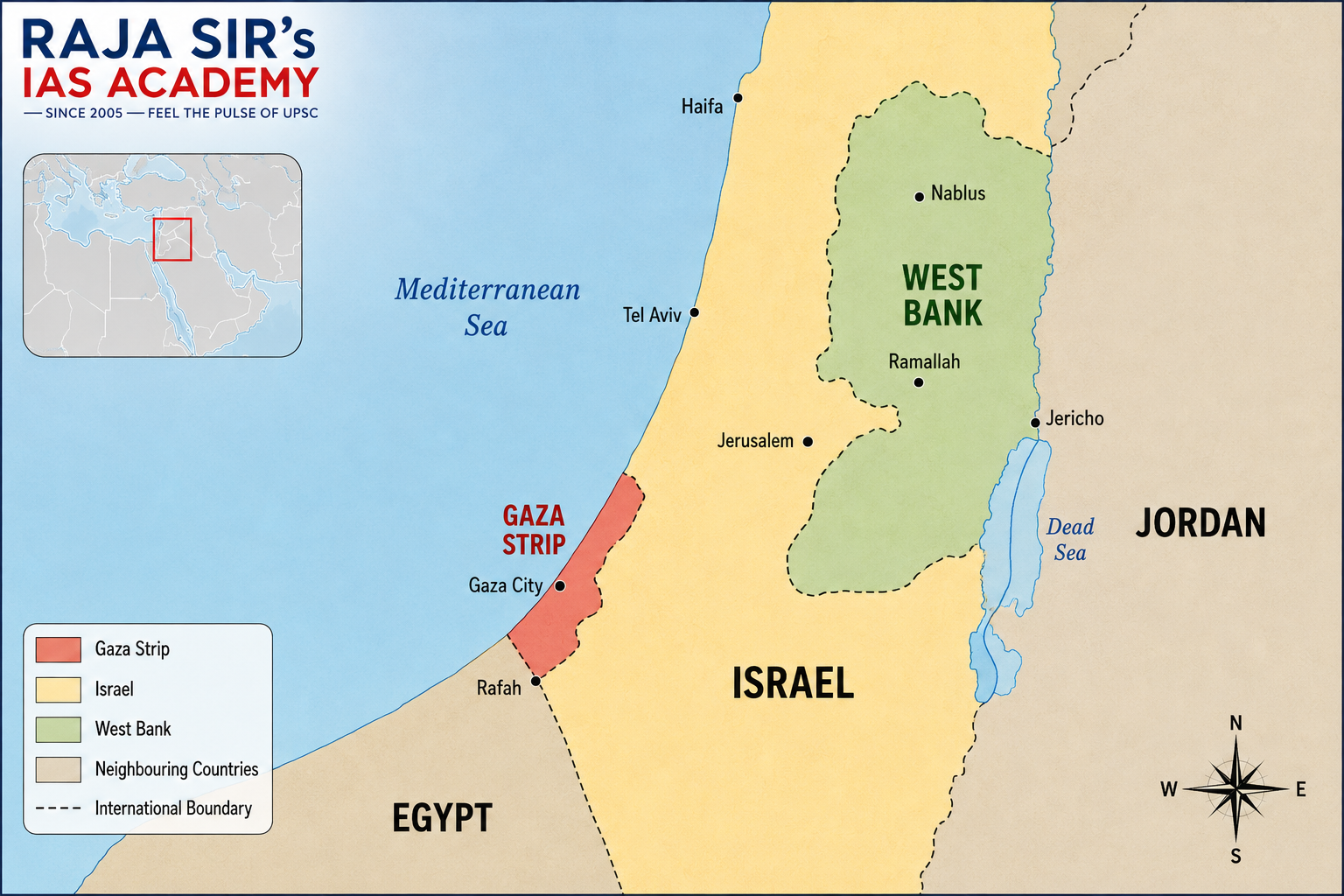
PEACE BOARDWhy in News? About the board of peace
Key Functions
Gaza Transition Framework
About Hamas
India's Position
|
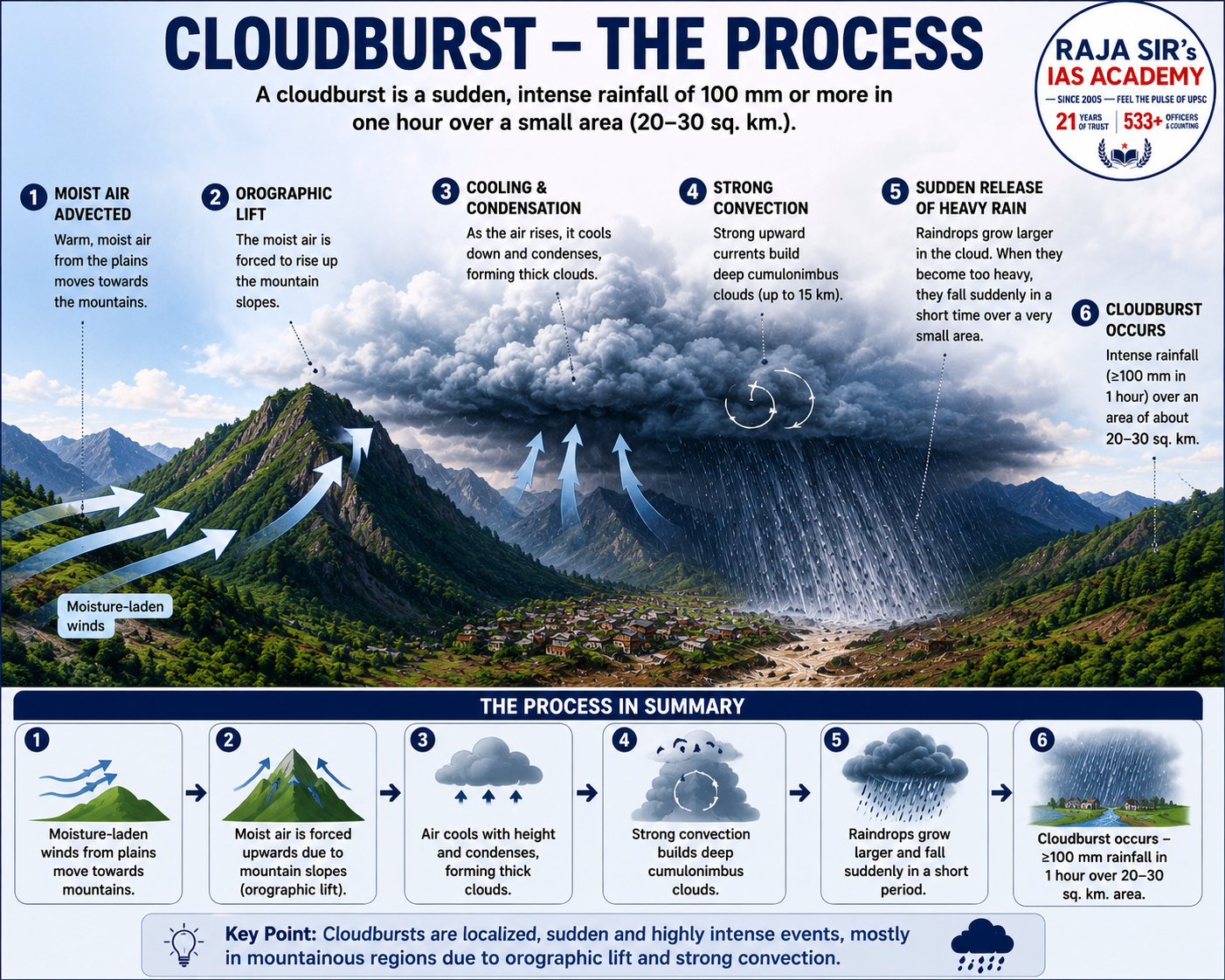
CLOUDBURSTS IN INDIAGS-I — Indian geography, climatology; GS-III — Disaster management, climate change.Why in News?Cloudbursts have become increasingly frequent in the Himalayan states, triggering flash floods, landslides and loss of life, with climate change emerging as a major contributing factor. Definition (IMD)• Rainfall of 100 mm or more within one hour over a small area of 20–30 sq. km. Causal Mechanism• Orographic lift: moisture-laden winds forced up mountain slopes, cooling and condensing rapidly. • Strong convection: warm air rises to form deep cumulonimbus clouds up to 15 km high. • Cyclonic circulation: often linked to westward-moving cyclonic circulation in the mid-troposphere. Geography• Predominantly Uttarakhand, Himachal Pradesh, Jammu & Kashmir, and the Western Ghats — mostly during July–August (SW Monsoon). • IMD has officially recorded about 30 cloudbursts (1970–2016); actual numbers likely higher due to under-reporting. Forecasting Challenges• Highly localised, rapid formation, mountainous terrain obstructs radar, sparse Automatic Weather Stations, and high computational demands. Government Initiatives• Mission Mausam: expands Doppler radar coverage and AWS network; uses AI for hyperlocal forecasting. • IMD Nowcasting: short-term alerts for imminent severe weather. Prelims Pointer: Cloudburst threshold: ≥100 mm rain/hour over 20–30 sq. km (IMD definition) — a frequently tested figure. |
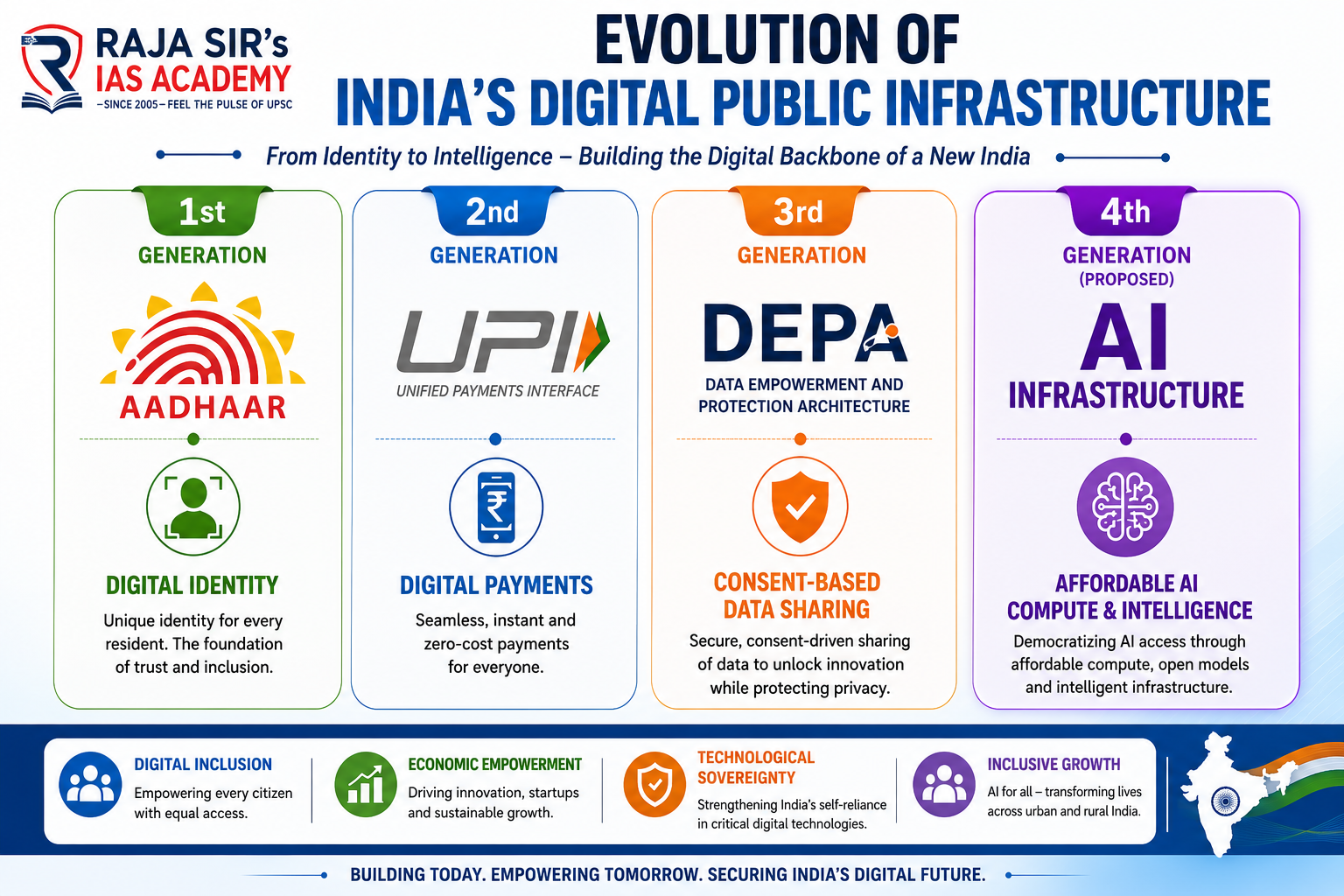
COMMODITISING AI AS INDIA'S NEXT DIGITAL PUBLIC INFRASTRUCTURE (DPI)GS-II — Governance, e-governance, Digital India, AI governance.Why in News?Public policy experts have proposed Artificial Intelligence as India's next Digital Public Infrastructure, advocating affordable AI inference, open-source models, and interoperable AI infrastructure on the lines of Aadhaar, UPI and DEPA. Concept• Treating AI compute/inference as a public utility (like electricity or the internet) rather than an expensive proprietary service — extending India's DPI journey from Aadhaar (identity) and UPI (payments) to AI. Rationale• Escapes the "digital quarry" model by retaining value from India's data and AI talent. • Democratises AI access for healthcare, agriculture, education, judiciary and MSMEs. • Promotes Indian startups by lowering AI service costs; strengthens strategic sovereignty. Challenges• Dependence on imported AI chips/GPUs; high infrastructure/data-centre costs; expensive dollar-denominated APIs. • Limited Indian-language datasets; dominance of proprietary foreign models; data privacy concerns; AI skill gap. Way Forward• Expand indigenous GPU/semiconductor manufacturing; strengthen the IndiaAI Mission; renewable-powered data centres; AI skilling. Prelims Pointer: India's DPI trio to remember: Aadhaar (identity) → UPI (payments) → DEPA (data exchange) → proposed AI layer. |
ELECTRONIC GOLD RECEIPT (EGR)GS-III — Indian economy, capital markets, financial market reforms. Why in News?The functioning of Electronic Gold Receipts (EGRs) and India's Gold Exchange framework has gained attention as India seeks a transparent, regulated domestic gold market. About EGR• A SEBI-regulated electronic security representing ownership of physical gold (995/999 purity) stored in SEBI-accredited vaults. • Held in a Demat account; notified as a security under the Securities Contracts (Regulation) Act, 1956. • Objective: "One Nation, One Gold Price" through unified domestic price discovery; reduce dependence on international bullion markets (LBMA/Dubai). How it Works• Creation: physical gold deposited with a SEBI-registered Vault Manager; equivalent EGRs credited to Demat account. • Trading: traded on NSE/BSE with T+1 settlement. • Redemption: investor surrenders EGR via Depository Participant; Vault Manager delivers physical gold. Tax Treatment• Trading in EGRs attracts zero GST; 3% GST applies only upon redemption into physical gold. Challenges• Low investor awareness; competition from Gold ETFs, Sovereign Gold Bonds and Digital Gold; limited vault infrastructure. Prelims Pointer: EGR is regulated by SEBI (not RBI); it is a security under SCRA, 1956; note the zero-GST-on-trading vs 3%-GST-on-redemption distinction. |
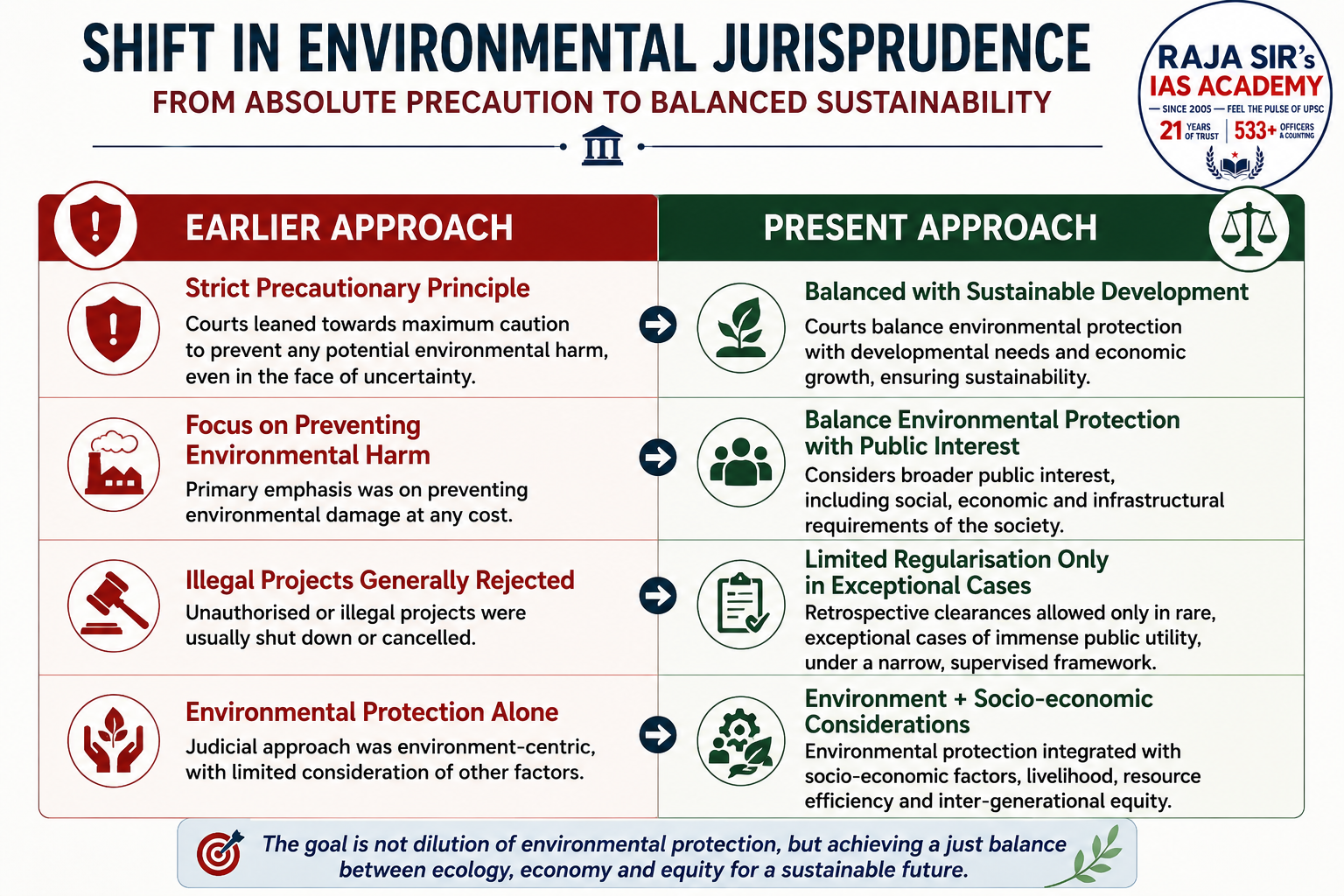
GREEN BEFORE GROWTH — SUPREME COURT ON EX POST FACTO ENVIRONMENTAL CLEARANCEGS-III — Environmental governance, Environmental Impact Assessment reforms; GS-II — Judicial review of executive action. Why in News?The Supreme Court quashed the 2021 Office Memorandum (OM) that permitted Ex Post Facto Environmental Clearances (ECs), holding that prior Environmental Clearance under the EIA Notification, 2006 is mandatory. Background• Environmental Clearance (EC): prior approval required before projects likely to significantly impact the environment. • Legal basis: Environment (Protection) Act, 1986; EIA Notification, 2006. • Ex Post Facto EC: retrospective approval granted after a project has already begun construction/operations without prior clearance. Key Holdings of the Court• Quashed the 2021 OM for creating a continuous mechanism to regularise violations via executive order. • Reaffirmed that prior EC is mandatory before commencement of any project. • An Office Memorandum cannot override statutory law or create a permanent amnesty mechanism — only a statutory notification under Section 3 of the Environment (Protection) Act, 1986 can. • Article 14: the 2021 OM allowed arbitrary regularisation, failing tests of reasonable classification and proportionality. • Article 21: compromised the Right to Life, which includes the Right to a Clean and Healthy Environment. • Clearances already granted under the 2017 Notification/2021 OM remain valid unless specifically challenged. • Retrospective EC is not fully barred — allowed only via statutory notification, for exceptional public interest (e.g., hospitals, airports, strategic defence infrastructure), in a time-bound, supervised manner. Significance• Strengthens environmental rule of law and discourages a "pollute and then pay" approach. • Balances conservation with development, recognising some infrastructure has high demolition costs. Prelims Pointer: EIA Notification is issued under the Environment (Protection) Act, 1986. Prior EC ≠ Ex Post Facto EC — the 2026 SC ruling makes prior EC the norm; retrospective EC only via statutory notification.
|
INDIA'S DEMOCRATIC AND INSTITUTIONAL CHALLENGESGS-II — Governance, cooperative federalism, parliamentary accountability, institutional reform.Why in News?Recent controversies around NEET, parliamentary functioning, media-driven politics and public protests have revived debates on institutional accountability, cooperative federalism, democratic deliberation and governance reforms. Major Issues• Centralised examinations: uniform standards but higher paper-leak risk and disadvantage to diverse backgrounds (e.g., NEET). • Federalism concerns: over-centralisation reduces State autonomy despite education being a Concurrent List subject. • Performative politics: protests often prioritise media symbolism over policy debate. • Weak parliamentary deliberation: frequent disruptions reduce committee scrutiny and legislative oversight. • Media attention economy: sensational coverage over substantive governance issues. • Coaching industry: high-stakes exams fuel inequality and student mental stress. International Best Practices• USA: SAT/ACT with holistic admissions (academics, extracurriculars, essays, interviews). • Germany: state-level Abitur balancing national standards with State autonomy. • UK: UCAS system reduces dependence on a single exam. • Finland & Singapore: independent examination authorities for transparent assessment. Significance of Reform• Strengthens democracy, protects federalism, enhances institutional trust, ensures educational equity, and safeguards the demographic dividend. Prelims Pointer: Education is in the Concurrent List (7th Schedule) — key for the federalism angle in this topic.
|
INDIA'S FIRST TELECOM MANUFACTURING ZONE (TMZ)GS-III — Infrastructure, indigenisation, electronics/telecom manufacturing. Why in News?The Department of Telecommunications (DoT) and the Government of Madhya Pradesh signed an MoU to establish India's first integrated Telecom Manufacturing Zone (TMZ) at Gwalior, Madhya Pradesh. About TMZ• India's first integrated plug-and-play industrial cluster for telecom manufacturing, electronics production, R&D, testing, certification and IP creation. • Governance: managed by a Special Purpose Vehicle (SPV). • Equity: Madhya Pradesh — 51%; DoT — 49%. • Investment: expected ₹12,000–15,000 crore; ₹3,500+ crore already committed. • Jobs: expected to create 14,000 direct skilled jobs. Aim• Reduce import dependence on telecom equipment; develop 5G/6G technologies; boost telecom exports. Significance• Supports Aatmanirbhar Bharat, Make in India, Digital India, and the National Electronics Policy. • Domestic manufacturing strengthens cyber and network security by reducing dependence on foreign suppliers. Challenges• Global competition from China, Vietnam, South Korea; semiconductor import dependency; skilled workforce gap. Prelims Pointer: TMZ is located at Gwalior, Madhya Pradesh; MP holds majority equity (51%) in the SPV over DoT (49%). |
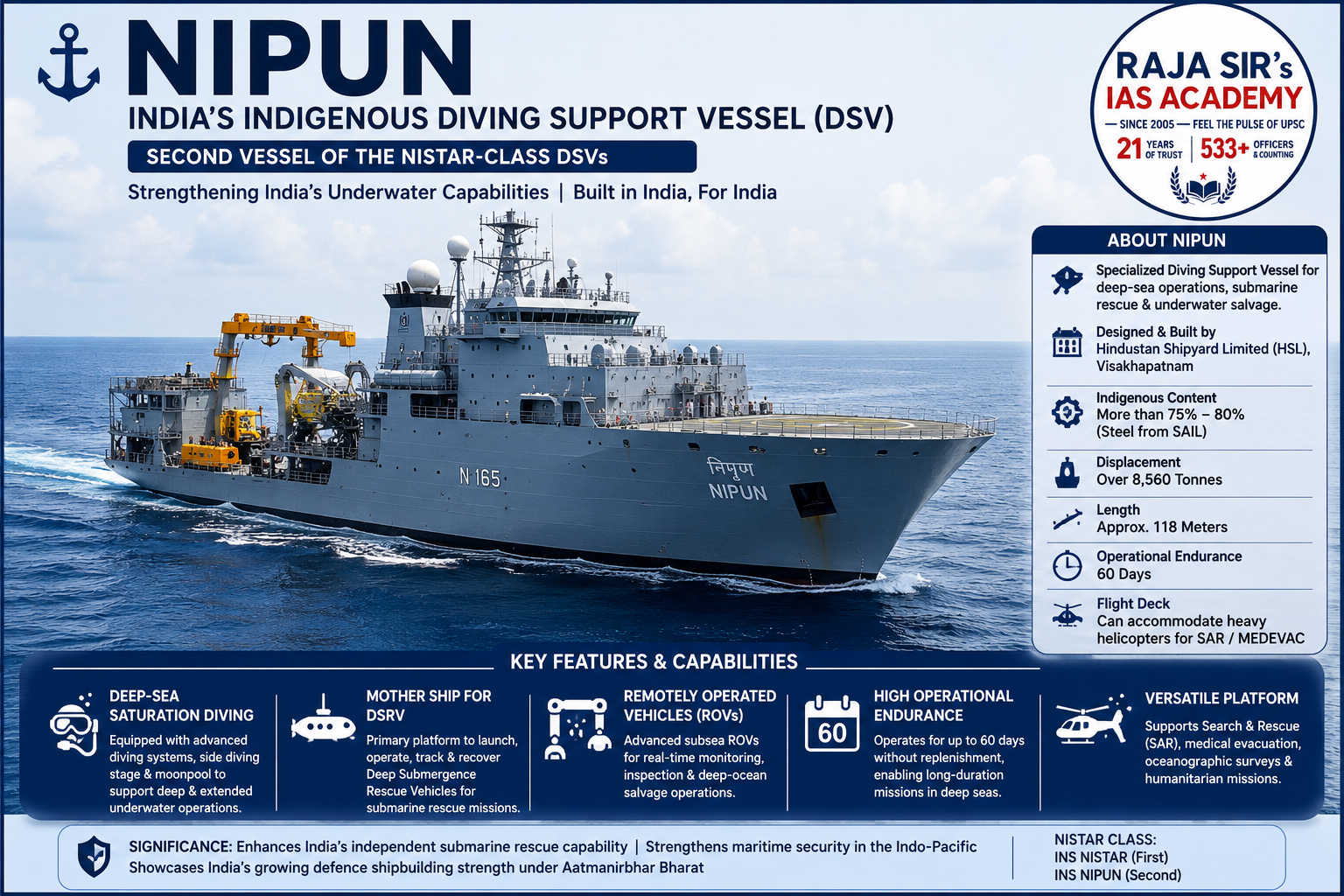
NIPUN — INDIA'S INDIGENOUS DIVING SUPPORT VESSEL (DSV)GS-III — Defence technologyWhy in News?Hindustan Shipyard Limited (HSL), Visakhapatnam, delivered NIPUN, the second indigenous Diving Support Vessel of the Nistar-class, to the Indian Navy, enhancing underwater warfare and submarine rescue capabilities. About NIPUN• Class: Nistar-class (second vessel, after INS Nistar). • Builder: Hindustan Shipyard Limited (HSL), Visakhapatnam. • Indigenous content: 75–80%, built using SAIL-produced steel — supports Aatmanirbhar Bharat. • Endurance: 60 days without replenishment. Key Capabilities• Deep-sea saturation diving (saturation diving system, side diving stage, moonpool). • Mother ship for Deep Submergence Rescue Vehicles (DSRV) — locates and rescues distressed submarines. • Advanced Remotely Operated Vehicles (ROVs) for salvage without risking human lives. • Flight deck for heavy helicopters — supports SAR, MEDEVAC and logistics. Significance• Strengthens underwater warfare capability and reduces reliance on foreign assistance. • Reinforces India's role as a Net Security Provider in the Indian Ocean Region/Indo-Pacific. • Advances Aatmanirbhar Bharat in defence manufacturing. Prelims Pointer: NIPUN = Nistar-class DSV (2nd vessel), built by HSL Visakhapatnam. DSRV = Deep Submergence Rescue Vehicle, launched from a DSV like NIPUN. |
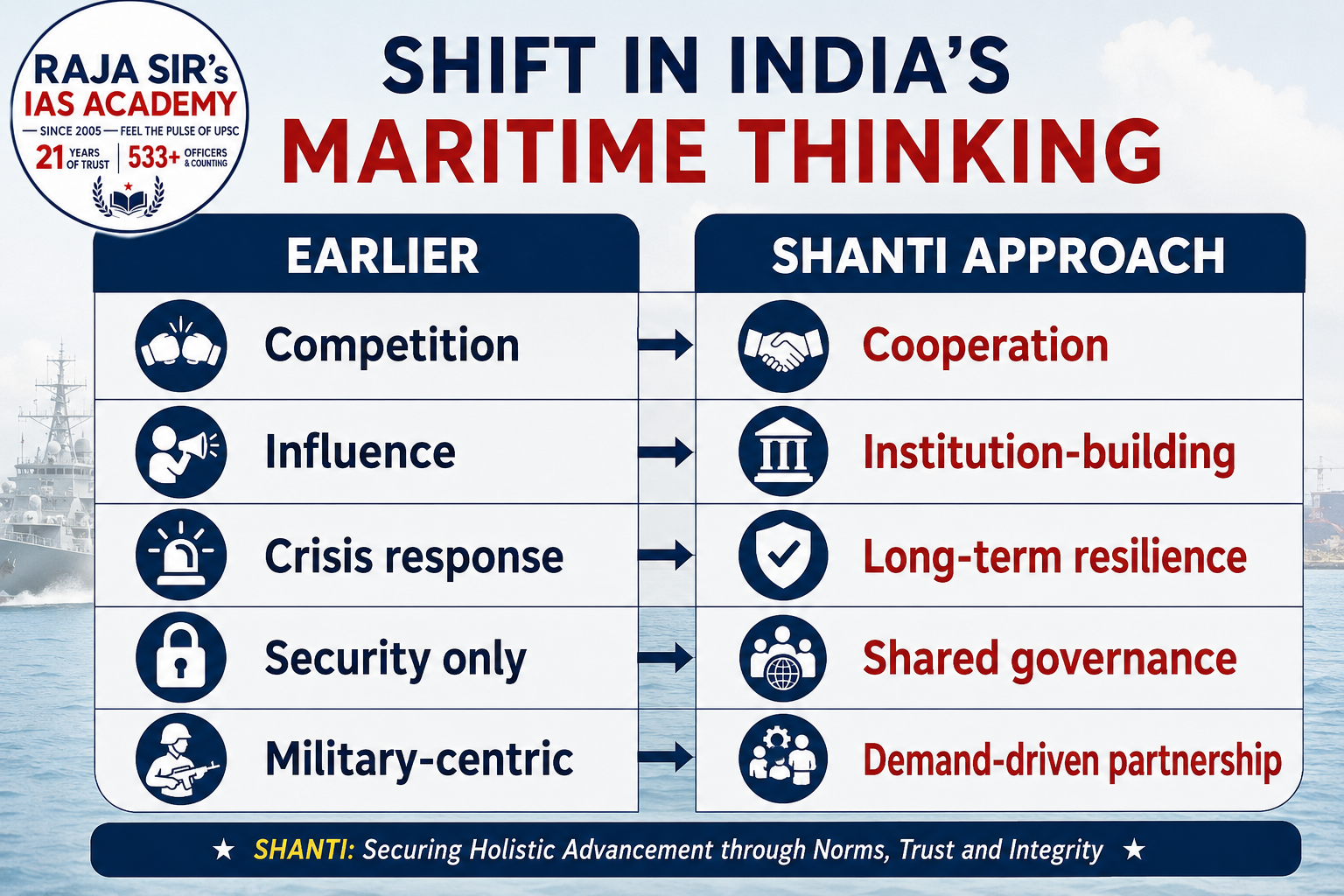
SHANTI FRAMEWORK — INDIA'S MARITIME GOVERNANCE VISIONGS-II — International Relations, India and its neighbourhood, BIMSTEC; GS-III — Maritime security and Blue Economy. Why in News?India launched the SHANTI (Securing Holistic Advancement through Norms, Trust and Integrity) framework while announcing its candidature for the UN Security Council (UNSC) 2028–29, proposing the Bay of Bengal as the pilot region for a rules-based maritime governance model before expanding across the Indo-Pacific. India's Maritime Vision — Evolution• SAGAR (2015): Security and Growth for All in the Region. • MAHASAGAR (2025): Mutual and Holistic Advancement across Regions. • SHANTI (2026): Norms-based Maritime Governance. Objectives• Promote rules-based maritime governance built on Norms, Trust and Integrity. • Enhance regional maritime security against traditional (piracy, rivalry) and non-traditional (IUU fishing, trafficking, pollution) threats. • Position India as a preferred security partner and first responder in the Indo-Pacific. • Deepen BIMSTEC integration rather than creating new institutions. • Promote the Blue Economy — fisheries, ocean energy, coastal tourism, marine biodiversity. Challenges• Geopolitical competition: China's presence via Kyaukphyu Port and naval deployments in the Bay of Bengal. • Myanmar instability: disrupts the India–Myanmar–Thailand Highway and Kaladan Multimodal Transit Transport Project. • Weak connectivity/infrastructure and fragmented customs procedures. • Institutional gaps within BIMSTEC and trust deficit over India's "Big Brother" perception. • Non-traditional threats: climate change, sea-level rise, cyclones, IUU fishing, piracy, trafficking. Way Forward• Maritime Domain Awareness: expand the Information Fusion Centre–Indian Ocean Region (IFC-IOR). • BIMSTEC: implement the Maritime Transport Cooperation Agreement (MTCA). • Inclusive regionalism, regional HADR framework, and NSA/naval-level cooperation. Prelims Pointer: Remember the SAGAR → MAHASAGAR → SHANTI sequence with years. SHANTI's pilot region is the Bay of Bengal; IFC-IOR is India's maritime domain awareness hub. |
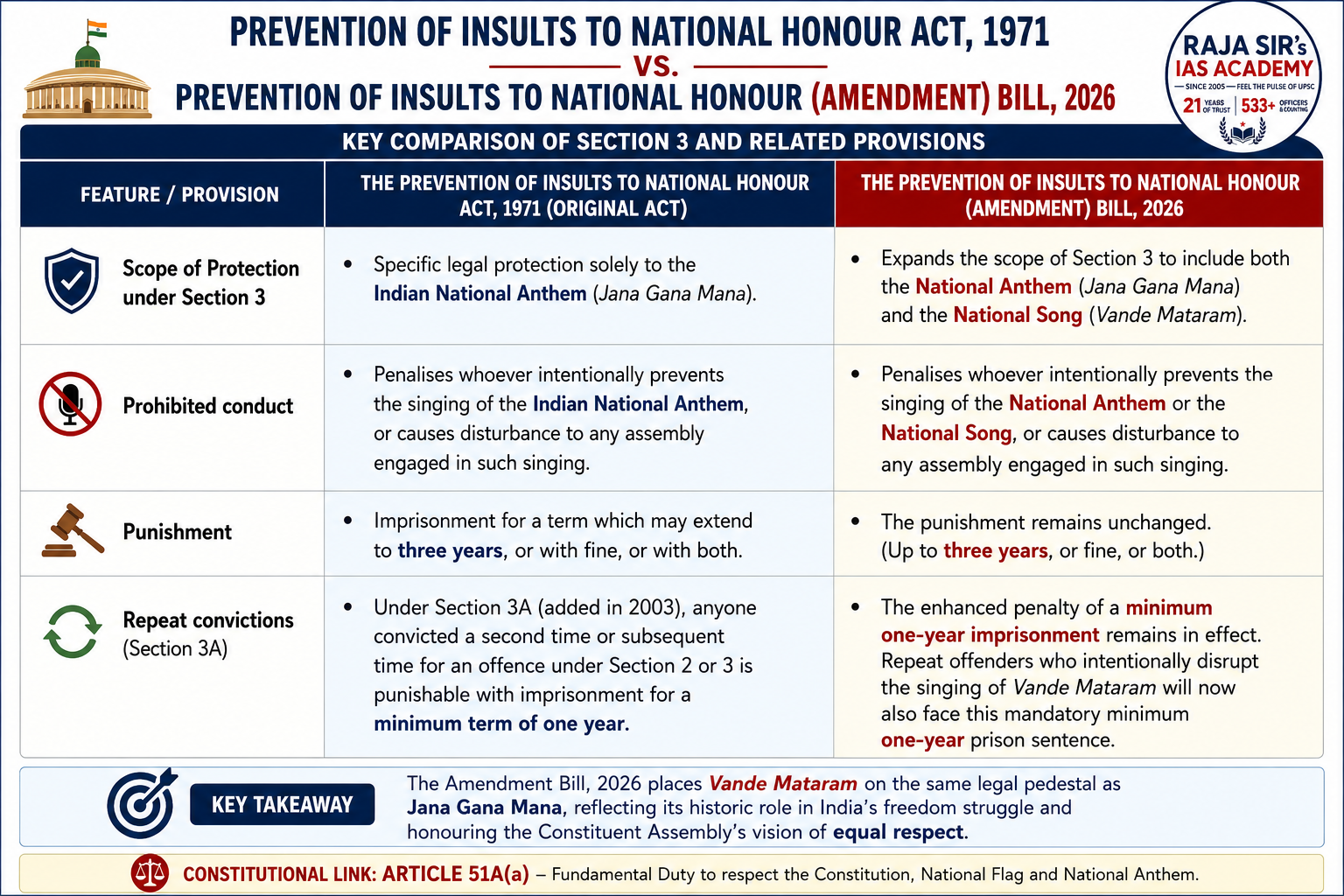
VANDE MATARAM GETS STATUTORY PROTECTIONGS-II — Polity; Fundamental Duties; national symbols and constitutional patriotism; balancing Fundamental Rights with Fundamental Duties. Why in News?Parliament has passed the Prevention of Insults to National Honour (Amendment) Bill, 2026, extending statutory protection to Vande Mataram (National Song) by making intentional obstruction or disturbance during its official singing a punishable offence, on par with the National Anthem. Key Provisions• Amends: Prevention of Insults to National Honour Act, 1971 — extends Section 3 protection to Vande Mataram. • Punishable acts: intentionally preventing, obstructing, or disturbing its official rendition. • Punishment: imprisonment up to 3 years, or fine, or both. • Repeat offence: minimum imprisonment of 1 year. About the 1971 Act• Section 2: protects the National Flag and the Constitution of India (burning, defacing, desecrating, insulting). • Section 3: protects the National Anthem — prevention/disturbance punishable up to 3 years or fine or both. • Section 3A (2003 amendment): minimum 1 year imprisonment for repeat offenders. Historical Significance• 1896 Calcutta Session, INC: Rabindranath Tagore first sang Vande Mataram. • Swadeshi Movement (1905): became the battle cry against Partition of Bengal. • Stuttgart, 1907: Madam Bhikaji Cama displayed India's flag bearing "Vande Mataram". • 24 January 1950: Dr. Rajendra Prasad stated Vande Mataram should enjoy equal honour with Jana Gana Mana. Concerns• Potential tension with Article 19(1)(a) — freedom of speech and expression. • Difficulty distinguishing intentional disrespect from genuine inability or conscientious objection. • Constitution does not explicitly recognise a "National Song", so scope of statutory protection may see continued legal debate. Prelims Pointer: National Anthem is protected under Section 3 of the 1971 Act; Vande Mataram now gets parallel protection via the 2026 Amendment. Fundamental Duty under Article 51A(a) is the constitutional link. |