|
Bridging India’s Road-Safety Enforcement Gap
GS III – Infrastructure: Roads, Transport, Road Safety
Why in News?
The Act completed seven years amid continuing concerns over road safety and implementation. The persistence of high road fatalities highlights the gap between legislative reforms and enforcement on the ground.
Aim
To strengthen the Motor Vehicles Act, 1988 through:
- Higher penalties for traffic violations.
- Technology-enabled enforcement.
- Greater accountability of vehicle owners and other stakeholders.
- Protection of accident victims and Good Samaritans.
- Improved road-safety governance.
Significance
- Good Samaritan Protection : Section 134A provides statutory protection to Good Samaritans assisting road-accident victims.Intended to reduce fear of unnecessary police/legal harassment.
- Electronic Enforcement : Section 136A provides for electronic monitoring and enforcement of road-safety rules. Enables mechanisms such as automated enforcement and electronic challans.
- Infrastructure Accountability : Section 198A deals with responsibility for failure to comply with standards relating to road design, construction and maintenance.
- Accident Victim Protection : The amendment introduced provisions aimed at improving treatment and compensation mechanisms for accident victims.
|
Issue
|
Implication
|
|
Enforcement deficit
|
Laws alone cannot ensure road safety
|
|
State-level variation
|
Motor-vehicle administration involves substantial State implementation
|
|
Vulnerable road users
|
Pedestrians, cyclists and two-wheeler users face disproportionate risks
|
|
Poor road engineering
|
Black spots and unsafe designs increase crash severity
|
|
Emergency response gaps
|
Delayed trauma care increases mortality
|
Way Forward
- Adopt Safe System/Forgiving Roads: Design roads to minimise the consequences of human errors.
- Institutionalise Road-Safety Audits: Make safety audits mandatory across the planning, design, construction and maintenance stages.
- Strengthen Black-Spot Management: Use scientific identification, rectification and post-treatment monitoring of accident-prone locations.
- Leverage Technology: Expand AI-enabled surveillance, automated speed enforcement, e-challans and intelligent transport systems.
- Strengthen Trauma Care: Develop integrated Golden Hour emergency-response and trauma-care networks along major highways.
|
|
Building Strategic Tech Sovereignty
GS III – Science & Technology / Industrial Policy
Why in News?
The Union Cabinet approved Semicon 2.0 with an outlay of ₹1,27,500 crore to strengthen India’s semiconductor ecosystem.
Aim
- To build an end-to-end semiconductor ecosystem covering:
Design → Manufacturing → Packaging → Materials → Equipment → R&D → Talent
Significance
- Strategic Autonomy : Reduces dependence on external semiconductor supply chains.Enhances resilience against global disruptions.
- Electronics & Industrial Growth : Semiconductors are critical for automobiles, telecom, defence, power electronics, consumer electronics and AI.
- Indigenous Design Capability : Builds on India''s existing strength in semiconductor chip design and seeks to expand domestic capabilities.
- Supply-Chain Resilience : Encourages development of domestic capabilities across chips, packaging, materials and equipment, rather than focusing only on fabrication.
Key Challenges
- High capital intensity and long gestation periods.
- Rapid technological obsolescence.
- Requirement of ultra-pure water and reliable power.
- Shortage of highly specialised talent.
- Strong competition from established semiconductor hubs.
Way Forward
- Strengthen industry–academia R&D and talent programmes.
- Expand domestic EDA tools, chip design and semiconductor materials capabilities.
- Provide sustained support for advanced R&D and technology acquisition.
- Use government procurement and stable policies to create predictable demand.
Semicon 1.0 vs Semicon 2.0
|
Feature
|
Semicon 1.0
|
Semicon 2.0
|
|
Outlay
|
₹76,000 crore
|
₹1,27,500 crore
|
|
Approach
|
Semiconductor ecosystem
|
Expanded end-to-end ecosystem
|
|
Design
|
Supported
|
Greater emphasis
|
|
Manufacturing
|
Supported
|
Continued & strengthened
|
|
Packaging
|
Supported
|
Expanded
|
|
Materials & Equipment
|
Limited ecosystem development
|
Greater emphasis
|
|
R&D & Talent
|
Supported
|
Expanded
|
|
|
Measuring the Substance of Indian Democracy
GS II – Indian Polity & Governance
Why in News?
V-Dem Institute released the Democracy Report 2026, assessing democracy through a multidimensional institutional framework.
What is V-Dem?
Varieties of Democracy (V-Dem) is a research project that evaluates democracy beyond the mere conduct of elections. It examines the quality, functioning and institutional foundations of democracy.
Five Dimensions
- Electoral Democracy – free and fair elections.
- Liberal Democracy – rights, rule of law and institutional checks.
- Participatory Democracy – citizen participation beyond elections.
- Deliberative Democracy – reasoned public debate and justification of decisions.
- Egalitarian Democracy – equal political influence and opportunities.
|
Procedural Democracy
|
Substantive Democracy
|
|
Elections
|
Elections + Rights
|
|
Universal adult franchise
|
Rule of Law
|
|
Representation
|
Institutional Accountability
|
|
Electoral competition
|
Independent Institutions
|
|
Formal participation
|
Meaningful Political Participation
|
Concerns
- Weakening of institutional checks and balances
- Restrictions affecting media freedom and civil liberties
- Concerns over executive accountability
- Need to preserve judicial and institutional autonomy
Way Forward
- Strengthen Parliamentary scrutiny and institutional independence.
- Ensure transparency, electoral integrity and media freedom.
- Uphold rule of law and civil liberties.
- Deepen citizen participation and democratic accountability.
|
|
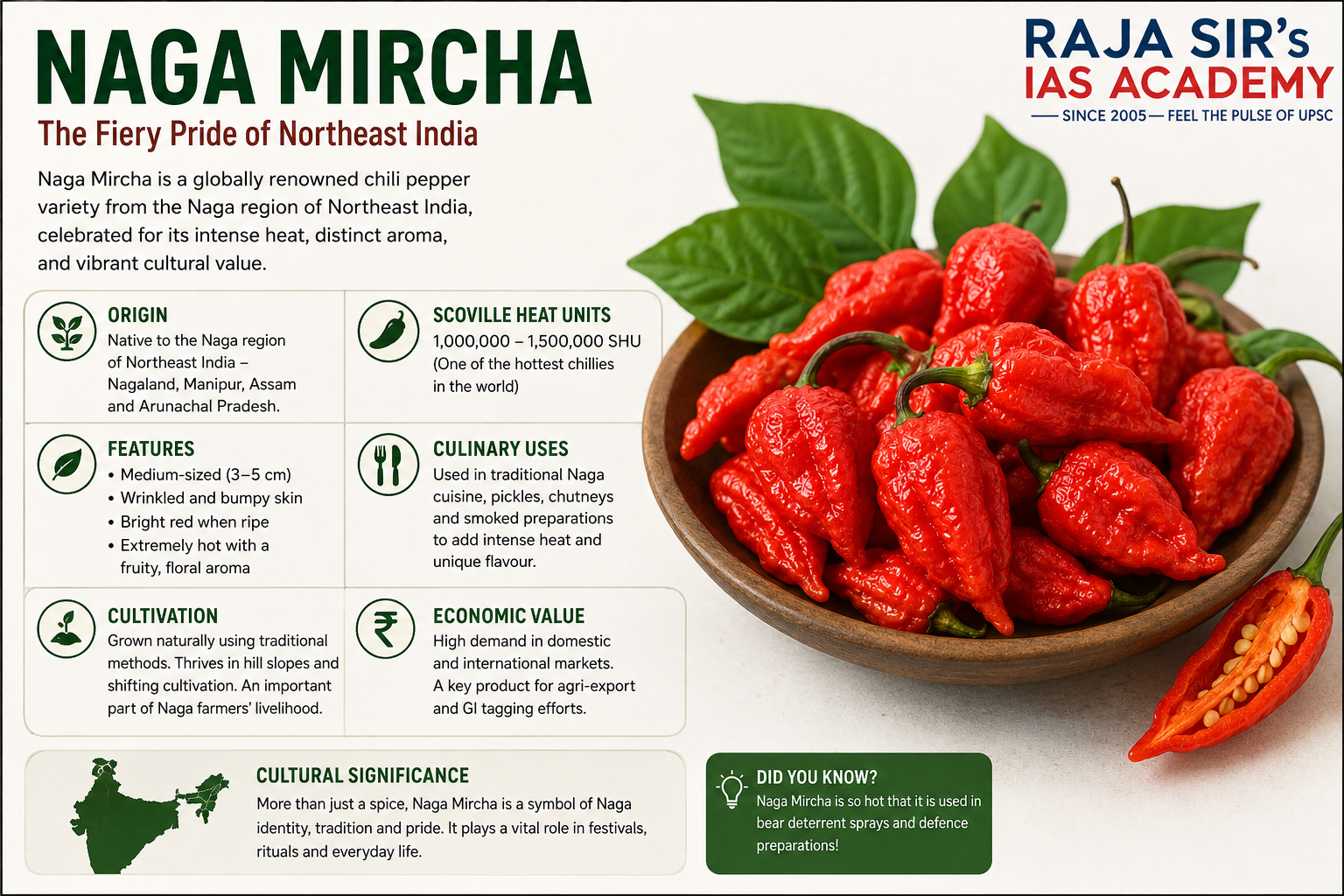
Northeast India’s Fiery GI Treasure (Naga Mircha)
GS III – Agriculture / GI Tags
Scientific Identity
- Scientific name: Capsicum chinense
- One of the hottest chilli varieties cultivated in India.
Region
- Primarily associated with Nagaland and the Northeastern region.
- Also known as Bhut Jolokia-type chilli in the broader Northeast context, though specific varieties and GI identities should not be conflated.
GI Tag
- Naga Mircha (Naga King Chilli) received a Geographical Indication (GI) tag in 2008.
Importance
- High capsaicin content → significant pungency.
- Important horticultural and cash crop of the Northeast.
- Supports farmer livelihoods, processing and value addition.
- Has potential for speciality-food and export markets.
|
|
Protecting Women’s Careers and Workplace Dignity
GS II – Social Justice | Governance
Why in News?
In Rakhi Bisht v. Union of India, the Delhi High Court emphasised that maternity leave should not adversely affect a woman''s professional status, responsibilities or career prospects.
The judgment reinforces the principle that maternity protection must extend beyond mere retention of employment.
Key Observations
- Maternity protection is broader than continuity of employment and wages.
- A woman returning from maternity leave should ordinarily be restored to her previous position.
- Where the previous position genuinely ceases to exist, she should receive an equivalent position in terms of: Pay, Grade, Status, Responsibilities
- Maternity cannot be used as a basis for demotion, humiliation or career discrimination.
- The principle reflects substantive equality, rather than merely formal equality.
|
Provision
|
Relevance
|
|
Article 14
|
Equality before law and equal protection of laws
|
|
Article 15(1)
|
Prohibits discrimination on grounds including sex
|
|
Article 15(3)
|
Permits special provisions for women and children
|
|
Article 21
|
Right to life, dignity and dignified existence
|
|
Article 39(d)
|
Equal pay for equal work
|
|
Article 42
|
Directs the State to secure just and humane conditions of work and maternity relief
|
Statutory & International Context
Maternity Benefit Act, 1961
- Provides statutory maternity protection to eligible women workers.
- Seeks to prevent adverse employment consequences arising from maternity.
ILO Convention No. 183
- Provides an international framework for maternity protection at work, including protection of employment and non-discrimination.
Significance
- Promotes substantive gender equality : Equality requires removal of structural disadvantages associated with motherhood, not merely identical treatment.
- Prevents the “motherhood penalty” : Career interruptions associated with childbirth can affect promotions, responsibilities and long-term career progression. Protection against demotion helps address this structural disadvantage.
- Improves women''s workforce participation : Strong maternity protection can increase women''s confidence in remaining in formal employment.
- Protects dignity at workplace : Maternity should not become a basis for humiliation, professional sidelining or loss of status.
Challenges
- Informal employment: A large proportion of women workers remain outside effective formal maternity protections.
- Implementation gaps: Legal safeguards may not always translate into workplace practices.
- Motherhood penalty: Career progression may still be affected by prolonged career breaks and workplace biases.
- Care burden: Unequal distribution of childcare responsibilities disproportionately affects women.
- Private-sector concerns: Smaller establishments may face challenges in replacing employees during extended leave, potentially creating discriminatory incentives.
- Lack of awareness: Employees may be unaware of their statutory rights and available remedies.
Way Forward
- Ensure effective enforcement of maternity and anti-discrimination provisions.
- Promote flexible work arrangements and return-to-work mechanisms.
- Strengthen childcare infrastructure and crèche facilities.
- Encourage shared parental responsibilities rather than treating childcare exclusively as a woman''s responsibility.
- Establish transparent criteria for promotion, appraisal and post-maternity placement.
- Improve grievance-redressal mechanisms for workplace discrimination.
- Extend effective social protection to women in the informal and gig economy.
|
|
Reshaping Land-Based Deterrence in the Indo-Pacific
GS III – Defence Technology / International Security
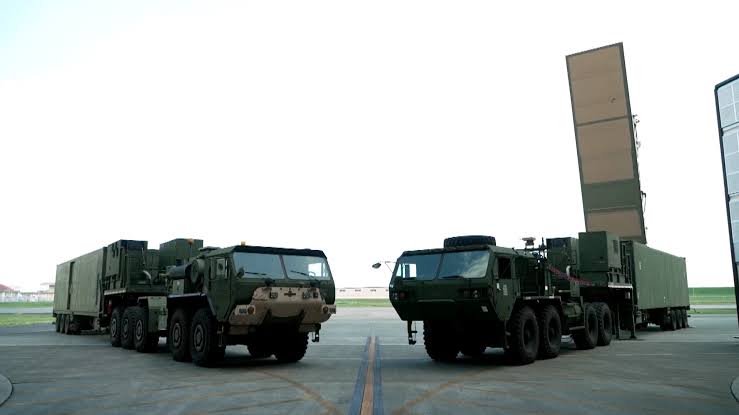
What is Typhon?
|
Feature
|
Details
|
|
Country
|
United States
|
|
Operator
|
U.S. Army
|
|
Programme
|
Mid-Range Capability (MRC)
|
|
Nature
|
Ground-based, mobile missile system
|
|
Primary role
|
Long-range precision strike
|
|
Key missiles
|
Tomahawk and SM-6
|
|
Strategic theatre
|
Indo-Pacific
|
Strategic Significance
- Indo-Pacific: Enhances the US ability to conduct land-based precision strikes in maritime theatres.
- Deterrence: Strengthens the ability to deter potential adversaries by increasing the range and flexibility of conventional fires.
- A2/AD: Relevant to efforts to counter Anti-Access/Area Denial (A2/AD) strategies.
- Regional Security: Its deployment in the Indo-Pacific has implications for the strategic calculations of China, Japan and other regional actors.
|
|
Sacred Heritage - Pasupathinath Temple
GS I – Art & Culture
Location
- Located in Kathmandu, Nepal.
- Situated on the banks of the Bagmati River.
- Deity : Dedicated to Lord Shiva, worshipped as Pashupati.
UNESCO Status
- Pashupatinath is part of the Kathmandu Valley UNESCO World Heritage Site.
- Kathmandu Valley → UNESCO World Heritage Site → 1979.
Architecture
- Famous for traditional Nepalese pagoda-style architecture.
Characterised by:
- Multi-tiered roofs
- Rich wood and metal craftsmanship
- Distinctive temple architecture of the Kathmandu Valley.
Cultural Significance
- One of the most important Shaivite pilgrimage centres.
- Reflects the shared Hindu-Buddhist civilisational heritage of South Asia.
India–Nepal Relations
- Religious and cultural heritage provides an important civilisational dimension to India–Nepal relations.
- Cultural cooperation complements bilateral ties in areas such as connectivity, development and people-to-people relations.

|
|
SCO and the Eurasian Equation
GS II – International Relations
Why in News?
The SCO Council of Heads of State summit brought together leaders of the organisation to discuss regional security, economic cooperation, connectivity and the evolving Eurasian geopolitical order.The summit adopted a joint declaration and several cooperation documents.
Key Highlights
- Reaffirmation of sovereignty, territorial integrity and non-interference in the internal affairs of states.
- Emphasis on strengthening the multilateral trading system.
- Renewed commitment to combating the “three evils”. Terrorism, Separatism, Extremism
- Greater cooperation in areas such as: Security, Economy and trade, Transport and connectivity
- Energy, Culture and people-to-people relations
- Greater coordination among Eurasian multilateral organisations can contribute to regional stability.
SCO Plus
What is it?
- SCO Plus provides a broader platform for interaction between SCO members and non-member countries, observers, dialogue partners and international organisations.
- It expands the SCO''s outreach beyond its formal membership.
Significance
- Promotes dialogue on regional and global issues.
- Provides an avenue for engagement with countries outside the core SCO membership.
- Strengthens the organisation''s role as a platform for Eurasian multilateralism.
Significance for India
- Engagement with Eurasia SCO provides India with an institutional platform to engage with Central Asia, Russia and other Eurasian countries.
- Counter-terrorism cooperation : SCO''s focus on terrorism, separatism and extremism aligns with India''s security concerns. The Regional Anti-Terrorist Structure (RATS) provides an institutional mechanism for security cooperation.
- Strategic autonomy : Participation enables India to engage simultaneously with Russia, China, Central Asian states and other Eurasian countries.
- Connectivity : SCO can facilitate discussions on transport corridors, logistics and regional connectivity.
Challenges
- India–China tensions : Border disputes and strategic competition can constrain deeper cooperation.
- India–Pakistan tensions : Bilateral tensions can complicate consensus-building within the organisation.
- Divergent interests : SCO members have different strategic priorities and foreign-policy orientations.
- Russia–West confrontation : The Ukraine conflict and Russia–West tensions complicate the wider Eurasian geopolitical environment.
- China-centric concerns : China''s growing economic and strategic influence raises questions about the balance of power within the SCO.
- Connectivity constraints : Geopolitical tensions and unresolved regional conflicts can limit the development of effective connectivity corridors.
- Institutional limitations : Consensus-based decision-making and the diversity of members can make implementation slower.
Way Forward
- Deepen Central Asian engagement through diplomatic, economic and cultural initiatives.
- Use the SCO primarily for functional cooperation rather than allowing bilateral disputes to dominate the agenda.
- Strengthen cooperation against terrorism, extremism and organised crime.
- Promote secure and transparent connectivity respecting sovereignty and territorial integrity.
- Expand cooperation in energy, critical minerals, digital technology and pharmaceuticals.
- Continue advocating a representative, multipolar and rules-based international order.
|
|
Taking Digital Finance to India’s Last Mile
GS III – Economy
Why in News?
- India Post Payments Bank (IPPB) marked its 9th Foundation Day. (September 1, 2018)
- It launched the DakPay Sound Box and digital platforms for mutual funds and insurance, expanding its financial-services ecosystem.
|
Feature
|
Details
|
|
Established
|
2018
|
|
Ownership
|
100% Government of India-owned
|
|
Administrative Ministry
|
Ministry of Communications
|
|
Department
|
Department of Posts
|
|
Regulator
|
Reserve Bank of India (RBI)
|
|
Legal Form
|
Public limited company under the Companies Act, 2013
|
|
Core Focus
|
Financial inclusion
|
|
Network Advantage
|
India Post''s extensive physical and rural network
|
Objective
To provide accessible, affordable and convenient banking and digital financial services to unbanked and underbanked populations.
Major Services
- Demand deposits subject to the prescribed Payments Bank limit.
- Domestic remittances and fund transfers.
- Direct Benefit Transfer (DBT) and government payments.
- Digital payments through mobile and other channels.
- Bill payments and merchant payments.
- Distribution of third-party financial products, such as insurance and mutual funds.
Significance
- Last-mile financial inclusion : Leverages the India Post network and postal personnel to reach remote and underserved regions.Helps bridge the rural–urban financial access gap.
- Digital financial inclusion : Promotes digital payments and account-based transactions among populations with limited access to conventional banking.
- DBT delivery : Provides an additional channel for transferring government benefits directly to beneficiaries.Can reduce dependence on intermediaries and improve payment accessibility.
- Boost to rural economy : Easier access to payments, remittances and other financial services can support rural households, small businesses and informal-sector workers.
- Women and vulnerable groups : Doorstep and assisted banking can improve financial access for people facing mobility, connectivity and banking-access barriers.
- Convergence of physical and digital infrastructure : IPPB combines India''s traditional postal infrastructure with digital financial services, creating a hybrid last-mile delivery model.
Challenges
- Digital divide: Limited digital literacy and internet connectivity in some regions.
- Cybersecurity risks: Increasing digital transactions require stronger protection against fraud and cyberattacks.
- Low financial awareness: Merely opening accounts does not ensure meaningful financial inclusion.
- Infrastructure constraints: Remote areas may face connectivity and technological limitations.
- Competition: Commercial banks and fintech platforms provide increasingly sophisticated digital services.
- Payments Bank limitations: Payments Banks have restrictions on activities such as lending, limiting their ability to offer a complete banking relationship.
Way Forward
- Strengthen digital and financial literacy through postal networks.
- Expand assisted digital banking for elderly, rural and digitally excluded populations.
- Improve cybersecurity and fraud-awareness mechanisms.
- Integrate IPPB more deeply with UPI, DBT and other digital public infrastructure.
- Use data-driven outreach to identify financially excluded households.
- Strengthen interoperability with banks, fintechs and other financial institutions.
- Expand access to insurance, pension, investment and other formal financial products through appropriate safeguards.
|
|
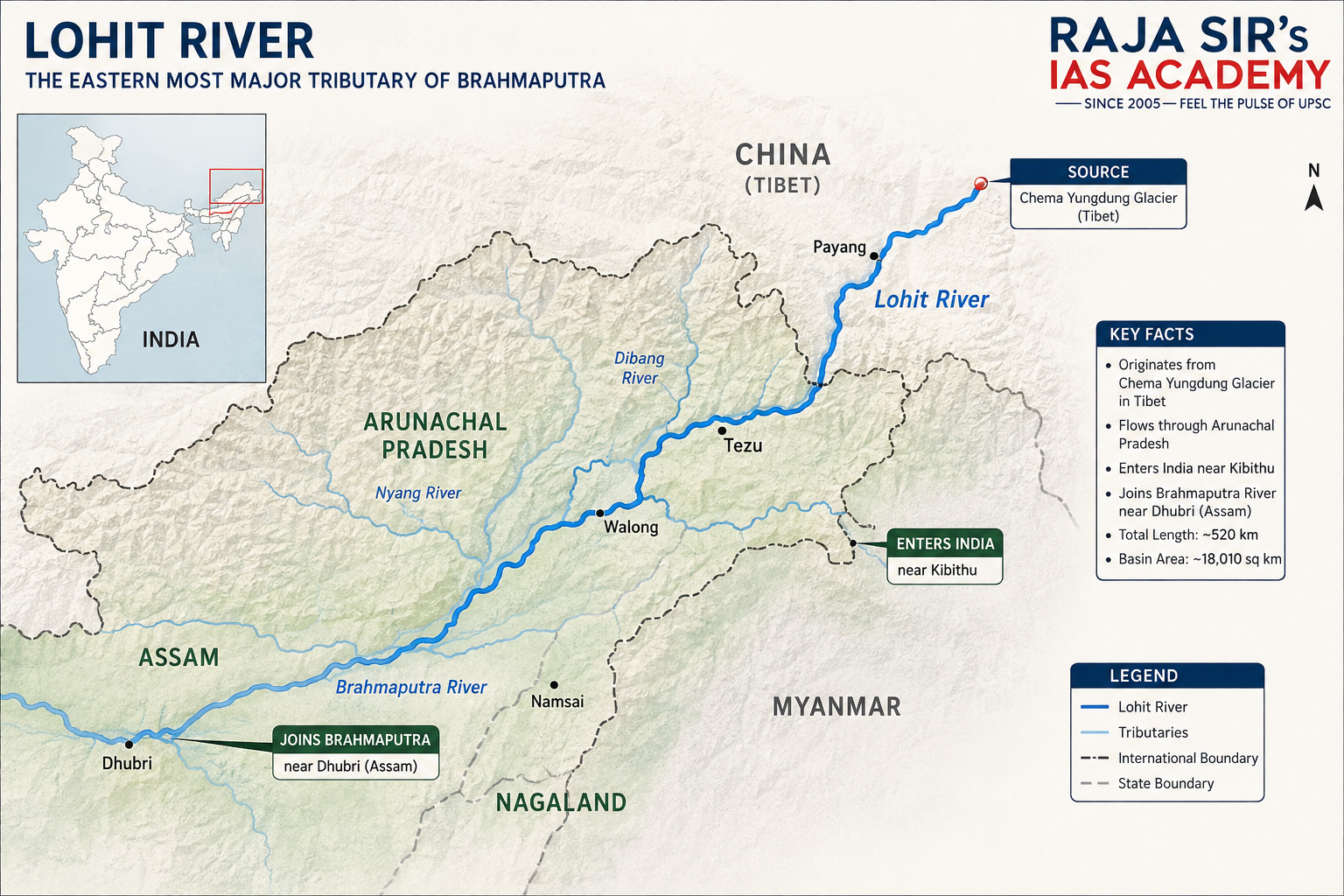
The Eastern Gateway of the Brahmaputra System
GS I – Indian Geography
Key Facts
- Major tributary of the Brahmaputra.
- Originates in the Tibet region and enters Arunachal Pradesh.
- Flows through the Mishmi Hills region.
- Parshuram Kund, an important pilgrimage site, is located on the Lohit River.
- Joins the Brahmaputra system in Arunachal Pradesh.
River System
Tibet → Lohit → Brahmaputra → Assam → Bangladesh
Brahmaputra in Arunachal Pradesh : The Brahmaputra is known as Yarlung Tsangpo in Tibet. After entering Arunachal Pradesh, the river system is associated with:
- Siang/Dihang
- Dibang
- Lohit
|
|
The Supreme Court’s Constitutional Safety Valve
GS II – Constitution & Judiciary
Why in News?
The Supreme Court''s recent consideration of relief in examination-related protest cases renewed attention to the scope of Article 142.
What is Article 142?
- Empowers the Supreme Court to pass any decree or order necessary for doing “complete justice” in a matter before it.
- Such orders are enforceable throughout the territory of India.
Significance
- Constitutional Safety Valve: Enables effective remedies where existing legal mechanisms may be inadequate.
- Bridges Remedial Gaps: Helps address exceptional situations requiring innovative judicial remedies.
- Has been invoked in areas such as environmental protection, matrimonial disputes, compensation and institutional reforms.
Concerns
- Judicial Overreach: Excessive use may affect the separation of powers.
- Judicial Law-Making: Broad remedial powers may bring the judiciary into areas primarily meant for the legislature or executive.
Constitutional Limits
Article 142 is wide but not unlimited. It cannot:
- Contravene substantive statutory law in an impermissible manner.
- Override Fundamental Rights.
- Be exercised contrary to constitutional limitations.
|
|
Unveiling India’s Deep-Sea Biodiversity
GS III – Environment & Biodiversity
Why in News?
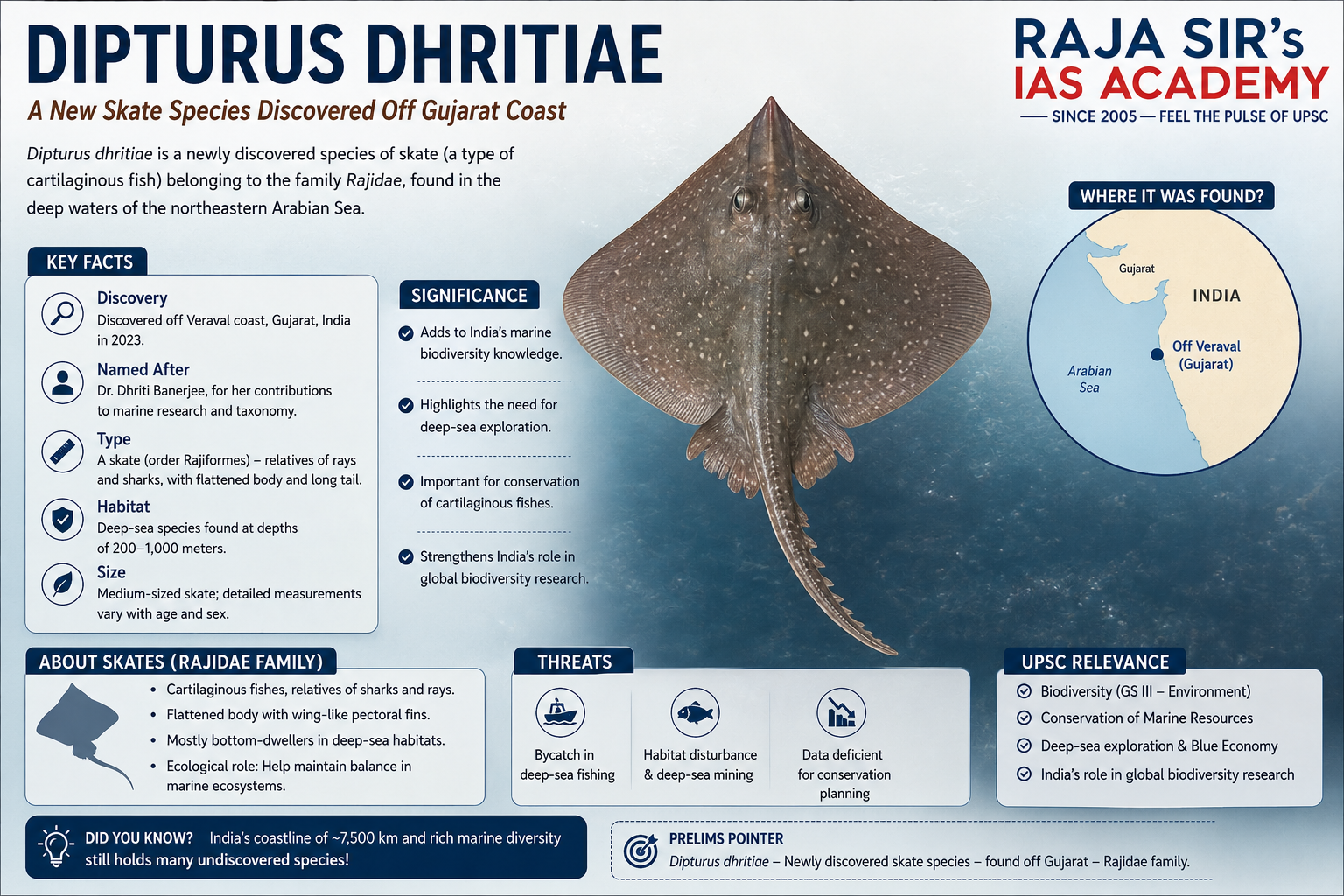
Scientists from Zoological Survey of India (ZSI) and CMFRI described a new deep-sea skate species, Dipturus dhritiae, from the southeastern Arabian Sea under the Deep Ocean Mission.
Key Facts
- Common name: Arabian Skate
- Scientific name: Dipturus dhritiae
- Group: Chondrichthyes — cartilaginous fishes
- Habitat: Deep-sea marine environment
- Maximum reported length: 131.5 cm
- Named in honour of Dr Dhriti Banerjee, former Director of ZSI and the first woman to head the institution.
Conservation Significance
Deep-sea skates and other chondrichthyans are particularly vulnerable because of their:
- Slow growth
- Late sexual maturity
- Low reproductive output
- Long population-recovery periods
|