|
AVM Shakti Sharma – Breaking the Glass Ceiling in Defence
GS II : Women empowerment GS III: Defence reforms
Why in News?
On 1 September 2026, Shakti Sharma became the first non-medical woman officer in India’s defence forces to attain the rank of Air Vice Marshal (AVM).
About Air Vice Marshal Shakti Sharma
- She was commissioned into the Education Branch of the Indian Air Force (IAF) in 1994.
- She has completed over three decades of service in the IAF.
- She has served in: Training establishments, Field stations, Command Headquarters, Air Headquarters
- She contributed to institutional development and defence education.She played a key role in establishing IAF Chairs of Excellence at IIT Kanpur and Pune University, promoting research and strategic defence collaboration.
- She became the first woman officer from the Tri-Services to command a Sainik School.
- She served as the Principal of Sainik School, Kapurthala.
Significance
- Women Empowerment: Reflects increasing participation of women in senior defence leadership.
- Breaking the Glass Ceiling: Demonstrates the gradual removal of institutional barriers to women''s career progression.
- Gender Equality: Highlights the principle of equal opportunities in traditionally male-dominated institutions.
- Merit-based Leadership: Reinforces professional competence and experience as key determinants of career advancement.
- Institutional Transformation: Indicates the evolution of India''s armed forces towards a more inclusive and diverse organisational structure.
- Role Model: Her achievement can encourage greater participation of women in defence and other strategic sectors.

|
|
Can AI be an “Author” under Indian Copyright Law?
GS III – Science and Technology
Why in News?
The Indian Copyright Office has taken the view that an AI system cannot itself be recognised as an “author” under the existing framework of the Copyright Act, 1957, raising questions about copyright protection for AI-generated works.
Core Legal Issue
The central question is: Can a non-human AI system possess the legal status necessary to be recognised as an “author” and hold copyright?
Under the present framework, AI does not have:
- Legal personhood
- Independent juridical will
- Legal capacity to own rights
- Independent legal liability
Why AI Cannot Be an Author?
- Absence of Legal Personhood : AI systems are technological systems and are not recognised as legal persons under Indian law.
- No Independent Legal Will : An AI system does not possess legally recognised intention or will comparable to a human author.
- Copyright Traditionally Centres on Human Authorship : Copyright protection is generally linked to human intellectual creativity and expression.
- No Independent Ownership Capacity : An AI system cannot independently hold property rights, enter legal relationships or enforce copyright.
- Legislative Question : Recognising AI as an independent author would involve creating a new legal category, which would ultimately require legislative intervention.
Arguments in Favour of Protecting AI-Generated Works
- Incentivising Innovation : Copyright protection could encourage investment in AI-based creative technologies.
- Originality of AI Output : Some AI-generated outputs may demonstrate a degree of novelty or unexpected creativity, raising questions about conventional notions of authorship.
- Avoiding Public-Domain Gap : If purely machine-generated works receive no protection, commercially valuable outputs could potentially remain outside copyright protection.
- Sui Generis Framework : Instead of treating AI as a human-like author, lawmakers could consider a sui generis legal framework specifically for machine-generated works.
|
Aspect
|
Key Fact
|
|
Principal Legislation
|
Copyright Act, 1957
|
|
Nature of Protection
|
Protects original expression, not mere ideas
|
|
Protected Categories
|
Literary, dramatic, musical & artistic works; cinematograph films; sound recordings
|
|
General Term
|
Literary, dramatic, musical & artistic works: Author’s lifetime + 60 years
|
|
Copyright Administration
|
Copyright Office
|
|
Administrative Department
|
DPIIT, Ministry of Commerce & Industry
|
|
International Framework
|
India is a party to the Berne Convention
|
Significance of the Debate
- Legal : Tests the limits of traditional concepts of authorship, originality and ownership.
- Economic : Has implications for the rapidly expanding AI-generated content economy.
- Technological : Raises questions about how copyright law should respond to increasingly autonomous generative AI.
- Policy : Requires balancing Innovation ↔ Human Creativity ↔ Copyright Protection ↔ Public Domain
Challenges for Policymakers
- Human Contribution: Determining how much human creativity is necessary for AI-assisted work to qualify for copyright protection.
- AI-Assisted vs AI-Generated : Distinguishing works created substantially by humans from those produced mainly by AI.
- Excessive Copyright Claims : Preventing copyright from being granted too broadly to purely machine-generated content.
- Human Creativity vs AI Innovation : Protecting creators while ensuring copyright rules do not unnecessarily restrict AI development.
- Ownership & Liability : Clarifying who owns AI-generated content and who is responsible when it infringes existing copyrights.
Way Forward
- Legal Clarity : Clearly define the copyright status of AI-assisted and purely AI-generated works.
- Human Creativity Test: Establish clear criteria to assess meaningful human creative contribution.
- Learn from Global Practices : Examine how different countries are adapting copyright law to AI.
- Sui Generis Framework : Consider a separate legal framework for AI-generated content if existing copyright law proves inadequate.
- Protect Human Creativity : Ensure reforms continue to provide incentives for human creators and innovators.
- Transparency & Attribution : Promote clear disclosure of AI involvement and accountability for AI-generated content.
|
|
Digital Growth vs Ecological Limits: India’s Data-Centre Challenge
GS III – Environment + S&T
Why in News?
India''s rapidly expanding data-centre industry is expected to reach around 6.5 GW capacity by 2030, raising concerns regarding electricity consumption, water stress and urban heat.
What is the Issue?
Data centres require:
- Continuous electricity supply.
- Large quantities of cooling water.
- High-capacity transmission infrastructure.
When concentrated in already stressed urban regions, they can intensify pressure on water, electricity and local climate systems.
Key Data
- Capacity: 520 MW in 2020 → ~1.5 GW in 2026 → 6.5 GW projected by 2030.
- Electricity consumption: 13 TWh in 2024 → 57 TWh projected by 2030.
- A 100 MW data centre may consume approximately 2 million litres of water daily.
- Aggregate water use could rise to 358 billion litres annually by 2030.
- Renewable electricity curtailment reached 300 GWh in Q1 2026.
- Data centres can contribute to localised surface-temperature increases.
Major Environmental Impacts
- Water Stress : Data centres often require substantial quantities of water for cooling, creating competition with domestic and agricultural requirements.
- Energy Stress : Round-the-clock power requirements can increase dependence on conventional baseload electricity when renewable transmission infrastructure is inadequate.
- Urban Heat : Cooling systems release waste heat, potentially reinforcing existing urban heat-island effects.
- Renewable Energy Curtailment : Transmission bottlenecks can prevent renewable electricity from reaching high-demand data-centre clusters.
- Cost Socialisation : Public investment in water and transmission infrastructure may ultimately increase costs borne by consumers.
Impact
|
Dimension
|
Impact
|
|
Environment
|
Water depletion, heat stress
|
|
Energy
|
Higher baseload demand
|
|
Urban areas
|
Intensification of heat islands
|
|
Agriculture
|
Competition for freshwater
|
|
Consumers
|
Possible higher utility costs
|
|
Digital economy
|
Supports AI and digital infrastructure
|
Way Forward
- Establish an enforceable National Sustainability Framework for data centres.
- Mandate disclosure of water and electricity consumption.
- Promote efficient cooling technologies.
- Introduce energy-efficiency standards.
- Deploy battery storage near renewable-energy pooling stations.
- Encourage data-centre development near coastal/renewable-energy corridors.
- Develop markets for storage, demand response and round-the-clock renewable powers.
|
|
Districts as Export Hubs (DEH)
GS III Economic
Why in News?
The Department of Commerce is implementing the Districts as Export Hubs (DEH) initiative in a phased manner to promote exports at the district level.
What is Districts as Export Hubs?
The initiative seeks to transform districts from mere production centres into export-oriented planning and promotion units by identifying products/services with export potential and addressing constraints related to production, quality, logistics and market access.
Objectives
- Promote district-level export promotion.
- Identify products/services with export potential.
- Integrate local producers with global markets.
- Strengthen MSMEs, artisans and farmers.
- Reduce regional concentration of exports.
- Create employment and increase local incomes.
Key Features
- Nodal Agency: Directorate General of Foreign Trade (DGFT).
- ODOP Linkage: Integrates with the One District One Product (ODOP) approach.
- District Export Action Plans (DEAPs): Prepared to identify products/services and address bottlenecks.
- Scheme Convergence: Utilises existing Central and State Government schemes.
- Infrastructure & Logistics: Focus on connectivity, packaging, warehousing, testing and other export-related infrastructure.
- Digital/E-commerce Linkages: Facilitates access to wider domestic and international markets.
- Capacity Building: Supports local producers in standards, quality certification and export procedures.
Three-Tier Institutional Structure
|
Level
|
Institution
|
Major Role
|
|
Central
|
Department of Commerce / DGFT
|
Policy direction, coordination and export promotion
|
|
State
|
State Export Promotion Committee
|
State-level coordination and facilitation
|
|
District
|
District Export Promotion Committee
|
Identifies export products, bottlenecks and prepares action plans
|
Significance
- Decentralisation of Exports : Shifts export promotion from traditional metropolitan/industrial centres towards districts.
- MSME Development : Provides smaller producers with access to global value chains and international markets.
- Employment Generation : Promotes local manufacturing, processing, packaging, logistics and allied services.
- Regional Development : Can reduce geographical concentration of economic opportunities.
Challenges
- Inadequate Infrastructure : Districts may lack proper testing, packaging, storage and logistics facilities required for exports.
- Limited MSME Awareness: Small businesses often lack knowledge of export procedures, documentation and regulations.
- Quality & Standards : Meeting international quality, certification and safety standards can be difficult and costly.
- High Logistics Costs: Transport, handling and documentation costs can reduce the competitiveness of district products. Strengthen coordination among Centre–State–District institutions.
Way Forward
- Strengthen District Export Action Plans : Set clear, measurable targets and regularly monitor progress.
- Build Export Infrastructure: Develop local testing, certification, packaging, storage and logistics facilities.
- Improve Export Finance : Expand access to affordable credit, insurance and working capital for MSMEs.
- Promote Digital Exports : Use e-commerce and digital platforms to connect district producers with global markets.
|
|
Eyes from Orbit: India’s Next-Gen Earth Observation
GS III – S&T
Why in News?
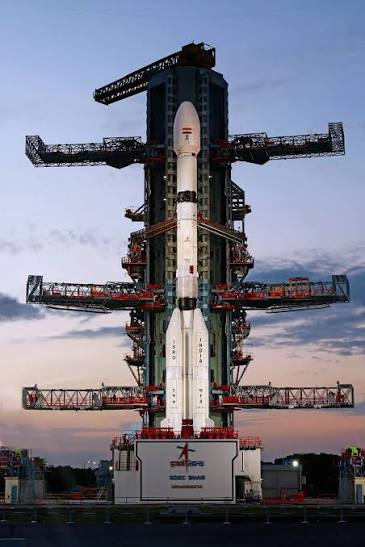
ISRO is scheduled to launch EOS-05, formerly known as GISAT-1A, using the GSLV-F17 (GSLV Mk II) from Sriharikota.
About EOS-05
- Developed by: Indian Space Research Organisation (ISRO)
- Former name: GISAT-1A
- Launch Vehicle: GSLV-F17 / GSLV Mk II
- Satellite Platform: I-2K
- Orbit: Geosynchronous Orbit
- Orbital altitude: Approximately 35,786 km
- Primary objective: Provide continuous geo-imaging of India and its surrounding regions.
Applications
EOS-05 is expected to strengthen India''s capabilities in:
- Disaster Management – monitoring floods, cyclones, landslides and other disasters.
- Agriculture – crop monitoring and assessment of agricultural conditions.
- Environmental Monitoring – observing changes in land, vegetation and environmental conditions.
- Resource Monitoring – supporting planning and management of natural resources.
Significance
- Enables frequent and continuous observation of a large geographical area.
- Provides timely satellite data for disaster response and management.
- Supports agricultural planning and environmental assessment.
- Strengthens India''s indigenous Earth-observation capabilities.
- Demonstrates the importance of geostationary/geosynchronous satellite systems for continuous regional monitoring.
|
|
India’s Hub-and-Spoke Aviation Strategy
GS III Science and technology
Why in News?
The Ministry of Civil Aviation has introduced a hub-and-spoke international aviation strategy, with Delhi envisaged as the initial major hub for consolidating international passenger traffic.
What is Hub-and-Spoke Model?
It is an aviation network in which:
- Hub: A major airport that acts as a central connecting point.
- Spokes: Regional airports that feed passengers into the hub.
Instead of operating direct international flights from every regional airport, passengers are consolidated at a major hub and then connected to international destinations.
How Does It Work?
- Regional Airport → Major Hub → International Destination
The model depends on:
- Through-ticketing: Single ticket for the connected journey.
- Through baggage handling: Baggage transferred to the final destination.
- Coordinated schedules: Arrival and departure timings are synchronised.
- Airside transit: Passengers can transfer without unnecessary terminal movement/formalities.
- Digital passenger verification: Facilitates smoother passenger processing.
Significance
- Improves Regional Connectivity : Passengers from Tier-2 and Tier-3 cities can gain better access to international destinations through the major hub.
- Strengthens Indian Aviation Hubs : It can help Indian airports develop into international gateways, increasing India''s role in global aviation networks.
- Reduces Dependence on Foreign Hubs : Currently, some international passengers from Indian cities may connect through foreign hubs.
- A stronger Indian hub network can: Retain passenger traffic within India → Strengthen Indian airlines and airports → Improve aviation competitiveness
- Economies of Scale : Concentrating passengers at major hubs allows airlines to operate higher-frequency and potentially more economically viable international routes.
- Supports Viksit Bharat 2047 : Efficient transport infrastructure is important for India''s broader objective of becoming a developed economy by 2047.
Challenges
- Airport Congestion at Major Hubs : Concentration of flights at a few major airports can lead to overcrowding, longer waiting times, runway congestion and operational delays.
- Excessive Dependence on Few Airports: Over-reliance on a limited number of hubs makes the aviation network vulnerable to disruptions caused by weather, technical failures, strikes or other emergencies.
- Slot Constraints : Limited take-off and landing slots at major international airports restrict airlines from adding new routes or increasing flight frequencies.
- Network-Wide Impact of Delays : Since hub-based aviation networks are interconnected, delays in one connecting flight can create a chain reaction across multiple routes..
Way Forward
- Develop Multiple International Hubs : Create a network of strong hubs across different regions instead of concentrating international traffic in a single city, improving resilience and balanced growth.
- Upgrade Airport Infrastructure : Expand terminals, runways, gates, baggage systems and other facilities to handle rising passenger and aircraft volumes efficiently.
- Strengthen Regional Connectivity: Improve air connectivity between regional airports and major cities to distribute traffic and integrate smaller markets into the national aviation network.
- Synchronise Flight Schedules : Coordinate domestic and international flight timings to reduce connection times and improve the efficiency of hub operations.
- Strengthen Digital Passenger Processing: Expand technologies such as biometric authentication, automated check-in, e-gates and digital baggage systems to reduce congestion and processing time
|
|
Insurance Goes Digital: Building a Federated Data Ecosystem
GS II – Governance + GS III – Economy
Why in News?
The Insurance Regulatory and Development Authority of India (IRDAI) has proposed establishing a Public Insurance Registry (PIR) as a Digital Public Infrastructure (DPI) for India''s insurance sector.
What is PIR?
- The Public Insurance Registry is envisaged as an interoperable information-exchange layer that allows authorised entities to discover, verify and share insurance-related information.
- Unlike a centralised database, the PIR would follow a federated architecture, where the original institutions continue to retain ownership and control of their data.
Key Features
- Federated architecture: Data remains with the respective source institutions.
- Interoperability: Different databases can communicate using common digital standards.
- Data ownership: Source institutions retain control over their records.
- Identity verification: Helps authenticate policyholders and relevant records.
- Consent-based access: Information is accessed only through authorised and consent-driven mechanisms.
- Cross-sector integration: Can potentially connect insurance information with:Vehicle databases, Health databases, Weather databases, Disaster-related databases, Court/legal databases
Significance
- Faster Claim Settlement : Verified information from multiple sources can reduce documentation and verification delays, enabling quicker insurance claims.
- Fraud Detection : Interoperable data can help identify Duplicate claims, False information, Suspicious patterns, Policy-related fraud
- Reduced Policy Duplication : A common information-exchange framework can help authorised entities identify multiple or duplicate insurance policies/records.
- Insurance Inclusion : Better digital infrastructure can make insurance services more accessible, particularly by reducing information and transaction barriers.
- Better Risk Assessment : Integration of data such as weather, health and disaster information can improve insurers'' ability to assess and manage risks.
- Data-Driven Policymaking : Aggregated and appropriately governed information can help regulators formulate evidence-based insurance policies.
Challenges
- Data Privacy and Security : Large-scale digital systems collect sensitive personal data, creating risks of data breaches, leaks and violation of individual privacy.
- Consent Management : Ensuring that users understand what data is collected, why it is used and who can access it is difficult, especially when multiple institutions are involved.
- Cybersecurity Risks : Increasing digitalisation expands the attack surface, making systems vulnerable to hacking, malware, ransomware and other cyber threats.
- Data-Quality Differences : Different institutions may follow different formats, standards and methods of data collection, leading to inaccurate, incomplete or inconsistent data.
- Unauthorised Access or Misuse : Weak access controls can allow sensitive information to be accessed or used beyond its intended purpose.
Way Forward
- Strong Data Governance : Establish clear rules for data collection, storage, sharing, retention and deletion, supported by robust privacy safeguards.
- Common Standards : Adopt uniform interoperability, data-format and cybersecurity standards to enable secure and seamless information exchange.
- Informed and Revocable Consent : Individuals should clearly understand how their data will be used and should have the ability to withdraw consent where applicable.
- Clear Institutional Accountability: Clearly define the roles and responsibilities of every participating agency to prevent responsibility gaps.
|
|
Measuring Growth Right: India’s GDP Debate
GS III – Economy
Why in News?
MoSPI defended India’s 7.8% real GDP growth in Q1 FY 2026–27, rejecting concerns that the growth rate was inflated because of changes in the GDP base year and methodology.
What is Double Deflation?
- Under the Double Deflation Method, output and intermediate inputs are deflated separately using appropriate price indices.
- Real GVA = Deflated Gross Output – Deflated Intermediate Consumption
This is particularly relevant when the prices of inputs and outputs move differently.
Key Economic Indicators
|
Indicator
|
Q1 FY 2026–27
|
|
Real GDP
|
₹81.36 lakh crore
|
|
Real GDP growth
|
7.8%
|
|
Nominal GDP growth
|
10.3%
|
|
Real GVA growth
|
8.2%
|
|
Manufacturing GVA growth
|
9.2%
|
|
Services growth
|
10.0%
|
|
Agriculture, Forestry & Fishing
|
3.6%
|
|
GFCF growth
|
11.9%
|
|
PFCE growth
|
7.1%
|
Why is Double Deflation Important?
- Provides a better estimate of real value addition.
- Separately captures changes in input and output prices.
- Particularly useful for manufacturing where input costs may rise faster than output prices.
- Reduces dependence on broad price proxies.
Significance of the 2022–23 Base Year
The revised national accounting framework:
- Introduces Producer Price Indices (PPI).
- Expands sectoral deflators to 300+ items.
- Incorporates modern services and digital-sector changes.
- Uses high-frequency economic indicators.
- Improves measurement of the changing structure of India''s economy.
Major Concerns
- Divergence between different price indices can create debates over the GDP deflator.
- Quarterly estimates may undergo subsequent revisions.
- Measurement of informal-sector activity remains challenging.
- Differences between production and expenditure approaches can create statistical discrepancies.
Way Forward
- Strengthen high-frequency input-price data.
- Improve integration of MCA21 and GST data.
- Increase transparency regarding GDP methodology.
- Conduct regular technical consultations with economists and stakeholders.
- Institutionalise periodic base-year revisions
|
|
Pichavaram Mangrove Ecosystem
GS III Environment
Why in News?
- A recent study estimated the Total Economic Value (TEV) of the Pichavaram mangrove ecosystem at approximately ₹2,485.38 crore, highlighting the significant economic and ecological services provided by mangroves.
- Location : Pichavaram → Cuddalore district → Tamil Nadu
- Located between: Vellar Estuary – North and Coleroon/Kollidam Estuary – South
- Forms part of the Vellar–Coleroon estuarine system.
- Connected to the Bay of Bengal through the coastal backwater-estuarine network.
Ecological Importance
- One of India''s important mangrove ecosystems.
- Acts as a blue-carbon sink, storing carbon in vegetation and waterlogged sediments.
- Provides a natural buffer against cyclones, storm surges and coastal erosion.
- Serves as a nursery and breeding ground for fish, prawns and crabs.
- Supports the livelihoods of local fishing communities.
- Provides habitat for diverse flora and fauna, particularly birds and aquatic species.
Protection Status
- Ramsar Site – 2022
- Recognised as an Important Bird Area (IBA).
- Important for migratory birds associated with the Central Asian Flyway.
Significance of Total Economic Value (TEV)
TEV captures not only the direct economic benefits of an ecosystem but also its wider ecological and social services.
For Pichavaram, these include:
- Fisheries + Carbon sequestration + Coastal protection + Tourism + Biodiversity + Livelihood support
- Thus, mangrove conservation can be viewed as an economic investment, not merely an environmental obligation.
Significance
- Climate mitigation: Carbon sequestration.
- Climate adaptation: Protection against cyclones and storm surges.
- Biodiversity conservation: Habitat and nursery grounds.
- Livelihood security: Supports fisheries and coastal communities.
- Natural infrastructure: Ecosystem services can reduce dependence on expensive artificial coastal protection.
Way Forward
- Strengthen mangrove restoration and protection.
- Promote community-based conservation.
- Prevent aquaculture, pollution and unplanned coastal development.
- Integrate mangroves into coastal disaster-management planning.
- Use Total Economic Valuation to incorporate ecosystem services into development decisions.
|
|
River Interlinking and India’s Water Security
GS III – Environment
Why in News?
River interlinking is being debated as a possible strategy to address India''s spatial and seasonal imbalance in water availability. While it can improve water availability in water-stressed regions, concerns exist regarding its ecological, social, economic and federal implications.
India''s River Interlinking Framework
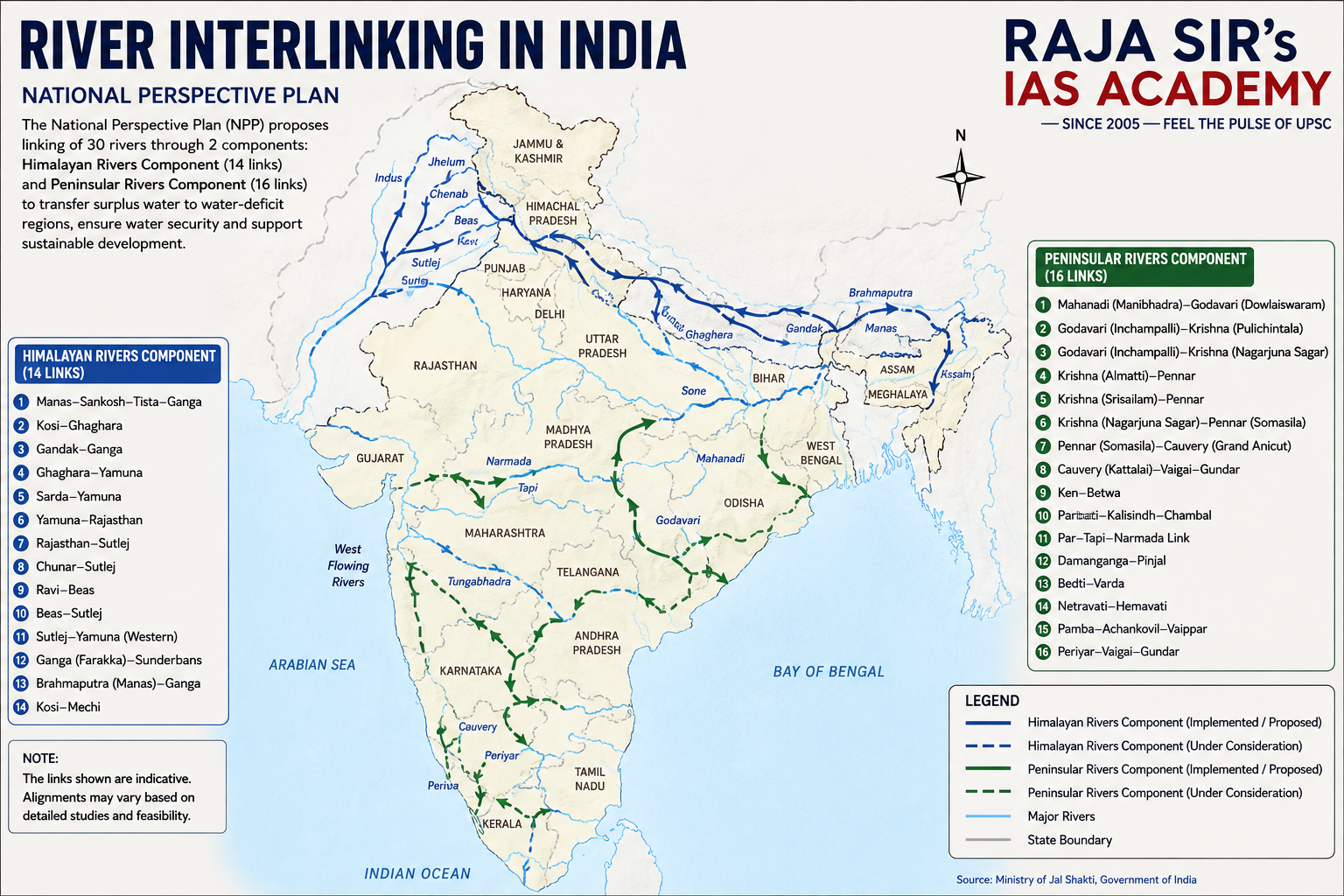
- National Perspective Plan (NPP): Introduced in 1980.
- Implementing agency: National Water Development Agency (NWDA).
- The NPP broadly envisages: 14 Himalayan river links 16 Peninsular river links Total: 30 links
What is River Interlinking?
It involves transferring water from a relatively water-surplus basin to a water-deficit basin through a network of: Dams, Reservoirs, Canals , Water-transfer systems.
Why is River Interlinking Controversial?
- Climate Uncertainty: Changing rainfall, floods, droughts and glacier melt can make the distinction between “surplus” and “deficit” basins unreliable.
- Ecological Impacts : Dams and canals can alter river flows, fragment habitats and disturb wetlands, aquatic ecosystems and sediment movement.
- Downstream Impacts : Reduced downstream flow can affect fisheries, deltas and estuaries, while increasing risks of coastal erosion and salinity intrusion.
- Displacement & Social Costs : Large projects may require land acquisition and displace farmers, rural and tribal communities.
- Inter-State Water Disputes : Water allocation, cost-sharing and downstream rights can create conflicts among states, requiring cooperative federalism.
- High Fiscal Burden : Huge investments are required for dams, canals, pumping systems, land acquisition and maintenance, raising questions of economic viability.
Sustainable Alternatives
- Watershed Development: Improves soil moisture, rainwater retention and groundwater recharge.
- Rainwater Harvesting : Stores local rainfall and reduces dependence on external water transfers.
- Micro-Irrigation : Drip and sprinkler systems improve water-use efficiency in agriculture.
- Crop Diversification : Promotes less water-intensive and climate-resilient crops.
- Wastewater Recycling : Treated wastewater can be reused for industry, landscaping and suitable agricultural purposes.
- Participatory Groundwater Management : Involves communities in regulating groundwater extraction and recharge.
- Decentralised Conservation : Check dams, farm ponds, wetlands and recharge structures strengthen local water security.
|
|
SCO 2.0: India in the Emerging Eurasian Order
GS II – International Relations
Why in News?
The 26th SCO Council of Heads of State Summit concluded in Bishkek, Kyrgyzstan, with the adoption of the Bishkek Declaration.
About SCO
- SCO: Shanghai Cooperation Organisation.
- It is a Eurasian regional organisation focusing on security, economic and developmental cooperation.
- India became a full member in 2017.
- Founding members: China, Kazakhstan, Kyrgyzstan, Russia, Tajikistan and Uzbekistan.
- India and Pakistan joined as full members in 2017.
Key Points
- Host: Bishkek, Kyrgyzstan.
- Summit Chair: Sadyr Japarov.
- Presidency: Handed over to Pakistan for 2026–27.
- Theme: “25 Years of the SCO: Together for Sustainable Peace, Development and Prosperity.”
Major Outcomes
- Counter-Terrorism : Condemned terrorism in all its forms and manifestations.
- Sovereignty & Territorial Integrity : Reaffirmed respect for sovereignty, territorial integrity and political independence of states.
- Not a Military Alliance: Its cooperation covers security, economic, cultural, technological and developmental areas.
- De-dollarisation / Local Currencies : This can reduce dependence on dominant international currencies and strengthen financial cooperation among member states.
- Connectivity : Support for major connectivity initiatives such as China–Kyrgyzstan–Uzbekistan (CKU) railway, International North-South Transport Corridor (INSTC)
- India''s relevance: Connectivity through Eurasia can strengthen India''s access to Central Asia and beyond.
Significance for India
- Eurasian Engagement : SCO provides India with an important platform to engage with Central Asia, Russia and China within a multilateral framework.
- Counter-Terrorism : The SCO''s focus on terrorism is particularly relevant to India''s security concerns.
- Connectivity to Central Asia : Initiatives such as the INSTC can help India overcome its geographical constraints in accessing Central Asian markets.
- Strategic Autonomy : SCO participation supports India''s approach of multi-alignment and strategic autonomy, allowing engagement with multiple power centres.
- Multipolarity : The SCO reflects the emergence of a more multipolar Eurasian order, in which emerging and established powers cooperate through regional institutions.
|
|
Status of the World’s Soil Resources 2026
GS III – Environment
Why in News?
The FAO’s Status of the World’s Soil Resources 2026 assessed major threats to global soil resources using evidence from 75 countries.The report highlights the growing concern over soil biodiversity loss and deterioration of sustainable soil-management practices.
What is Soil Biodiversity?
Soil biodiversity refers to the variety of living organisms present in soil and their interactions with one another and with the soil environment.
Major Components
- Bacteria
- Fungi
- Archaea
- Protozoa
- Nematodes
- Earthworms
- Arthropods
Why is Soil Biodiversity Important?
- Soil organisms perform essential ecological functions such as: Decomposition → Nutrient Cycling → Soil Formation → Plant Growth → Ecosystem Productivity
- They also contribute to: Soil fertility, Organic matter decomposition, Nutrient availability, Carbon storage, Water infiltration, Disease suppression, Plant productivity
Key Findings
- Soil Biodiversity Loss : Loss of soil biodiversity ranked fourth among seven major threats to soil resources.
- Intensive Agriculture : Certain intensive agricultural practices can adversely affect soil habitats, including: Excessive irrigation, Heavy machinery use, Excessive fertiliser application, Pesticide use
- Declining Sustainable Management : A significant share of regional assessments indicates deterioration in sustainable soil-management practices.
Why Soil Biodiversity Matters for India?
- Agriculture : Healthy soil organisms support nutrient cycling and crop productivity.
- Food Security : Soil degradation can reduce the long-term productive capacity of agricultural land.
- Climate Change : Healthy soils can act as important carbon reservoirs, while degradation can reduce their carbon-storage potential.
- Water Security : Good soil structure improves infiltration and water-holding capacity.
- Sustainable Agriculture : Soil biodiversity is a foundation for reducing excessive dependence on chemical inputs.
Global Soil Partnership (GSP)
The Global Soil Partnership (GSP) was established by FAO in 2012.
Objectives
- Promote sustainable soil management.
- Strengthen soil governance.
- Maintain healthy and productive soils.
- Support ecosystem services.
- Contribute to food security.
- Support climate action.
|
|
Totaliser Machine in EVM Vote Counting
GS II Governance
Why in News?
The Supreme Court has sought the Centre’s response on the proposal to introduce totalisers for counting votes recorded in Electronic Voting Machines (EVMs).
What is a Totaliser?
- A totaliser is a device/system that aggregates votes from multiple EVMs before displaying the results.
- Instead of immediately revealing the result of each individual polling station, votes from several polling stations are combined.
- This makes it difficult to identify the voting pattern of a particular polling booth.
Why is it Needed?
- Protects secrecy of voting: Prevents easy identification of the voting preference of a particular booth.
- Reduces post-election intimidation: Candidates or groups may otherwise identify areas that voted against them.
- Protects vulnerable voters: Particularly relevant in areas where voters may face social or political pressure.
- Promotes free choice: Strengthens the principle of secret ballot.
- Historical precedent: Similar aggregation was possible in the paper-ballot system.
- Law Commission support: The 255th Report (2015) supported the use of totalisers in appropriate circumstances.
Concerns
- Booth-wise transparency: Aggregation may make it more difficult to immediately know booth-level results.
- Verification: Questions may arise regarding reconciliation with Form 17C and VVPAT records.
- Transparency vs Privacy: Excessive aggregation could affect the ability to scrutinise electoral results, while insufficient aggregation may compromise voter privacy.
- Legal framework: Its implementation would require appropriate statutory, technical and procedural safeguards.
|