|
Antwerp to Atmanirbhar
GS-II – International Relations
Why in News?
The Belgian Prime Minister’s visit to India aims to deepen bilateral cooperation beyond trade into defence, semiconductors, clean energy, investment, counter-terrorism and logistics.
Key Areas of Cooperation
- Trade: Target to double bilateral trade in five years.
- Defence: Defence-industrial cooperation, co-development and co-production.
- Semiconductors: Collaboration between Indian institutions/start-ups and Belgium’s advanced semiconductor ecosystem.
- Clean Energy: Cooperation in green hydrogen, offshore wind and energy storage.
- Security: Cooperation against terrorism, organised crime and cyber threats.
- Logistics: Belgium’s strategic ports and logistics infrastructure can strengthen India–Europe connectivity.
Why Belgium Matters to India?
- European Gateway: Important link to European markets and supply chains.
- Port & Logistics Hub: Antwerp-Bruges is a major European maritime and logistics centre.
- Technology Partner: Expertise in semiconductors, biotechnology, research and clean technology.
- Defence Partner: Scope for co-development, co-production and defence supply chains.
- EU Linkage: Belgium can contribute to strengthening India’s engagement with the European Union.
|
|
BIO-NIVESH and India’s Biotech Capital Push
GS-III – Science & Technology
Why in News?
The Ministry of Science & Technology launched BIO-NIVESH to connect biotechnology startups with investors and facilitate private investment in biotech innovation.
Objective
To mobilise private capital for biotechnology innovations that are ready for:
- Scale-up
- Commercialisation
- Market deployment
Key Features
|
Feature
|
Details
|
|
Purpose
|
Connect biotech startups with investors
|
|
Focus
|
Scale-up, commercialisation & market deployment
|
|
Engagement
|
Two-way startup–investor interaction
|
|
For Startups
|
Understand investor expectations & investment perspectives
|
|
For Investors
|
Understand scientific, regulatory & development pathways
|
|
Inaugural Edition
|
20 biotechnology/deep-tech startups
|
|
Investors
|
Around 50
|
|
Ministry
|
Ministry of Science & Technology
|
How BIO-NIVESH Works
Biotech Research → Startup/Innovation → Investor Connect → Private Capital → Scale-up → Commercialisation → Market Deployment
Significance
- From Lab to Market : Helps translate scientific research into commercially viable products.
- Private Capital Mobilisation : Reduces excessive dependence on government funding for scaling innovative technologies.
- Deep-Tech Ecosystem :Supports capital-intensive and technologically complex biotechnology/deep-tech ventures.
- Better Investor–Scientist Understanding : Enables investors to assess scientific feasibility, regulatory requirements and development timelines.
- Strengthens Bioeconomy : Can contribute to India''s biotechnology ecosystem, innovation capacity, employment and economic growth.
Way Forward
- Strengthen public–private partnerships in biotech.
- Improve access to patient capital for long-gestation technologies.
- Simplify regulatory pathways while maintaining safety standards.
- Expand technology-transfer and incubation mechanisms.
- Improve industry–academia–startup linkages.
|
|
Digital Farmer, Data-Driven Agriculture
GS-III – Agriculture
Why in News?
Telangana received ₹599 crore in central incentives for achieving milestones under AgriStack.
What is AgriStack?
- Digital Public Infrastructure (DPI) for agriculture.
- It is a key component of the Digital Agriculture Mission, approved in September 2024.
Aim: To create a reliable digital ecosystem connecting farmers, land, crops and agricultural services.
Three Foundational Registries
|
Registry
|
Purpose
|
|
Farmer Registry
|
Provides a digital identity through Farmer ID, linked with agricultural records.
|
|
Crop Sown Registry
|
Maintains a digital record of crops sown by farmers.
|
|
Geo-referenced Village Map Registry
|
Provides land- and location-linked geographical infor
|
Farmer ID
- Links farmer information with: Land records, Crops, Livestock, Demographic information,
Government schemes & benefits
Target: 11 crore farmers.
Potential Benefits
- Farmer ID + verified agricultural data → targeted & faster service delivery
- Paperless crop loans
- Faster crop-insurance settlement
- Better input availability
- Pest/disease advisories
- DBT delivery
- MSP procurement
Implementation
- Foundational registries are created and maintained by States/UTs.
- Farmer Registry: Target — March 2027
- Northeastern States: March 2028
- Geo-referenced Village Maps: March 2027
Significance
- Digitalisation of agriculture: Moves agricultural service delivery towards data-driven governance.
- Financial inclusion : Verified farmer data can facilitate easier access to formal agricultural credit.
- Risk management : Better crop information can improve crop-insurance processes.
- Targeted welfare : Enables more efficient delivery of DBT and agricultural schemes.
- Precision agriculture :Crop and location data can support advisories on pests, diseases and inputs.
- Market integration : Can improve the efficiency of MSP procurement and other agricultural services.
Concerns
- Data privacy and consent
- Accuracy and updating of land/crop records
- Digital divide and limited digital literacy
- Interoperability between different State databases
- Exclusion risks if farmer records are incomplete or incorrect
Way Forward
- Build AgriStack on the principles of consent-based data sharing, interoperability, data accuracy, cybersecurity and assisted access for digitally vulnerable farmers.
|
|
Global Bond Sell-Off
GS-III – Indian Economy
Why in News?
- Global sovereign bond markets are witnessing increased selling pressure, resulting in falling bond prices and rising bond yields.
- Basic Concept: Bond Price and Bond Yield
The relationship between bond price and bond yield is inverse.
- When the price of an existing bond falls, its yield increases.
- When the price of an existing bond rises, its yield decreases.
Why does this happen?
- Suppose a bond gives a fixed annual interest of ₹50.
- If you buy that bond for ₹1,000, your return is 5%.
- If the same bond''s market price falls to ₹800, you still receive ₹50.
- Now ₹50 is a larger return relative to the ₹800 purchase price.
- Therefore, when bond prices fall, yields rise.
Why are Investors Selling Bonds?
- High Government Borrowing – More government borrowing means more bonds in the market, which can put downward pressure on prices.
- Inflation Concerns – Inflation reduces the real value of fixed interest payments.
- Higher Interest Rates – Investors may prefer new bonds offering higher interest rates over older bonds with lower coupons.
- Geopolitical Uncertainty – Higher energy prices can increase inflation expectations and bond yields.
Impact on India
- Government: Higher bond yields mean the government may have to pay more to borrow.
- Corporates: Government bond yields influence market borrowing rates, so companies may also face higher borrowing costs.
- Foreign Portfolio Investors: If advanced economies offer higher bond yields, investors may shift money there, potentially putting pressure on the rupee.
- Economic Growth: Higher borrowing costs can discourage private investment and consumption.
|
|
India’s Nuclear Energy Technology Transition
GS-III – Science & Technology
Why in News?
India is expanding nuclear energy to support energy security, clean electricity, industrialisation and the net-zero transition.
- Nuclear Energy Mission: Target of 100 GW nuclear capacity by 2047.
- Focus on indigenous Small Modular Reactors (SMRs).
India’s Three-Stage Nuclear Programme
|
Stage
|
Reactor
|
Fuel / Material
|
Main Objective
|
|
I
|
PHWR (Pressurised Heavy Water Reactor)
|
Natural Uranium
|
Generate electricity + produce Plutonium-239
|
|
II
|
Fast Breeder Reactor (FBR)
|
Plutonium-based fuel + Uranium-238
|
Generate electricity + breed more fissile material
|
|
III
|
Thorium-based reactors
|
Thorium-232 → Uranium-233
|
Utilise India’s abundant thorium resources for long-term nuclear energy
|
Nuclear Fuel Cycle
- Stage I: Natural Uranium → PHWR → Electricity + Pu-239
- Stage II: Pu-239 + U-238 → FBR → More fissile material
- Stage III: Th-232 → U-233 → Electricity
Why Nuclear Energy?
- Low-carbon: Helps reduce dependence on fossil fuels.
- Reliable power: Provides continuous electricity with high capacity utilisation.
- Energy security: Diversifies India’s energy mix.
- Industrial decarbonisation: Can support steel, chemicals, hydrogen, desalination and other energy-intensive sectors.
Major Challenges
- Economic: High capital costs, long construction periods and financing risks.
- Technological: Complex development of FBRs, thorium systems and SMRs.
- Safety: Accident risks, radiation concerns and radioactive-waste management.
- Fuel: Limited domestic uranium resources for long-term requirements.
Recent Policy Direction
- Nuclear Energy Mission: Target of 100 GW nuclear capacity by 2047.
- SMRs: Focus on indigenous designs such as BSMR-200 (220 MWe) and SMR-55 (55 MWe).
- SHANTI Act, 2025: Aims to enable wider private-sector participation in nuclear energy.
Way Forward
- Nuclear Safety: Strengthen independent regulation and emergency preparedness.
- Indigenous Technology: Promote domestic reactor technology and R&D.
- Waste Management: Ensure safe long-term radioactive-waste storage and disposal.
- Domestic Supply Chain: Build indigenous manufacturing and skilled manpower.
- SMRs: Deploy SMRs where technically and economically viable.
- Public Trust: Ensure environmental safeguards, transparency and public participation.
|
|
Northern Goshawk
GS-III – Environment & Biodiversity
Why in News?
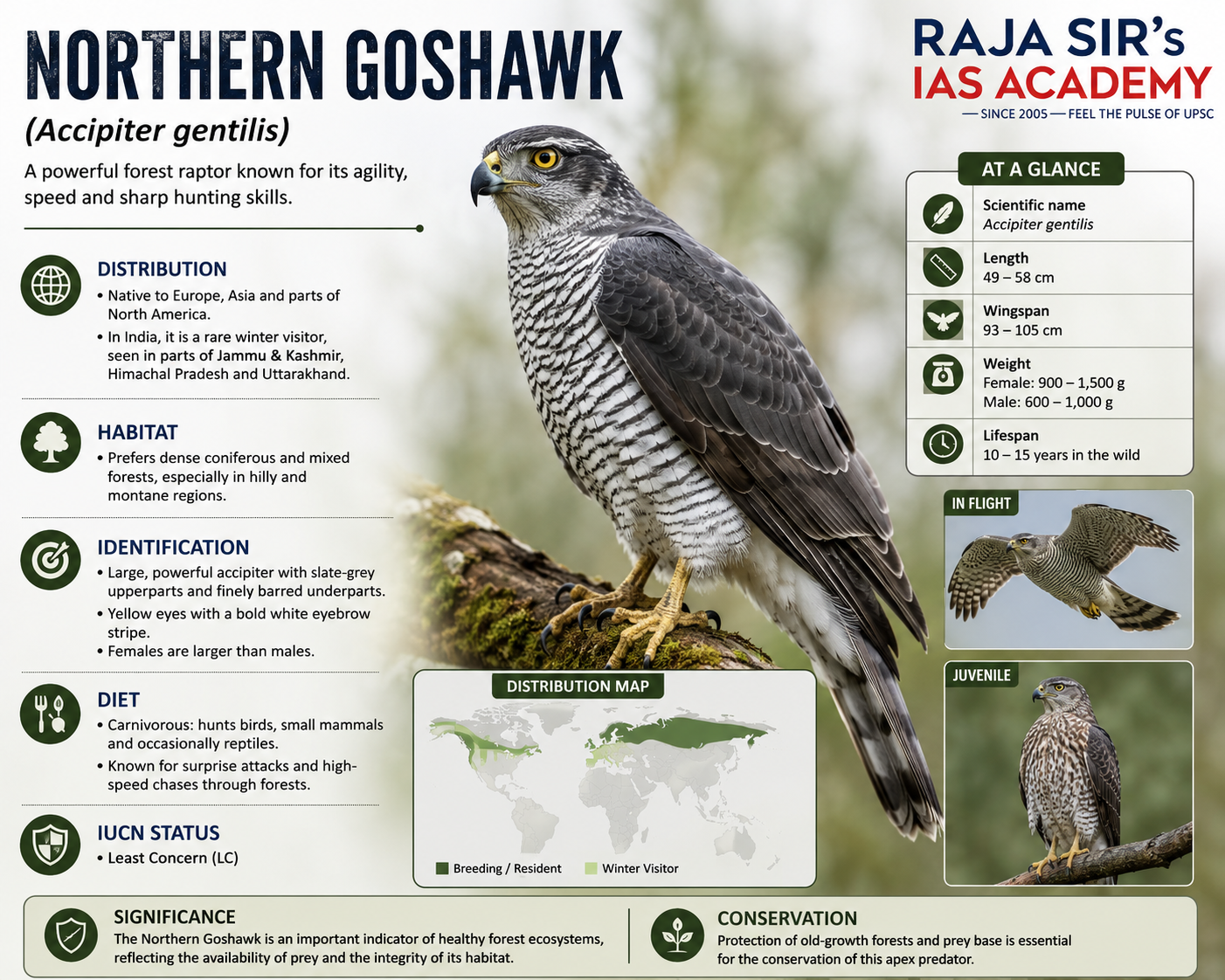
The Northern Goshawk is in news as the State Bird of Punjab.
Key Facts
|
Feature
|
Details
|
|
Scientific name
|
Accipiter gentilis
|
|
Family
|
Accipitridae
|
|
Distribution
|
Europe, Asia and parts of North America
|
|
Habitat
|
Dense coniferous and mixed forests
|
|
IUCN Status
|
Least Concern (LC)
|
|
Nature
|
Large and powerful bird of prey
|
|
Wings & Tail
|
Short, broad wings; long tail
|
|
Sexual dimorphism
|
Females larger than males
|
|
Behaviour
|
Generally solitary or in pairs
|
|
Activity
|
Diurnal and territorial
|
|
Hunting strategy
|
Perch hunting
|
|
Migration
|
Partial migrant
|
Key Characteristics
- A powerful forest raptor adapted for hunting in dense woodland.
- Its short, broad wings and long tail provide manoeuvrability through forests.
- Primarily hunts from a concealed perch, detecting prey and launching rapid attacks.
- Shows strong territorial behaviour, particularly during breeding.
- Some populations are resident, while others undertake seasonal movements.
|
|
Osbeckia ulotricha
GS-III – Environment & Biodiversity
Why in News?
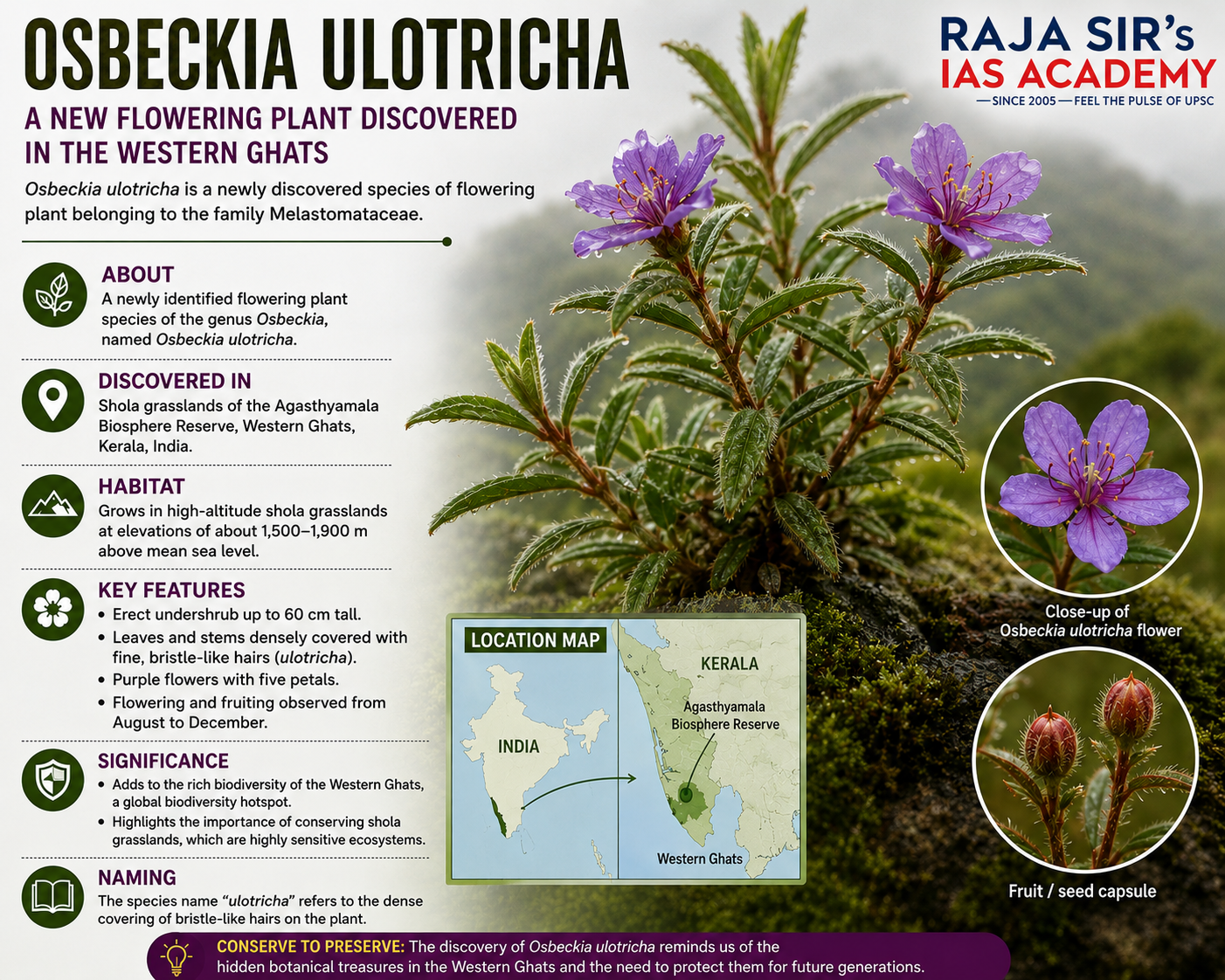
Botanical Survey of India (BSI) has discovered a new flowering plant species, Osbeckia ulotricha, in the Agasthyamala Biosphere Reserve (ABR) of the Western Ghats.
Key Facts
|
Feature
|
Details
|
|
Scientific name
|
Osbeckia ulotricha
|
|
Family
|
Melastomataceae
|
|
Habitat
|
Shola–grassland ecosystem
|
|
Elevation
|
1,200–1,500 m
|
|
Distribution
|
Endemic to the Agasthyamala region
|
|
Morphology
|
Woolly-haired; clustered leaves; urn-shaped hypanthium
|
|
Flowering/Fruiting
|
February–May
|
|
Region
|
Western Ghats
|
Why is it Important?
- Highlights the high floral diversity and endemism of the Western Ghats.
- Shola–grassland ecosystems act as important habitats for endemic and specialised mountain flora.
- Discovery of new species strengthens the case for habitat protection and biodiversity conservation.
- BSI plays an important role in plant exploration, identification, documentation and conservation in India.
Agasthyamala Biosphere Reserve (ABR)
- Location: Southern Western Ghats; spans Kerala and Tamil Nadu.
- UNESCO: Part of the UNESCO World Network of Biosphere Reserves since 2016.
Major ecosystems:
- Tropical evergreen forests
- Semi-evergreen forests
- Moist deciduous forests
- Montane forests
- Shola–grassland ecosystems
Important Rivers
- Thamirabarani
- Neyyar
- Karamana
Important Protected Areas
- Kalakkad–Mundanthurai Tiger Reserve
- Neyyar Wildlife Sanctuary
- Peppara Wildlife Sanctuary
- Shendurney Wildlife Sanctuary
Significance of discovering endemic plant species:
- Biodiversity hotspot conservation : underscores the exceptional species richness of the Western Ghats.
- Endemism : geographically restricted species are particularly vulnerable to habitat degradation.
- Ecosystem protection : conserving shola–grassland habitats protects specialised montane biodiversity.
- Scientific documentation : new discoveries improve India''s taxonomic and ecological knowledge base.
- Conservation planning : species-level information can strengthen habitat-specific conservation strategies.
Way Forward
- Strengthen long-term botanical surveys and taxonomic research.
- Protect fragile shola–grassland ecosystems from habitat fragmentation and land-use change.
- Integrate local communities into biodiversity conservation.
- Improve ex-situ and in-situ conservation of endemic flora.
- Strengthen monitoring of biodiversity impacts from climate change and invasive species.
|
|
RAKSHA – Defence Diplomacy Document
GS-II – International Relations / GS-III – Defence & Security
Why in News?
The Defence Minister released RAKSHA, a strategic document providing a 10-year roadmap for India’s global defence partnerships.
Aim
To transform defence diplomacy from ad-hoc military engagement into a long-term strategic instrument for:
- Strategic partnerships
- Capacity building
- Defence exports
- Maritime security
- Strategic autonomy
Key Pillars
- Strategic Partnerships: Deepen bilateral and multilateral defence cooperation.
- Capacity Building: Expand military exercises, training, institutional exchanges and best-practice sharing.
- Defence Exports: Promote Make in India and position India as a defence manufacturing and export hub.
- Maritime Security: Strengthen India as a Net Security Provider and First Responder, particularly in the Indian Ocean Region.
Significance
- Strategic: Strengthens India’s position amid geopolitical competition.
- Economic: Defence exports → foreign exchange + industrial growth + employment + technology absorption.
- Diplomatic: Defence cooperation can strengthen wider bilateral relations.
- Maritime: Supports India’s vision of a free, open and secure Indian Ocean.
Way Forward
- Defence Manufacturing: Link defence diplomacy with domestic production.
- Co-development: Expand joint development and co-production.
- Interoperability: Improve compatibility among partner armed forces.
- Defence Diplomacy: Strengthen the role of defence attaches.
- Training: Expand military training and institutional partnerships.
- Strategic Autonomy: Build partnerships without creating excessive strategic dependence.
|
|
Reverse Vaccinology
GS-III – Science & Technology / Biotechnology
Why in News?
Scientists are using reverse vaccinology for developing a vaccine against pneumonia.
What is Reverse Vaccinology?
- A genome-based vaccine development approach that uses genomics, bioinformatics and computational tools to identify potential vaccine targets.
- Instead of studying the pathogen first to find antigens, scientists begin with its genome and computationally predict suitable antigen candidates.
Mechanism
- Genome Sequencing → Computational Antigen Identification → Protein Expression → Screening → Animal Testing → Vaccine Development
|
Feature
|
Details
|
|
Approach
|
Genome-based vaccine development
|
|
Key tools
|
Genomics, bioinformatics, computational analysis
|
|
Coined by
|
Rino Rappuoli (2000)
|
|
Firstsuccessful application
|
Serogroup B Neisseria meningitidis (MenB)
|
|
Other applications
|
Bacillus anthracis, Streptococcus pneumoniae, Mycobacterium tuberculosis
|
Conventional vs Reverse Vaccinology
|
Conventional Vaccinology
|
Reverse Vaccinology
|
|
Starts with the pathogen
|
Starts with the genome
|
|
Identifies antigens through laboratory study
|
Predicts potential antigens computationally
|
|
Antigen → Testing → Vaccine
|
Genome → Antigen prediction → Testing → Vaccine
|
|
More dependent on culturing and experimental screening
|
Reduces dependence on initial culture-based antigen discovery
|
Significance
- Faster target identification : computational screening can rapidly examine large numbers of proteins.
- Useful for difficult-to-culture pathogens : genome information can help identify targets without relying entirely on conventional culture-based approaches.
- Precision : enables identification of pathogen proteins likely to trigger an immune response.
- Supports emerging-disease preparedness : genomic data can accelerate early-stage vaccine research.
Limitations
- Computational prediction does not guarantee immunogenicity.
- Candidate antigens require laboratory, animal and clinical validation.
- Genomic variation among pathogen strains can affect vaccine effectiveness.
- Requires strong genomic databases, bioinformatics capacity and laboratory infrastructure.
|
|
The Golden River and Its Eastern Journey
GS-I – Indian Geography / GS-III – Disaster Management & Water Resources
Why in News?
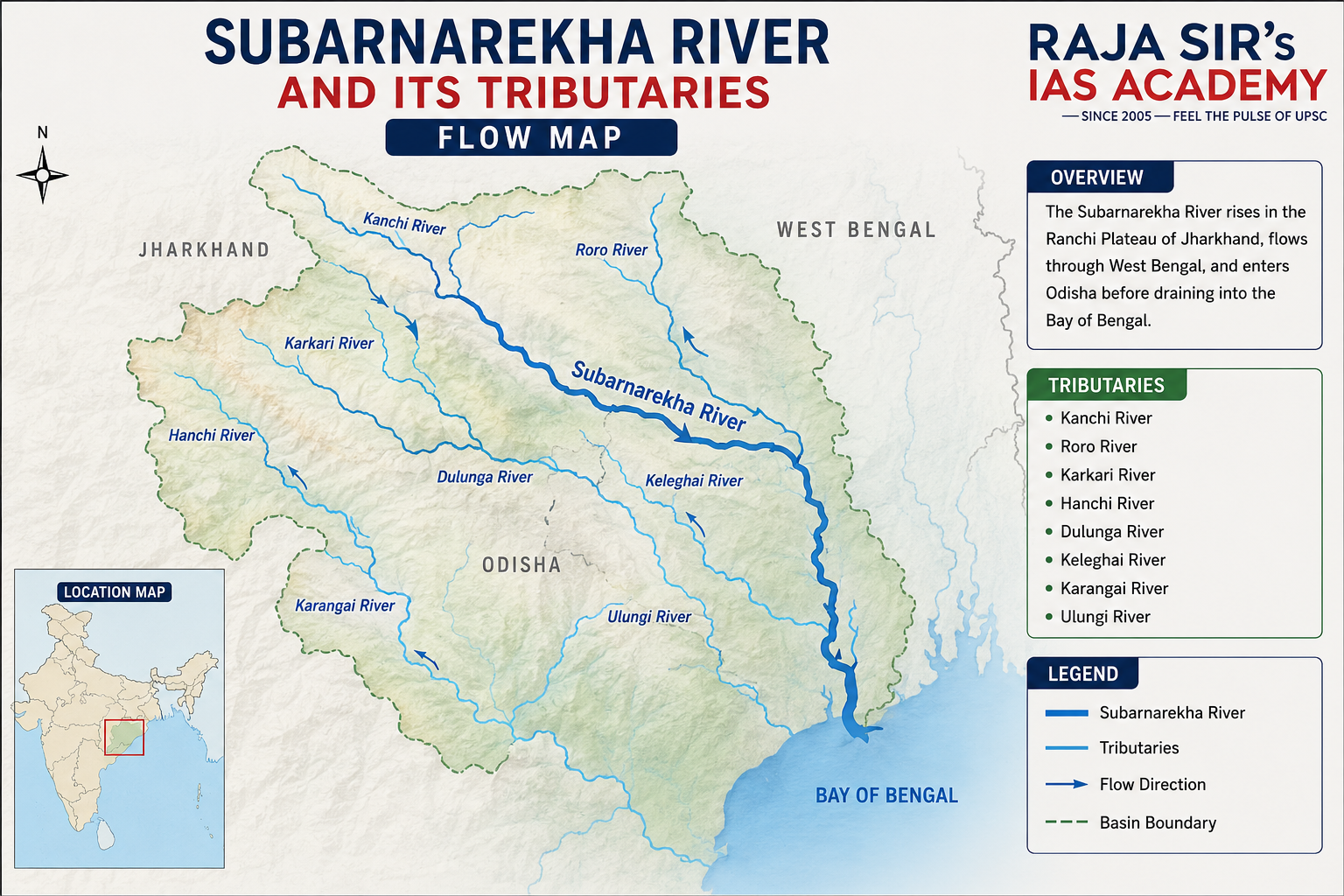
Flooding occurred in Odisha after the Subarnarekha River breached its banks.
|
Feature
|
Details
|
|
Type
|
East-flowing Peninsular river
|
|
Origin
|
Near Nagri, Ranchi district, Jharkhand
|
|
States
|
Jharkhand → West Bengal → Odisha
|
|
Physiography
|
Flows through the Chhotanagpur Plateau
|
|
Mouth
|
Bay of Bengal
|
|
Meaning
|
“Streak of gold”
|
|
Special Feature
|
Historically associated with gold particles in its riverbed
|
Tributaries
Kanchi
- Originates in the Ranchi region of Jharkhand.
- Joins the Subarnarekha within Jharkhand.
Kharkai
- Flows through the Jamshedpur region.
- Joins the Subarnarekha at Jamshedpur/Sonari.
- Kharkai → Subarnarekha → Bay of Bengal
Karkari
Basin
|
Direction
|
Feature
|
|
North
|
Damodar Basin
|
|
South
|
Brahmani & Baitarani Basins
|
|
West
|
Chhotanagpur Plateau
|
|
East / Southeast
|
Bay of Bengal
|
Important Projects
Getalsud Reservoir Jharkhand
- Located on the Subarnarekha River near Ranchi.
- Important for water supply and irrigation.
- Major water source for the Ranchi region.
Chandil Dam Jharkhand
- Built across the Subarnarekha River near Chandil.
- Important component of the Subarnarekha Multipurpose Project.
- Associated with: Irrigation, Water regulation, Flood management, Hydropower/water-resource development
Galudih Barrage Jharkhand
- Constructed on the Subarnarekha River.
- Associated with the Subarnarekha Multipurpose Project.
- Mainly facilitates water diversion and irrigation.
Dam vs Barrage
- Dam → Primarily stores and regulates water.
- Barrage → Mainly regulates/diverts river water through gates.
Icha Dam Jharkhand
- Associated with the Subarnarekha Multipurpose Project.
- Intended primarily for irrigation and water-resource development.
|