|
Building a Circular Rural Waste Economy
GS Paper III – Environment
Why in News?
Rural India is witnessing a shift from mainly biodegradable waste to plastic, sanitary and other non-biodegradable waste.
Major Issues
- Infrastructure Gap : Poor waste collection, segregation, transportation and processing facilities.
- Governance Gap : Gram Panchayats often have limited technical expertise and financial resources.
- Behavioural : Poor source segregation and continued open dumping/burning reduce the effectiveness of waste management.
- Economic Gap : Dispersed settlements and low population density make door-to-door collection and transportation relatively expensive.
Why is Rural Waste Different?
- Dispersed settlements: Villages are spread over large areas.
- Low density: Smaller waste volumes make centralised systems less economical.
- Local dependence: Panchayats and community institutions play a greater role.
- Limited processing: Recycling and treatment facilities are often located far from villages.
Significance
- Water Pollution: Dumping can contaminate groundwater and surface water.
- Soil Degradation: Plastic and untreated waste affect soil quality.
- Air Pollution: Open burning releases harmful pollutants.
- Plastic Leakage: Waste can enter rivers, agricultural fields and ecosystems.
- Health Risks: Poor sanitation and waste accumulation increase public-health concerns.
Way Forward
- Gram Panchayats: Strengthen financial and technical capacity.
- SHGs: Involve them in collection and awareness activities.
- Local recyclers: Integrate kabadiwalas into formal recycling systems.
- Community participation: Promote behavioural change and source segregation.
- Social audits: Improve accountability.
- Digital monitoring: Track collection, processing and disposal.
|
|
Cotton Under Pressure: Pest, Climate and Value-Chain Challenges
GS Paper III – Agriculture & Economy
Why in News?
India is facing declining cotton production, with shrinking acreage in the northern cotton belt and increasing vulnerability to pests and climate variability.
Major Causes
- Pest Resistance : Pink Bollworm and Whitefly infestations reduce cotton yield and quality.Repeated pesticide use can further contribute to pest resistance.
- Bt Cotton Fatigue : Continuous cultivation of Bt cotton has contributed to the emergence of resistant pest populations.
- Climate Change : Erratic rainfall and prolonged dry spells adversely affect crop growth.Untimely rainfall during boll bursting can damage fibre quality and reduce yields.
- High Production Costs : Cotton requires significant labour for picking, increasing cultivation costs Rising prices of pesticides, fertilisers and other inputs reduce farmer profitability.
- Water and Cropping Incentives : In northern states, paddy procurement and subsidised electricity/irrigation can make rice more attractive than cotton.
- Soil Degradation : Monocropping and imbalanced fertiliser use can reduce soil fertility.
Impacts
- Farmer Income : Lower yields and higher input costs can reduce farm profitability.
- Import Dependence : Falling domestic production may increase India''s dependence on cotton imports.
- Textile Industry : Reduced availability of domestic cotton can create raw-material pressure for textile manufacturers.
- Export Competitiveness : Higher production costs and inconsistent quality can weaken India''s position in the global cotton value chain.
- Consumer Costs : Shortages and higher raw-material prices may increase textile and garment costs.
Way Forward
- Climate-Resilient Varieties : Develop cotton varieties resistant to drought, heat, pests and diseases.
- Integrated Pest Management : Combine biological control, crop rotation, resistant varieties and judicious pesticide use.
- Balanced Nutrient Management : Promote soil testing and balanced application of nutrients to restore soil health.
- Efficient Irrigation : Expand drip irrigation, water conservation and efficient irrigation practices in cotton-growing regions.
- Mechanisation : Promote mechanical cotton harvesting to reduce labour costs and dependence on manual picking.
- Integrate Farmers with Textile Value Chains : Strengthen linkages between farmers, ginners, spinners, textile manufacturers and exporters to ensure better price realisation.
|
|
Deepening Democracy in the High Himalayas
GS Paper II – Polity & Governance
Why in News?
LAHDC framework expanded to all seven districts of Ladakh, extending elected local governance to newly created districts.
What are LAHDCs?
- Elected statutory bodies for decentralised governance in Ladakh.
- Promote local participation in development and resource management.
Background
- LAHDC Leh: Established in 1995.
- LAHDC Kargil: Established in 2003.
- Model influenced by the Darjeeling Gorkha Hill Council.
Significance
- Grassroots Democracy : Brings decision-making closer to remote communities.
- Localised Development : Enables planning suited to high-altitude and difficult terrain.
- Resource Management : Facilitates local participation in managing land, water, forests and pastures.
- Cultural Preservation : Supports protection of local traditions, languages and heritage.
- Inclusive Governance : Helps balance development, local aspirations and fragile Himalayan ecology.
Challenges
- Limited Financial Autonomy: Dependence on UT funds restricts independent local development. Administrative Overlap: Overlapping roles between LAHDCs and UT administration can delay decisions.
- Inadequate Devolution: Limited transfer of powers weakens effective decentralisation.
- Difficult Terrain: High-altitude terrain and scattered settlements make service delivery costly and difficult.
- Development–Ecology Conflict: Tourism and infrastructure expansion can threaten Ladakh’s fragile ecosystem.
Way Forward
- 3Fs Devolution: Provide adequate Funds, Functions and Functionaries to strengthen councils.
- Fiscal Autonomy: Enhance councils’ ability to mobilise and manage financial resources.
- Clear Jurisdiction: Define responsibilities between LAHDCs and UT administration.
- Grassroots Strengthening: Empower Gram Panchayats and other local institutions.
- Sustainable Planning: Involve communities and adopt ecologically sensitive development.
|
|
India’s EV Transition
GS Paper III – Economy, Energy & Environment
Why in News?
- ICCT study: Faster EV adoption + domestic battery manufacturing could reduce India’s annual oil and battery import bill by up to $125 billion by 2050.
- EV battery demand may reach ~573 GWh annually by 2050.
Core Issue
EV adoption alone can reduce oil dependence, but may increase dependence on batteries and critical minerals, whereas EV adoption combined with localisation can reduce import dependence while strengthening domestic manufacturing.
Significance
- Oil Import Reduction : EVs reduce petroleum consumption and crude imports. Reduces exposure to global oil-price volatility.
- Energy Security : Lowers vulnerability to geopolitical disruptions in oil-producing regions.
- Atmanirbhar Bharat : Domestic battery production reduces dependence on imported cells and components.
- Industrial Growth : Promotes battery cells, BMS, power electronics, EV components and recycling.
- Climate Benefits : Supports transport decarbonisation and India''s climate goals.
Way Forward
- Domestic cell manufacturing : Scale up battery production.
- Battery recycling : Build a circular economy.
- Critical minerals : Diversify overseas and domestic supply.
- Alternative chemistries : Reduce dependence on scarce minerals.
- EV components : Strengthen domestic supply chains.
- Renewable charging : Link EV growth with clean electricity.
- Charging network : Expand beyond major cities.
|
|
India’s Geothermal Energy Frontier
GS Paper III – Energy & Environment
Why in News?
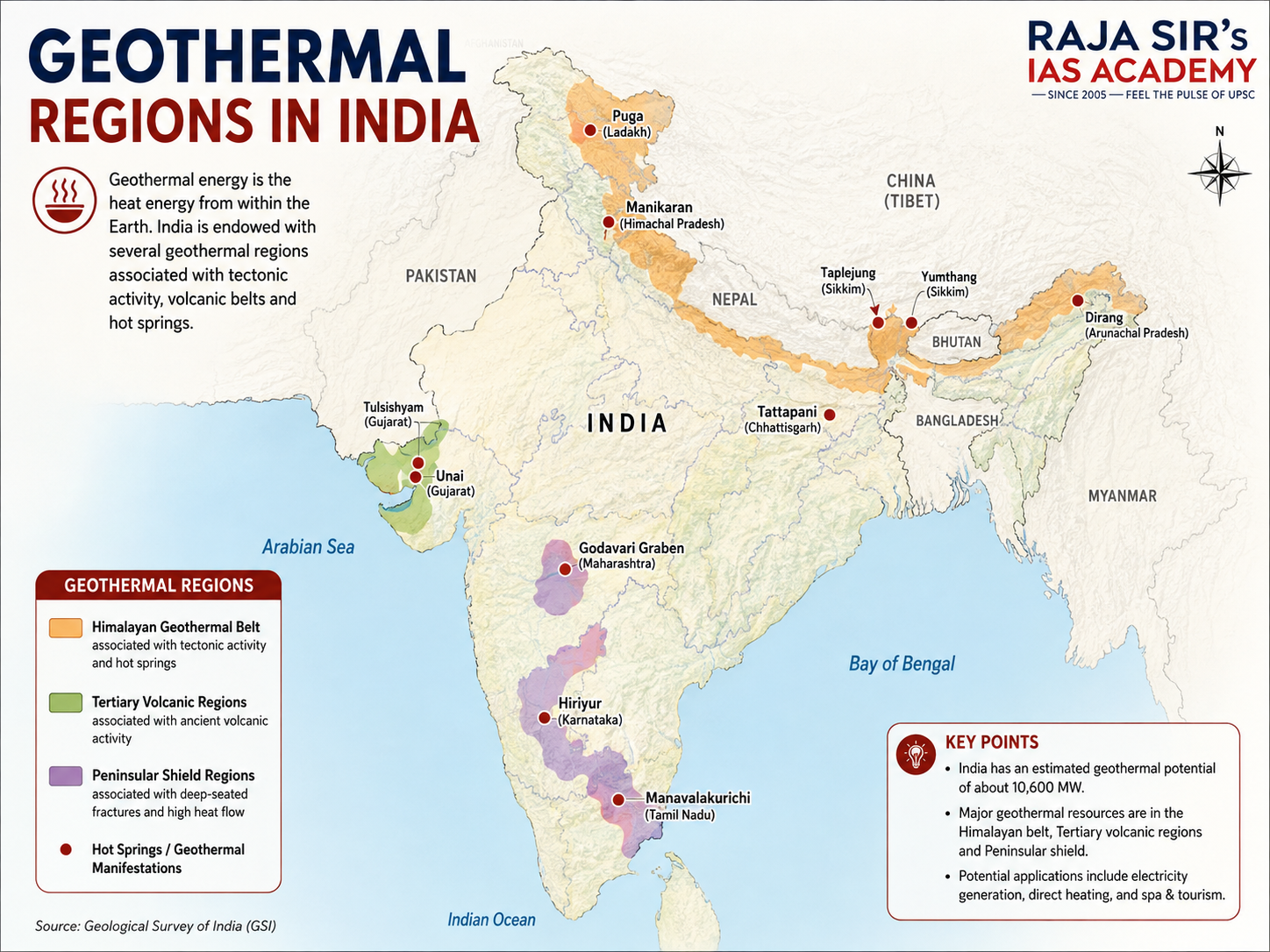
India has taken a significant step in geothermal energy with the commissioning of two 1,000-metre-deep geothermal wells in Puga Valley, Ladakh, supporting the development of a 1 MW demonstration-scale geothermal power plant.
What is Geothermal Energy?
- Energy derived from the Earth’s internal heat.
Heat originates from:
- Primordial heat retained from Earth''s formation.
- Radioactive decay of elements such as uranium, thorium and potassium.
- In tectonically active regions, groundwater circulates through fractures, gets heated and forms geothermal reservoirs.
India’s Geothermal Potential
- GSI estimates India''s theoretical geothermal potential at around 10.6 GW.
- Around 381 hot springs have been mapped across 10 geothermal provinces.
Important regions include
- Himalayan Province
- Naga-Lusai Belt
- Andaman & Nicobar
- SONATA Lineament
- Cambay Graben
- Aravalli Province
- Mahanadi Basin
- Godavari Basin
- South Indian Cratonic Region.
Why is it Significant for India?
- Baseload Renewable Energy : Unlike solar and wind, geothermal can provide round-the-clock electricity. Reduces dependence on battery storage for renewable balancing.
- Energy Security : Can reduce dependence on imported fossil fuels. Particularly useful in remote and strategically important regions.
- Border Infrastructure : Geothermal energy can replace diesel generators in Ladakh and other Himalayan regions. Improves energy security in difficult terrain.
- Decarbonisation : Supports India''s Net Zero 2070 objective. Provides a relatively low-carbon source of firm renewable power.
- Multiple Applications : Geothermal heat can support: Space heating/cooling, Greenhouses, Aquaculture, Food processing, Fruit drying, Cold chains, Tourism and balneotherapy.
- Critical Minerals : Geothermal brines can potentially contain lithium, boron, cesium and rubidium. Thus, geothermal development can complement India''s critical-mineral strategy.
Challenges
- High drilling cost: Deep drilling requires costly equipment and technology.
- Reservoir uncertainty: Difficult to predict underground temperature, permeability and resource size.
- Logistical constraints: Remote/high-altitude sites increase transport and construction costs.
- Corrosion & scaling: Minerals in geothermal fluids damage equipment and reduce efficiency.
- Fluid disposal: Improper disposal can contaminate soil and groundwater.
- Induced seismicity: EGS may trigger minor earthquakes due to fluid injection.
- Technology gap: Limited indigenous geothermal drilling and power-generation technologies.
Way Forward
- Viability Gap Funding: Reduce financial risks of exploratory drilling.
- PPPs: Combine government support with private investment and expertise.
- Reuse abandoned wells: Convert old oil/gas wells for geothermal heat extraction.
- Use ONGC/OIL data: Integrate existing geological data with geothermal mapping.
- Promote EGS & closed-loop systems: Expand geothermal access beyond conventional reservoirs.
- Indigenous technology: Develop domestic drilling, heat-exchanger and turbine technologies.
- Environmental standards: Ensure safe fluid reinjection, groundwater protection and seismic monitoring.
|
|
Language in Judiciary
GS Paper II – Polity & Constitution
Why in News?
The Tamil Nadu Legislative Assembly passed a resolution seeking recognition of Tamil as the principal language of the Madras High Court.
Constitutional Provision — Article 348
Article 348(1): General Rule
- Proceedings in the Supreme Court and High Courts are generally conducted in English.
- Authoritative texts of Bills, Acts, Ordinances, Orders, Rules and Regulations are also generally in English.
Article 348(2): State Language
- The Governor of a State may authorise the use of Hindi or another official language of the State in High Court proceedings.
- Prior consent of the President is mandatory.
Significance
- Access to Justice: Use of the local language can make court proceedings more accessible to litigants who are not proficient in English.
- Substantive Equality: Language accessibility can strengthen equal access to justice, particularly for economically and educationally disadvantaged sections.
- Cooperative Federalism: Article 348(2) recognises the role of States in determining the language of their High Court proceedings, subject to Presidential consent.
- Cultural and Linguistic Federalism: Allowing regional languages in constitutional institutions can strengthen India’s linguistic diversity and federal spirit.
- Judicial Participation: Lawyers, litigants and witnesses may participate more effectively when proceedings are available in a familiar language.
Challenges
- Authoritative Legal Texts: Maintaining consistency between English and regional-language versions of judgments, laws and legal terminology can be difficult.
- All-India Legal Mobility: English facilitates communication among judges and lawyers from different States.
- Translation Infrastructure: Large-scale, accurate and legally reliable translation requires specialised human and technological capacity.
- Precedential Uniformity: Supreme Court judgments and constitutional jurisprudence are predominantly available in English, creating a need for reliable translations.
Way Forward
- India can adopt a multilingual judicial framework by expanding high-quality legal translation, developing standardised legal terminology in Indian languages, using AI-assisted translation with human verification, and ensuring that English versions remain authoritative where constitutionally required.
|
|
Small Islands as Strategic Oceans
GS Paper II – International Relations
Why in News?
PIF is significant amid geopolitical competition in the Pacific and debates over Taiwan’s regional participation.
What is PIF?
- Major regional organisation of Pacific countries.
- Established in 1971 as South Pacific Forum.
- Renamed Pacific Islands Forum in 1999.
- Headquarters: Suva, Fiji.
Significance
- Climate Diplomacy: Represents highly vulnerable island states facing sea-level rise, extreme weather and ocean warming.
- Indo-Pacific Geopolitics: Pacific islands occupy strategically important maritime spaces.
- Maritime Security: Important for fisheries, sea lanes and ocean governance.
- Collective Bargaining: Provides small island states greater diplomatic influence.
- Great-Power Competition: Increasing engagement by China, US, Australia, New Zealand and Japan.
Importance for India
- Supports India’s SAGAR vision and Indo-Pacific approach.
- Strengthens climate diplomacy and development partnerships.
- Promotes maritime cooperation with Pacific Island Countries.
- FIPIC provides an important platform for India–Pacific cooperation.
Challenges
- Great-Power Rivalry: Pacific islands face pressure from competing external powers.
- Climate Vulnerability: Rising seas and extreme weather threaten livelihoods and territory.
- Economic Constraints: Small economies limit development capacity.
- Internal Differences: Divergent interests can affect regional consensus.
- Inclusiveness Issues: Disagreements over participation of external entities can create tensions.
Way Forward
- Development Partnership: Support infrastructure, health and digital connectivity.
- Climate Resilience: Focus on adaptation, disaster preparedness and climate finance.
- Capacity Building: Provide technology, skills and institutional support.
- Maritime Cooperation: Strengthen fisheries management, maritime security and ocean governance.
|
|
The Legacy of Dr. Sarvepalli Radhakrishnan
GS Paper I – Indian History & Culture
Why in News?
September 5 is celebrated as Teachers’ Day in India to commemorate the birth anniversary of Dr. Sarvepalli Radhakrishnan, one of India’s most prominent philosophers, educationists and statesmen.
His life represents the convergence of Indian philosophical thought, modern education, public administration and diplomacy.
Who was Dr. Sarvepalli Radhakrishnan?
- Born: 5 September 1888
- Birthplace: Tiruttani, present-day Tamil Nadu
- Profession: Philosopher, educationist, academic and statesman
- He played an important role in presenting Indian philosophy to the Western world.
- He emphasised the role of education in developing moral, intellectual and responsible citizens.
Academic and Philosophical Contributions
- Promotion of Indian Philosophy : Radhakrishnan was a major interpreter of Indian philosophical traditions, particularly Vedanta. He argued that Indian philosophy was not merely religious speculation but contained systematic philosophical thought.
- East–West Intellectual Dialogue : His writings sought to establish a dialogue between Indian philosophical traditions and Western philosophy.
Contributions to Higher Education
University Education Commission, 1948–49
- Radhakrishnan chaired the University Education Commission (1948–49).
- It was constituted to examine the condition of university education in newly independent India.
The Commission emphasised
- Improvement in quality of higher education.
- Better standards of teaching and research.
- Importance of teacher quality.
- Development of universities as centres of intellectual and national development.
- Promotion of research and academic freedom.
Political and Constitutional Career
- First Vice-President of India
- Radhakrishnan became the first Vice-President of India.
- Tenure: 1952–1962.
- He also served as the ex-officio Chairman of the Rajya Sabha.
Second President of India
- He became the second President of India.
- Tenure: 1962–1967.
- His presidency coincided with a challenging period in India''s history, including the 1962 India–China War and the 1965 India–Pakistan War.
Diplomatic Contributions
- Ambassador to the Soviet Union
- Radhakrishnan served as India''s Ambassador to the Soviet Union.
- His intellectual stature and philosophical background helped strengthen India''s diplomatic engagement with the Soviet Union during the early years of the Cold War.
UNESCO
- He was associated with UNESCO and its educational and cultural activities.
- His involvement reflected his broader belief in education and cultural exchange as instruments of international understanding.
Bharat Ratna
- Radhakrishnan was awarded the Bharat Ratna in 1954.
- He was among the early recipients of India''s highest civilian award.
|
|
The Rise of Privacy-Preserving Identity Verification
GS Paper II – Governance & GS Paper III – Science & Technology
Why in News?
Punjab School Education Board became the first school education board, and Maharishi Dayanand University, Rohtak the first university, to onboard UIDAI’s OVSE framework.
What is OVSE?
- UIDAI framework enabling offline identity verification through digitally verifiable credentials.
- Verification occurs without directly querying the Central Identities Data Repository (CIDR).
Key Features
- Offline Verification: Identity can be verified without real-time database access.
- User Consent: Verification requires the individual’s consent.
- Selective Sharing: Only required identity information is shared.
- No CIDR Query: Avoids direct real-time access to the central database.
- Digital Signature: Credentials can be cryptographically verified.
- Privacy-Preserving: Minimises unnecessary disclosure of personal data.
- Less Paperwork: Reduces dependence on physical certificates and photocopies.
Significance
- Privacy by Design: Limits unnecessary exposure of personal information.
- Reduced Fraud: Digitally signed credentials are difficult to tamper with.
- Administrative Efficiency: Useful for admissions, examinations, recruitment and certificate verification.
- Offline Capability: Enables verification even with limited connectivity.
|