


India-Brazil Increases Bilateral Trade Target to $30 Billion
- PM Modi and Brazilian President Lula da Silva met on the sidelines of the AI Impact Summit in New Delhi to elevate strategic ties against rising global trade protectionism.
Key Outcomes of the Meeting
- Trade Target: India and Brazil set a bilateral trade target of $30 billion by 2030, doubling the current $15 billion in trade.
- Aviation Facility: Brazilian aviation firm Embraer, in partnership with Adani Defence & Aerospace, will set up an assembly line and an MRO facility in India for its E175 regional jets.
- T Mazagon Dock Shipbuilders, the Indian Navy, and the Brazilian Navy signed a tripartite agreement to exchange technical data about the shared fleet of Scorpene-class submarines.
- Regulator MoU: India’s CDSCO and Brazil’s ANVISA signed an MoU to increase affordable Indian generic medicine supply to Brazil.
About Critical Mineral Pact
- Supply Diversification: India signed a critical minerals MoU with Brazil to diversify the supply of rare earths, lithium, graphite, niobium, and nickel for its steel, defence, and EV sectors.
- Resource Leverage: Brazil holds 94% of global niobium reserves, is the world’s second-largest iron ore producer, and has major manganese and rare earth deposits.
- Steel Supply: A dedicated steel-sector MoU will channel Brazilian iron ore, manganese, and nickel to help India achieve a 300 MT steel production target by 2030.
- Upstream Access: The mineral pact allows Indian firms to acquire mining assets, develop processing hubs, and conduct joint geoscientific exploration in Brazil.
- Battery Security: It seeks to secure a long-term supply of lithium and graphite to insulate India’s electric vehicle ecosystem from global price volatility.
Overview of India-Brazil Trade Relations
- Trade Scale: Brazil is India’s largest trading partner in Latin America, with bilateral trade crossing $15 billion for the first time in 2025.
- Trade Basket: India exports refined petroleum, agrochemicals, and pharmaceuticals, while importing crude petroleum, raw sugar, and soybean oil.
- Mercosur Expansion: Both countries are negotiating the expansion of the India-Mercosur PTA (2004) to remove agricultural non-tariff barriers and open South American markets to Indian exporters.
- MSME Access: A recently signed bilateral agreement on postal services and digital trade aims to streamline cross-border logistics for Indian MSMEs entering the Brazilian market.
India Recorded a Fourfold Increase in Organ Transplants
- Source (PIB): India has witnessed a fourfold increase in organ transplants, rising from under 5,000 procedures in 2013 to nearly 20,000 in 2025.
- Donation Gap: Despite this growth, India’s deceased organ donor rate remains below 1 per million, far behind Spain’s ~48 donors per million.
Organ Donation and Transplantation Framework in India
- Foundational Law: The Transplantation of Human Organs and Tissues Act (THOTA), 1994, regulates organ removal and transplantation.
- National Programme: The National Organ Transplant Programme (NOTP) promotes deceased donation through a three-tier national, regional, and state network.
- Consent Barrier: India operates an opt-in system where explicit family approval is legally mandatory for deceased donation, regardless of prior individual pledges.
- Digital Registry: The Aadhaar-linked National Organ and Tissue Transplant Registry facilitates transparent, secure registration of donation pledges nationwide.
- Eligibility Reforms: Under the 2023 reforms, the upper age limit and the state domicile requirement for recipient registration were both removed.
Organ Donation and Transplantation Landscape in India
- Transplant Volume: India ranks third globally (after the U.S. and China) in total organ transplants, with nearly 20,000 procedures in 2025.
- Deceased Share: Only 18% of transplants use deceased donor organs. India depends on living donors for the remaining 82%.
- Regional Skew: Of India’s 1,128 deceased donors in 2024, the vast majority were from southern and western states. Tamil Nadu has the highest share.
- Registration Surge: Over 4.8 lakh citizens have registered their intent to donate organs after death since September 2023.
- Surgical Leadership: India leads the world in the number of hand transplants performed. It has achieved competence in complex heart, lung, and pancreas procedures.
About National Organ and Tissue Transplant Organisation (NOTTO)
- NOTTO is the apex body overseeing organ procurement and allocation, under the Directorate General of Health Services, Ministry of Health & Family Welfare (MoHFW).
- Core Mandate: It coordinates procurement, equitable real-time allocation, and inter-state distribution of retrieved organs across India.
- Organ Registry: Its National Organ and Tissue Transplant Registry maintains waiting list data for all patients, ensuring transparency and patient traceability.
- Biomaterial Centre: NOTTO houses the National Biomaterial Centre, which supplies bone products, skin grafts, and corneas to address tissue shortages.
Satellite Phone
- Security agencies have flagged the illegal use of undeclared satellite communication devices by vessels in Indian waters, citing national security concerns.
What is a Satellite Phone?
- A satellite phone (satphone) is a communication device that connects directly to orbiting satellites instead of terrestrial mobile towers, enabling communication in remote or off-grid areas such as oceans, deserts, and disaster zones.
How Does It Work?
- The phone sends signals to a satellite in orbit, which relays them to ground stations or other users.
- Communication occurs through either Geostationary (GEO) or Low Earth Orbit (LEO) satellite systems.
- It requires a clear line-of-sight to the sky for effective transmission.
Key Features:
- Global/Remote Coverage: Works where cellular networks are unavailable (oceans, mountains, polar regions).
- Reliable Emergency Communication: Widely used for distress and safety operations (e.g., maritime GMDSS).
- Basic Functions: Voice calls, SMS, and limited data services.
- Resilience: Functions even during natural disasters when terrestrial networks fail.
- Hybrid Devices: Some modern models combine cellular + satellite connectivity.
Limitations:
- High Cost: Expensive devices and high per-minute call charges.
- Limited Data Speed: Mostly suited for voice/text; not high-speed internet.
- Line-of-Sight Requirement: Poor performance indoors or in dense terrain.
- Signal Delay: GEO satellites cause noticeable communication lag.
- Security Concerns: Difficult monitoring and tracing in certain regions, leading to regulatory restrictions.
The Linear No-Threshold (LNT) Model
- The U.S. Department of Energy (DOE) recently removed the ALARA principle from its radiation safety directives, marking a major shift in nuclear safety policy.
- This move has triggered global debate because international bodies still rely on the Linear No-Threshold (LNT) model as the foundation of radiation protection standards.
About The Linear No-Threshold (LNT) Model:
- The LNT model is a risk assessment framework used to estimate the health risks of ionizing radiation. It posits that there is no safe level of radiation; even the smallest dose carries a statistical risk of causing biological damage or cancer.
- Origin: The concept emerged in the late 1920s following Hermann Muller’s research on radiation-induced mutations in fruit flies. It was formally adopted by the ICRP in the 1950s and 60s as a cautious approach during the Cold War.
- Aim: Its primary goal is to provide a precautionary baseline for regulatory standards, ensuring that public health is protected even when scientific data on very low doses is uncertain.
Mechanism and Features:
- Linearity: The risk of harm (specifically stochastic effects like cancer) increases in direct proportion to the dose received.
- Zero-Threshold: Unlike many toxins, there is no floor or threshold below which radiation is considered harmless.
- Cumulative Risk: It assumes that the biological impact of small doses over time adds up, rather than the body fully repairing all damage.
About The ALARA Principle:
Definition:
- ALARA stands for As Low As Reasonably Achievable. It is the operational wing of the LNT model. Since LNT says any radiation is risky, ALARA mandates that we shouldn’t just meet a legal limit, but should strive to keep exposure as low as possible, provided it is practical and cost-effective.
Key Features:
- The Reasonable Balance: It requires a trade-off between safety gains and socio-economic costs. If a safety measure costs millions to save a negligible fraction of a dose, it might not be reasonably achievable.
Three Pillars of Protection:
- Time: Spending less time near a source.
- Distance: Increasing the space between the worker and the source.
- Shielding: Using barriers like lead or concrete.
- Continuous Improvement: It fosters a safety culture where facilities constantly seek better engineering controls and training.
The International Energy Agency (IEA)
- The International Energy Agency (IEA) ministerial meeting in Paris signalled that India’s bid for full membership has entered its final stages.
About The International Energy Agency (IEA):
- The International Energy Agency (IEA) is an intergovernmental organisation that works to ensure global energy security, reliable energy data, and sustainable energy policies.
- It acts as a major global platform for energy analysis, policy guidance, and emergency energy cooperation.
- Established In: 1974 in the wake of the 1973 oil crisis (Arab oil embargo).
- Headquarters: Paris, France.
- Aim: To help industrialized nations coordinate a collective response to major oil supply disruptions and ensure energy security.
Membership Structure:
- Full Members: Currently 33 countries (Colombia was inducted as the 33rd member in February 2026).
- Historically, a country must be a member of the OECD (Organisation for Economic Co-operation and Development) to join.
- Association Countries: 13 countries, including India, China, Brazil, and South Africa. These countries participate in discussions but lack decision-making rights.
Key Functions:
- Energy Security: Maintains a Strategic Petroleum Reserve mechanism where members must hold oil stocks equivalent to at least 90 days of net imports.
- Data & Analysis: Publishes the World Energy Outlook and the Monthly Oil Market Report, considered the gold standard for energy statistics.
- Energy Transition: Leads global efforts on climate change, renewables, and decarbonization through the Net Zero by 2050 roadmap.
- Critical Minerals: Recently launched a program to secure supply chains for minerals (lithium, cobalt) essential for clean energy.
India and the IEA:
- Timeline: India became an Associate Member in 2017 and signed a Strategic Partnership in 2021.
- The October 2023 Request: India formally applied for full membership to have a seat at the table in global energy decision-making.
The OECD Hurdle:
- India is not a member of the OECD and has no immediate plans to join.
- For India to become a full member, the IEA must amend its 1974 founding charter—a move the IEA leadership and major members now support to reflect India’s status as the world’s 3rd largest energy consumer.
New Delhi Declaration – AI Impact Summit 2026
- The AI Impact Summit concluded in New Delhi with 89 countries and international organizations endorsing the New Delhi Declaration.
- This landmark agreement establishes a global framework for “AI for All,” focusing on equitable access, ethical governance, and social empowerment.
About New Delhi Declaration – AI Impact Summit 2026:
- The New Delhi Declaration is a comprehensive, multi-nation consensus document aimed at governing the development and deployment of Artificial Intelligence.
- Grounded in the philosophy of “Sarvajan Hitaya, Sarvajan Sukhaya” (Welfare for all, Happiness for all), it serves as a non-binding roadmap for international AI cooperation.
- Aim: The declaration seeks to bridge the AI Divide by ensuring that foundational AI resources, such as computing power and data, are not concentrated in a few nations but are democratized for global economic growth and social good.
Key Features of the Declaration:
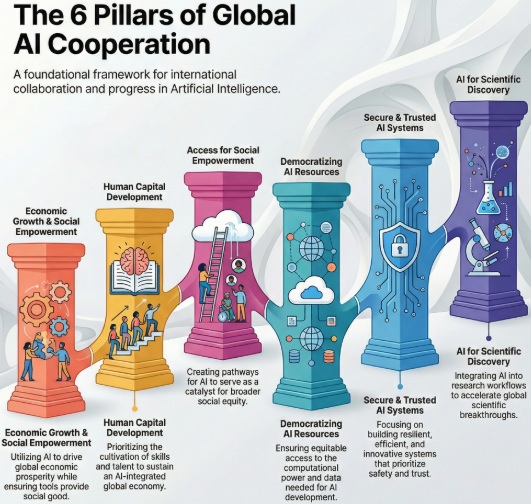
- Seven Pillars (Chakras) Framework: Built around seven pillars including democratizing AI resources, secure AI, human capital development, AI for science, and resilient AI systems.
- Global Collaborative Platforms: Launch of initiatives like Global AI Impact Commons, Trusted AI Commons, and AI for Social Empowerment Platform to enable shared learning and innovation.
- Global AI Impact Commons
- A voluntary global platform designed to help countries share and replicate successful AI solutions.
- It enables adoption and scaling of proven AI use-cases across regions to maximize development impact.
- Trusted AI Commons
- A voluntary, non-binding collaborative repository that brings together AI tools, benchmarks, technical resources, and best practices.
- It helps stakeholders build secure and trustworthy AI systems adaptable to different national contexts.
- International Network of AI for Science Institutions
- A voluntary collaborative network connecting scientific institutions worldwide to pool AI research infrastructure and expertise.
- Its objective is to accelerate scientific innovation through AI-enabled research collaboration across countries.
- Democratic Diffusion of AI Charter: Promotes affordable access to foundational AI resources and supports locally relevant innovation ecosystems.
- Focus on Trusted & Secure AI: Encourages voluntary technical standards, benchmarks, and best practices for safe AI deployment.
- Human Capital & Reskilling: Introduces AI workforce development playbook and guiding principles for reskilling in an AI-driven economy.
- Energy-efficient & Resilient AI: Emphasizes sustainable AI infrastructure and efficient systems to reduce energy and resource pressures.
- Multistakeholder & Sovereignty-based Approach: Balances global cooperation with respect for national laws and policy frameworks.
Significance:
- Global Governance Milestone: Represents one of the largest multilateral consensuses on AI, with 89 countries aligning on shared AI principles.
- India’s Leadership in AI Diplomacy: Positions India as a key voice shaping inclusive AI governance through the philosophy of Sarvajan Hitaya, Sarvajan Sukhaya.
Galapagos giant tortoise reintroduction
- The Galapagos National Park released 158 hybrid giant tortoises onto Floreana Island to help restore its delicate ecosystem.
- These juvenile tortoises carry significant DNA from the Chelonoidis niger, a species that had been considered extinct for 150 years.
About The Galapagos Islands:
- The Galapagos is an extraordinary volcanic archipelago consisting of 19 main islands and over 100 islets.
- Location: Situated in the Pacific Ocean, approximately 1,000 km (620 miles) west of the Ecuadorian coast.
- Geological Origins: Formed by volcanic activity at the confluence of three tectonic plates (Nazca, Cocos, and Pacific).
Key Features:
- Evolutionary Hub: Known as a living museum of evolution, it famously inspired Charles Darwin’s theory of natural selection.
- Endemic Species: Home to species found nowhere else, including marine iguanas, blue-footed boobies, and the iconic giant tortoises.
- UNESCO Heritage: Designated as a Natural World Heritage Site in 1978 for its unique biodiversity.
Hybrid Giant Tortoises: What it is?
- These are tortoises with mixed ancestry. While the original Floreana species (Chelonoidis niger) was hunted to extinction by the mid-19th century, scientists discovered hybrid descendants on Wolf Volcano (Isabela Island).
IUCN Status:
- Extinct in the Wild (Parent Species): The pure Chelonoidis niger is technically extinct.
- Conservation Status: The genus Chelonoidis as a whole is generally classified as Endangered or Critically Endangered by the IUCN.
- Conservation Goal: Through a selective breeding program, these hybrids (carrying 40%–80% original DNA) are being used to resuscitate the ecological role of the extinct species.
Key Characteristics:
- Ecological Engineers: They shape the landscape by dispersing seeds, clearing vegetation, and creating wallows that serve as micro-habitats for other animals.
- Saddlebacked Carapace: Unlike the dome-shaped shells of some other islands, Floreana-descended tortoises often have saddlebacked shells, an adaptation that allows them to lift their necks higher to reach tall cacti.
- Longevity & Resilience: Released between ages 8 and 13, these tortoises are large enough to survive potential threats from introduced rats and cats. They can live for over 100 years.
U.S. Supreme Court Struck Down President Trump’s Global Tariffs
- The U.S. Supreme Court struck down President Trump’s global tariffs imposed under the International Emergency Economic Powers Act (IEEPA).
U.S. Supreme Court Judgement
- Core Verdict: A 6-3 majority ruled that using IEEPA to impose global tariffs exceeded the executive branch’s constitutional authority.
- Constitutional Bar: The U.S. Constitution grants Congress the sole power to levy tariffs; the President cannot bypass this via emergency declarations.
- Statutory Limit: IEEPA permits regulating imports during emergencies, but does not grant authority to impose tariffs as revenue-raising instruments.
- False Emergency: Chronic trade deficits are a structural economic condition, not a foreign emergency that justifies IEEPA activation.
- Refund Mandate: Domestic importers are entitled to reclaim duties paid, exposing U.S. Customs and Treasury to refunds exceeding $175 billion.
About International Emergency Economic Powers Act (IEEPA)
- Emergency Powers: Enacted in 1977, IEEPA empowers the U.S. President to regulate international commerce and freeze foreign assets upon declaring a national emergency.
- Restraint Design: It was enacted to rein in unchecked presidential trade powers previously granted under the Trading with the Enemy Act, 1917.
- Narrow Application: Administrations have routinely used it for targeted sanctions against specific adversaries, including Iran and terrorist networks, but never for broad tariff regimes.
- Renewal Requirement: Each national emergency declared under IEEPA requires mandatory annual Presidential renewal to remain legally valid.
- Legislative Oversight: Congress must convene every six months to decide whether to end the declared emergency.
- Operational Reach: IEEPA forms the statutory foundation for U.S. sanctions and export controls, administered by the Office of Foreign Assets Control (OFAC).
President Trump Imposes 15% Global Import Surcharge under Trade Act, 1974
- Following the US Supreme Court’s invalidation of IEEPA tariffs, President Trump invoked the Trade Act of 1974 to impose a temporary 15% global import surcharge.
About New Global Tariff
- Implementation: Effective 24 February 2026, a 15% ad valorem tariff will be imposed globally under Section 122 of the Trade Act of 1974.
- Ad Valorem: An ad valorem tariff is a trade tax calculated as a fixed percentage of an imported good’s estimated value, not its weight or physical quantity.
- Strategic Exemptions: Critical minerals, agricultural goods, pharmaceuticals, and select vehicles are exempt to shield domestic supply chains from sudden import-driven inflation.
- Uniform Baseline: Unlike country-specific rates under IEEPA, the new directive imposes a flat, non-discriminatory surcharge on imports from all trading nations.
- India Impact: Indian exporters will now face a flat 15% tariff, a reduction from the 18% reciprocal rate previously set under IEEPA.
- Section 122 (US Trade Act, 1974): An emergency power letting the US President impose temporary import surcharges (up to 15%) and/or quotas to address a severe balance-of-payments problem or sharp dollar decline, with measures expiring after 150 days unless Congress extends them.
India Joins Board of Peace as an Observer
- India participated as an observer at the inaugural meeting of the U.S.-led Board of Peace in Washington, D.C.
- Observer Limits: As an observer, it can monitor proceedings and join discussions but cannot vote on resolutions or binding decisions.
- Strategic Calculus: India chose a calibrated observer role to maintain strategic autonomy without formally endorsing a platform that bypasses UN multilateralism.
About Board of Peace
- Davos Origin: The Board of Peace is a 27-member diplomatic bloc formally established at the January 2026 Davos summit.
- UN Bypass: It operates outside UN frameworks under Donald Trump’s permanent chairmanship.
- Membership Cost: Nations seeking permanent membership must make a mandatory $1 billion membership contribution.
- Gaza Mandate: Initially aligned with UNSC Resolution 2803 to oversee the Gaza peace plan, its mandate has since expanded to address broader global conflicts.
- Force Deployment: Member states contribute to an International Stabilisation Force comprising 20,000 soldiers and 12,000 police officers; the initial deployment is planned for Rafah.
Baglihar Hydropower Project
- Stage-I operations at the Baglihar hydropower project were temporarily suspended following minor flooding in the machine room.
- The Baglihar project is a major run-of-the-river power project on the Chenab River in the Ramban district of Jammu and Kashmir.
- The facility has a total capacity of 900 MW, developed in two 450 MW stages utilising natural river flows.
- It comprises a concrete gravity dam with about 475 million cubic metres of reservoir storage.
- The dam uses drawdown flushing technology to continuously remove heavy Himalayan silt.
India’s First Namo Bharat Regional Rapid Transit System (RRTS)
- PM Narendra Modi has inaugurated India’s first Namo Bharat Regional Rapid Transit System (RRTS).
- It is an 82 km high-speed, high-frequency rail corridor connecting Delhi, Ghaziabad, and Meerut.
- Implementing Agency: The National Capital Region Transport Corporation (NCRTC)—a joint venture of the Centre and the States of Delhi, Haryana, Rajasthan, and UP.
- Speed: The corridor has a design speed of 180 kmph and an operational speed of 160 kmph, reducing commute time to under an hour.
- Technology: It uses an advanced radio signalling system enabling real-time train control, closer headways, and better passenger safety without traditional signals.
- Multimodal Integration: It physically links to Indian Railways, local metros, and interstate bus terminals at hubs like Sarai Kale Khan.
- Interoperability: The design allows trains from different corridors (e.g., Alwar to Meerut) to share the same tracks without requiring passenger transfers.
- Operational Distinction: Unlike intra-city metros, the RRTS serves longer-distance regional commutes (up to 100 km) with significantly fewer stops.
- Significance: The project promotes polycentric development, reduces annual CO2 emissions by nearly 2.5 lakh tonnes, and advances ‘Nari Shakti’ by employing women as the majority of operators.
Vaan Island
- The decade-long deployment of artificial reefs on Tamil Nadu’s Vaan Island has generated socio-ecological benefits exceeding twice the project’s cost.
- Vaan Island, also known as Van Tivu or Church Island, is a small, uninhabited coral island in the Gulf of Mannar in Tamil Nadu.
- It is one of the 21 islands within the Gulf of Mannar Marine National Park.
- Waters surrounding the island host rich marine ecosystems, including coral reefs, seagrass beds, and diverse fish species.
- Coastal Erosion: Between 1969 and 2015, the island shrank from 20 hectares to 1.53 hectares (a 92% loss) due to extensive coral mining and sea-level rise.
- Restoration: Since 2015, scientists have deployed more than ten thousand reef modules. The “Vaan Model” halted coastal erosion and increased the land area by over 2.3 hectares by early 2026.
About Gulf of Mannar
- It is a shallow inlet of the Indian Ocean, situated between southeastern India & western Sri Lanka.
- Boundary: The Adam’s Bridge chain of shoals, Rameswaram Island, and Mannar Island separate the water body from Palk Bay in the north.
- Conservation Status: The region was designated India’s first Marine Biosphere Reserve in 1989 and recognised under UNESCO’s MAB Programme in 2001.
- Keystone Species: Gulf is the most significant remaining Indian habitat for the highly endangered marine mammal, the Dugong (sea cow).
Takeshima/Dokdo Islands
- South Korea lodged a firm diplomatic protest against Japan’s Takeshima Day, an annual event held in Shimane Prefecture to assert sovereignty over the disputed islets.
About Takeshima/Dokdo Islands:
- The territory is a cluster of small, rocky outcroppings located in the Sea of Japan (referred to as the East Sea by South Korea).
- Composition: It consists of two main volcanic islets—Dongdo (East Island) and Seodo (West Island)—along with roughly 30 to 90 smaller rocks and reefs.
Geographical Position:
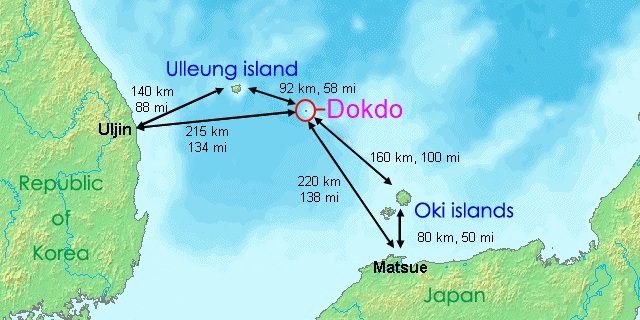
- The islands lie roughly equidistant between the two nations but are physically closer to the South Korean island of Ulleungdo (approx. 87 km) than to Japan’s Oki Islands (approx. 157 km).
History and Origin:
- Ancient Records: South Korea traces its claim back to the 6th-century Silla Kingdom, citing various historical maps and documents (like the Sejong Sillok Jiriji) that describe the islets as part of Korean territory.
- 1905 Annexation: Japan officially incorporated the islands into Shimane Prefecture in 1905, declaring them terra nullius (nobody’s land) during the Russo-Japanese War. South Korea views this as an illegal act of colonial aggression.
- Post-WWII (1945-1954): Following Japan’s defeat in 1945, the islands were placed under Allied control. In 1954, South Korea established a permanent coast guard presence on the islands, effectively regaining control after the end of Japanese colonial rule.
Features:
- Terrain: Volcanic rocks formed in the Cenozoic era. They feature steep cliffs, numerous sea caves, and a harsh, humid climate.
- Fisheries: The surrounding waters are a Goldilocks zone where warm and cold ocean currents meet, creating one of the world’s most fertile fishing grounds for squid, pollock, and cod.
- Energy Potential: Recent geological surveys suggest the seabed may hold 600 million tons of gas hydrates (often called fire ice).
- This natural gas resource is estimated to be worth nearly billion annually, making the islands a strategic energy asset.
Current Status:
- De Facto Control: South Korea maintains effective control over the islands, with a small detachment of police, lighthouse keepers, and a handful of residents.
- Legal Stance: South Korea refuses to take the matter to the International Court of Justice (ICJ), arguing that there is no dispute to settle as the islands are an integral part of their sovereign territory.
- Japan continues to claim the islands as an inherent part of its territory, hosting Takeshima Day every February 22nd.