




 Latest News
FEBRUARY 20, 2026 Current Affairs
Gaganyaan Drogue Parachute
- India achieved a key milestone in its human spaceflight programme as DRDO successfully conducted a qualification-level load test of the Drogue Parachute for the Gaganyaan mission.
Gaganyaan Drogue Parachute:
- The Gaganyaan Drogue Parachute is a crucial component of the deceleration system of India’s Gaganyaan Crew Module.
- It is deployed during re-entry to stabilize and reduce the velocity of the module before the main parachutes open.
Developed by:
- Developed collaboratively by Indian Space Research Organisation (ISRO) and Defence Research and Development Organisation (DRDO).
- Tested at the Terminal Ballistics Research Laboratory (TBRL), Chandigarh using the Rail Track Rocket Sled (RTRS) facility.
Aim:
- To stabilize the Crew Module during atmospheric re-entry.
- To reduce descent velocity to safe levels before deployment of main parachutes.
- To ensure safe splashdown/landing of astronauts in the Gaganyaan mission.
How it Works?
The Gaganyaan deceleration system consists of 10 parachutes (4 types):
- Apex Cover Separation Parachutes (2) – Remove protective cover.
- Drogue Parachutes (2) – Stabilize and reduce velocity at high altitude.
- Pilot Parachutes (3) – Extract main parachutes.
- Main Parachutes (3) – Provide final deceleration for safe landing.
- The drogue parachutes act as the critical transition stage, ensuring controlled descent before main canopy deployment.
Key Features:
- High-strength ribbon parachute design: Ribbon-type fabric structure allows controlled airflow, reducing shock loads while providing high tensile strength needed to safely slow the Crew Module during high-speed descent.
- Tested under qualification loads higher than maximum flight loads: The parachute was tested beyond expected real flight stresses to ensure reliability and performance even in worst-case scenarios, improving mission safety margins.
- Designed for extreme aerodynamic and ballistic conditions: It can function effectively under rapid speed changes, turbulence, and varying atmospheric pressures encountered during re-entry from space.
- Provides additional design safety margin: Engineering margins ensure that even if actual flight conditions deviate from predictions, the parachute system still performs safely without structural failure.
- Validated using high-speed dynamic testing at RTRS facility: Testing at DRDO’s Rail Track Rocket Sled simulates real flight dynamics, confirming parachute stability and deployment behaviour under near-mission conditions.
23rd Foundation Day of National Commission for Scheduled Tribes
- The National Commission for Scheduled Tribes (NCST) celebrated its 23rd Foundation Day in New Delhi, highlighting its role in safeguarding tribal rights and promoting inclusive development.
About National Commission for Scheduled Tribes (NCST):
- The National Commission for Scheduled Tribes (NCST) is a constitutional body established under Article 338A of the Constitution of India to protect, monitor and promote the rights and welfare of Scheduled Tribes (STs).
- It acts as a watchdog institution ensuring implementation of constitutional safeguards and addressing grievances related to tribal communities.
Established in:
- Established in 2004 following the Constitution (89th Amendment) Act, 2003.
- It separated tribal affairs from the earlier combined commission for Scheduled Castes and Scheduled Tribes to ensure focused attention on tribal issues.
History:
- 1978: Government set up a multi-member Commission for SCs & STs.
- 1992: Constitutional status granted through the 65th Constitutional Amendment, forming the National Commission for SCs & STs.
- 2003–04: 89th Constitutional Amendment bifurcated the body into:
- National Commission for Scheduled Castes (NCSC)
- National Commission for Scheduled Tribes (NCST)
NCST Members consists of:
- Chairperson
- Vice-Chairperson
- Three Members
- All are appointed by the President of India and generally include persons with expertise in tribal administration, social justice and policy.
Key Functions:
- Monitoring safeguards: Investigates and monitors constitutional and legal safeguards provided to Scheduled Tribes and evaluates their effectiveness.
- Inquiry into complaints: Examines complaints regarding deprivation of rights, land alienation, atrocities, or denial of benefits meant for tribal communities.
- Advisory role in development planning: Participates in policy formulation and advises governments on socio-economic development programmes for STs.
- Reporting to the President: Submits annual and special reports to the President regarding implementation of safeguards and policy recommendations.
- Civil court powers: While investigating cases, the Commission has powers similar to a civil court such as summoning individuals, calling documents, and recording evidence.
- Policy consultation: Union and State Governments are expected to consult the Commission on major policy matters affecting Scheduled Tribes.
The Vibrant Villages Programme–II (VVP-II)
- Union Home Minister launched the Vibrant Villages Programme–II (VVP-II) in Assam’s Cachar district to promote comprehensive development of border villages.
About The Vibrant Villages Programme–II (VVP-II):
- The Vibrant Villages Programme–II (VVP-II) is a Central Sector Scheme focused on the comprehensive development of villages located in blocks abutting India’s International Land Borders (ILBs) (excluding northern border areas already covered under VVP-I).
Launched in:
- Approved by the Central Government for implementation during FY 2024-25 to 2025-26, with financial support extending up to 2028-29.
- Officially launched in February 2026 at Nathanpur village, Cachar district, Assam.
History:
- 1986-87: Border Area Development Programme (BADP) launched to fill infrastructure gaps in border regions.
- Over time, border villages continued to face migration, livelihood insecurity and development deficits.
- 2023: Vibrant Villages Programme (VVP-I) launched for northern borders to reverse out-migration and strengthen strategic villages.
- VVP-II: Extended the model to other international land borders (Indo-Bangladesh, Indo-Nepal, Indo-Myanmar, Indo-Bhutan, Indo-Pakistan etc.) across 15 States and 2 UTs with area-specific strategies.
Aim:
- To address infrastructure gaps, improve living conditions and create sustainable livelihood opportunities in border villages.
- To integrate border populations with mainstream development and enable them to act as “eyes and ears” for border guarding forces.
Key Features:
- Central Sector Scheme with an outlay of ₹6,839 crore up to FY 2028-29.
- Implemented across 15 States and 2 Union Territories.
- Saturation-based approach: Ensures coverage of all eligible households under existing government schemes.
- Convergence model: Integrates multiple flagship schemes for efficient resource use.
Focus on 4 core infrastructure themes:
- All-weather road connectivity (PMGSY-IV)
- Telecom connectivity (Digital Bharat Nidhi)
- Television connectivity (BIND scheme)
- Electrification (RDSS)
- Identification of 1,954 strategic villages for intensive development.
- Livelihood promotion through tourism, SHGs, FPOs, skill development and financial inclusion.
- Border-specific outreach activities to build trust between communities and border security forces.
Shalimar Wheat
- Scientists at Sher-e-Kashmir University of Agricultural Sciences and Technology (SKUAST-K) have developed two new early-maturing wheat varieties to support the rice–wheat cropping system in Kashmir.
About Shalimar Wheat:
- Shalimar Wheat refers to newly developed early-maturing wheat varieties bred by SKUAST-K through conventional breeding techniques to suit Kashmir’s climatic conditions.
- They are designed specifically to fit into the rice–wheat cropping system, allowing timely wheat harvest before paddy transplantation.
Variety Names:
- Shalimar Wheat-4 (SW-4) – matures by the last week of May
- Shalimar Wheat-3 (SW-3) – matures by the first week of June
Key Features:
- Early maturity: Developed to mature earlier than traditional varieties, enabling timely field preparation for rice cultivation.
- Suitable for Kashmir climate: Adapted to mid-altitude regions up to about 1,850 m, unlike earlier varieties sourced from subtropical regions.
- Rice–wheat rotation compatibility: Ensures smooth crop sequencing by preventing delays in paddy transplantation.
- Disease resistance: Shows resistance to yellow rust, a major fungal disease affecting wheat in Kashmir.
- High productivity potential: SW-3 offers productivity up to 38 quintals per hectare, balancing yield with early maturity.
- Nutritional enhancement (Biofortification): SW-3 contains higher iron and zinc (>40 ppm) and around 12% protein, improving nutritional value.
- Developed through conventional breeding: Created using cross-breeding, pedigree selection and multi-year field testing over nearly a decade.
Significance:
- Strengthens food security by stabilizing the rice–wheat cropping system in Kashmir.
- Helps farmers avoid delays in paddy cultivation due to late wheat harvest.
Salem Sago (Javvarisi)
- APEDA facilitated the first direct export consignment of GI-tagged Salem Sago from Tamil Nadu to Canada, marking a major milestone for producer-led exports.
About Salem Sago (Javvarisi):
- Salem Sago (Javvarisi) is a starch-based food product made from tapioca roots (cassava), where wet starch is processed into small pearl-like granules.
- It is widely consumed as a staple and is also used in multiple industries such as food processing, textiles, pharmaceuticals and construction.
Origin:
- Originates from Salem district, Tamil Nadu, known as the “Land of Sago”.
- The region has favourable conditions such as high tapioca yield, abundant sunshine and established processing units.
- Over 80% of India’s sago production comes from the Salem region and nearby belts like Erode, Namakkal and Dharmapuri.
GI Tag:
- Geographical Indication (GI) tag granted in March 2023.
- GI registration obtained by The Salem Starch and Sago Manufacturers’ Service Industrial Co-operative Society Ltd (SAGOSERVE) under the Government of Tamil Nadu.
Key Characteristics:
- Tapioca-based product: Produced from starch extracted from tapioca roots containing about 30–35% starch.
- High regional productivity: Tapioca yield in Salem reaches 25–30 tonnes/ha, among the highest globally.
- Distinct physical traits: Small granules generally ranging between 2–4.5 mm in size with low calorific value (~310 kcal/100 g).
- Efficient processing: Around 1 kg of sago can be produced from about 5 kg of tapioca tubers.
- Multi-sector usage: Used in food, paper, textile, cosmetic, pharmaceutical, construction and alcohol industries.
Significance:
- Enhances export opportunities for GI-certified Indian agri products.
- Improves price realisation and income for farmers, including tribal communities involved in tapioca cultivation.
MILAN 2026 Naval exercise
- Raksha Mantri interacted with Navy Chiefs and delegations from nine ASEAN countries during the MILAN 2026 Naval Exercise held in Visakhapatnam.
About MILAN 2026 Naval Exercise:
- MILAN is a multilateral naval exercise initiated by the Indian Navy to enhance maritime cooperation, interoperability and trust among friendly navies in the Indo-Pacific region.
- It serves as a platform for joint training, operational coordination and strategic dialogue on maritime security challenges.
- Host: Hosted by the Indian Navy.
- MILAN 2026 is being conducted at Visakhapatnam, Andhra Pradesh.
Nations Involved:
- Largest-ever edition with participation from 74 nations.
- Includes nine ASEAN member states, reflecting strong regional engagement.
Aim:
- To strengthen maritime cooperation and collective security in the Indo-Pacific region.
- To improve interoperability and operational coordination among participating navies through joint drills and exchanges.
Key Features:
- Theme: “Camaraderie, Cooperation and Collaboration.”
- Includes Sea Phase exercises such as:
- Anti-Submarine Warfare (ASW)
- Air Defence drills
- Search and Rescue (SAR) operations
- Conduct of International Fleet Review 2026 and IONS Conclave of Chiefs.
- Platform for defence diplomacy and strategic engagement under India’s Act East Policy and MAHASAGAR vision.
- Showcases India’s indigenous naval capabilities such as INS Vikrant and Visakhapatnam-class destroyers.
Significance:
- Strengthens India’s role as a key maritime security partner in the Indo-Pacific.
- Enhances cooperation with ASEAN and other friendly navies.
India Signs MoU with the World Food Programme (WFP)
- Food Corporation of India (FCI) and the World Food Programme (WFP) signed an MoU to support global humanitarian efforts against hunger.
- Under the MoU, FCI will supply 2 lakh MT of rice (with up to 25% broken grain) to WFP over five years.
- Significance: The partnership reinforces India’s role as a trusted food supplier and advances its commitment to global food security.
About World Food Programme (WFP)
- The WFP is an international organisation within the United Nations (UN) that provides food assistance.
- It was established in 1961 through a joint initiative of the Food and Agriculture Organisation (FAO) and the United Nations General Assembly (UNGA).
- WFP is the largest global humanitarian organisation, headquartered in Rome, Italy.
- Its principal objective is to eliminate hunger & malnutrition to achieve SDG 2 (Zero Hunger) by 2030.
- The organisation provides emergency food assistance to displaced and vulnerable populations in conflict- and disaster-affected regions.
- Flagship Reports: It contributes to assessments, such as the Global Report on Food Crises (GRFC).
- Governance: A 36-member Executive Board provides intergovernmental oversight and policy direction for its programmes.
- Global Recognition: It received the Nobel Peace Prize in 2020 for combating hunger and preventing starvation as a weapon of war.
About Food Corporation of India
- The FCI is a statutory body established under the Food Corporation Act, 1964, and operates under the Ministry of Consumer Affairs, Food and Public Distribution.
- Primary Mandate: It ensures national food security by maintaining sufficient operational and buffer stock of food grains.
- Procurement: It procures wheat, paddy, & coarse grains at MSP to shield farmers from price volatility.
- Public Distribution: FCI supplies food grains to states for distribution under NFSA and PMGKAY.
Gender Budget 2026-27
- The Union Government released the Gender Budget Statement (GBS) 2026–27, marking its highest-ever allocation.
Key Highlights of GBS 2026–27
- Total Allocation: The allocation for women and girls under various schemes increased by 11.55% to ₹5.01 lakh crore in 2026-27.
- Budget Share: The Gender Budget share in the total Union Budget increased to 9.37% in FY 2026-27 from 8.86% in FY 2025-26.
- Component Shares: Part A (100% women-specific) accounts for 21.50%, Part B (at least 30% women-beneficiaries) constitutes 72.54%, and Part C (less than 30% women allocation) forms about 5%.
- Institutional Coverage: 53 Ministries and 5 Union Territories reported their gender-specific allocations this year, marking the highest participation so far.
- Leading Ministry: The Ministry of Women and Child Development (MWCD) allocated 81.73% of its budget to gender-responsive initiatives.
About Gender Budgeting
- Gender Budgeting is a public financial management tool that aligns government resource allocation with the constitutional goal of gender equality.
- It is not a separate women’s budget but rather a methodology for integrating a gender perspective across all stages of the budgetary process.
- The framework translates gender-related policy commitments into budgetary targets to reduce structural socio-economic disparities.
- Gender Budgeting was formally introduced into the Indian Union Budget in FY 2005-06 through the publication of Expenditure Statement 13.
- Nodal Authority: The Ministry of Women and Child Development issues guidelines and supports capacity-building for other ministries.
- Indian Framework: It divides allocations into 3 parts — Part A for schemes with 100% women beneficiaries, Part B for 30% to 99%, and Part C for less than 30% (introduced in FY 2024-25).
- Institutional Mechanism: Since 2004-05, the government mandated Gender Budgeting Cells (GBCs) in all ministries to review and shape allocations using a gender lens.
RuPay–BHIM UPI Incentives Driving India’s Payment Transformation
- The Department of Financial Services released an impact analysis showing that the RuPay-BHIM UPI incentive scheme accelerated the digital transition and economic formalisation.
- Incentive Scheme for RuPay Debit Cards and Low-Value BHIM-UPI P2M Payments
- This Central Sector Scheme was launched in December 2021 to promote low-value digital transactions under the Zero-MDR regime.
- Administrative Oversight: The Department of Financial Services (DFS) of the Ministry of Finance currently administers the scheme.
- Nodal Agency: The National Payments Corporation of India (NPCI) is the nodal agency responsible for calculating incentive claims and conducting transaction data due-diligence
- Primary Objective: The scheme subsidises transaction costs for banks to sustain the Zero-MDR regime for domestic payment platforms.
- Eligible Coverage: RuPay Debit Card transactions and low-value BHIM-UPI person-to-merchant (P2M) payments up to ₹2,000 are covered under the scheme.
- UPI Incentives: Acquiring banks receive an incentive of 0.15% of the transaction value for eligible BHIM-UPI P2M transactions made specifically to small merchants.
- RuPay Incentives: Incentives are 0.40% (capped at ₹100) for standard transactions and 0.15% (capped at ₹6) for specific “Industry Programmes” such as fuel and insurance.
- Performance Benchmarks: Acquiring banks must maintain technical decline rates below 0.75% and ensure system uptime of at least 99.5% to qualify for the final 20% disbursement.
- Incentive Transmission: The incentive is distributed among the acquiring bank, the issuing bank, the PSP bank, and the Third-Party Application Providers (TPAPs).
Impact of RuPay–BHIM UPI Incentives
- Transaction Growth: The incentive scheme triggered an 11-fold surge in digital transaction volumes. UPI now accounts for 80% of all digital payments in India.
- Consumer Preference: UPI surpassed cash as the preferred payment mode for 57% of users. Adoption is highest at 66% among users aged 18-25.
- Merchant Adoption: The Zero-MDR (Merchant Discount Rate) policy achieved 94% adoption among small vendors, with 57% reporting an increase in sales.
- Systemic Trust: About 90% of users report high trust in digital payment systems, with 65% performing multiple transactions daily.
- Strategic Pivot: RuPay debit card usage increased at physical PoS terminals and e-commerce. UPI Lite gained priority for micro-payments and micro-credit integration.
Thriving Coral Reef Discovery in Lakshadweep
- A healthy and continuous coral reef stretch was discovered near Kalpeni Island, Lakshadweep, amid the ongoing fourth global mass coral bleaching event.
- Coral reefs are marine ecosystems formed by coral polyps that live in a mutualistic symbiotic relationship with photosynthetic zooxanthellae, which enables high biodiversity & ecosystem productivity.
Global Coral Crisis Context
- Mass Bleaching Event: Global coral reef ecosystems are facing unprecedented and recurring stress from prolonged marine heatwaves and steadily rising ocean temperatures.
- Thermal Tipping Risk: At ~1.4°C long-term warming, warm-water reefs approach irreversible decline thresholds (Global Tipping Points Report 2025).
- Ecosystem Dependence: Coral reef systems collectively support nearly 25% of global marine biodiversity, despite occupying only a very small fraction of the ocean area.
Ideal Conditions for Coral Growth
- Stable climatic conditions: Corals are highly susceptible to quick changes. They grow in regions where the climate is significantly stable for a long period of time.
- Perpetually warm waters: Corals thrive in tropical waters (30°N and 30°S latitudes, where the temperature of water is around 20°C), where diurnal and annual temperature ranges are very narrow.
- Shallow water: Corals require a fairly good amount of sunlight to survive. The ideal depths for coral growth are 45 m to 55 m below the sea surface, where abundant sunlight is available.
- Abundant Plankton: Adequate supply of oxygen and microscopic marine food, called plankton (phytoplankton), is essential for growth.
- Little or no pollution: Corals are highly fragile and are vulnerable to climate change and pollution, and even a minute increase in marine pollution can be catastrophic.
- Clear salt water: Clear salt water is suitable for coral growth, while both fresh water and highly saline water are harmful.
Reasons for Thriving Coral Reef Discovery in Lakshadweep
- Thermal Buffering Effect: Local oceanographic processes, including currents and vertical mixing, likely reduced prolonged heat stress exposure on corals.
- Hydrodynamic Water Flushing: Strong and continuous water circulation improved nutrient exchange while preventing damaging thermal accumulation.
- Species-Level Heat Resilience: Dominance of relatively heat-tolerant coral species enhanced ecosystem survival under repeated marine heatwave conditions.
About Lakshadweep
- Location: A group of coral islands located in the Arabian Sea, off India’s southwestern coast.
- Topography: Characterised by flat terrain with the absence of hills, rivers, and valleys.
- Island Groups: Comprises the Amindivi Islands, Laccadive Islands, and the Minicoy Islands.
- Capital: Kavaratti serves as the administrative capital of Lakshadweep.
- Geographical Spread: The Amindivi Islands lie in the north, while the Minicoy Islands, the largest and relatively more developed island, form the southernmost extension.
- 8° N Channel: Separates the Maldives from the Minicoy Island.
- 9° N Channel: Separates the island of Minicoy from the main Lakshadweep archipelago.
Forest Fires in Northeast India
- Forest fires persisted for nearly a week across Arunachal Pradesh and Nagaland, prompting sustained aerial firefighting missions.
Affected Locations
- Lohit Valley: High-altitude aerial firefighting missions conducted above ~9,500 ft in remote mountainous regions of Arunachal Pradesh.
- Walong Region: Significant fire suppression operations undertaken in eastern Arunachal Pradesh, a strategically sensitive zone near the India–China frontier.
- Dzukou Valley: Forest fire hotspots observed in the ecologically fragile valley spanning the Nagaland–Manipur border, known for recurrent seasonal fires.
- Japfu Peak Area: Fire-affected zones reported near Japfu Peak, one of Nagaland’s highest elevations, where steep slopes intensified fire behaviour.
Operational Response
- Sustained Aerial Suppression: Indian Air Force helicopters carried out continuous precision water-dropping sorties to contain fires in inaccessible mountainous terrain.
- Large-Scale Water Deployment: Extremely high-volume aerial drops reported; E.g., ~139,800 litres released over Walong and ~12,000 litres over Lohit Valley.
Why Northeast is a Fire-Prone Zone?
- Climatic Vulnerability: Extended dry spells and rising temperatures increase fire risks; E.g., Arunachal Pradesh recorded ~200 times more fire incidents compared to the same period last year (FSI data).
- Shifting Cultivation Practices: Slash-and-burn agricultural cycles create seasonal ignition sources across hill landscapes, particularly during pre-monsoon months.
- Topographic Amplification: Steep slopes, narrow valleys, and strong mountain winds accelerate rapid fire spread and complicate ground-based containment efforts.
Forest Fire Vulnerability in India
- Prone Areas: About 36% of India’s forest cover is susceptible to forest fires, with ~4% highly prone and ~6% very highly prone zones.
- Fire Frequency Distribution: Around ~54.40% of forest areas witness occasional fires, ~7.49% face moderate fire incidence, and ~2.40% report high-frequency fires (FSI).
- Susceptible Forest Types: Dry deciduous forests remain most vulnerable due to high combustible biomass, whereas evergreen and montane temperate forests exhibit lower fire incidence.
Government Initiatives to Control Forest Fires
- Forest Fire Prevention & Management Scheme (FPM): Centrally Sponsored Scheme providing financial assistance to states for fire prevention infrastructure and firefighting capacity enhancement.
- Forest Survey of India (FSI) Fire Alerts: Satellite-based real-time monitoring system issuing early warnings using MODIS and SNPP-VIIRS sensors to enable rapid response.
- National Action Plan on Forest Fires (NAPFF): National framework emphasising prevention, mitigation strategies, technological integration, and community participation in fire management.
VoicERA Launched on BHASHINI National Infrastructure
- The Ministry of Electronics and Information Technology (MeitY) launched VoicERA on the BHASHINI National Language Infrastructure during the India AI Impact Summit 2026.
About VoicERA
- VoicERA is an open-source, end-to-end Voice AI stack. It serves as a national execution layer for delivering population-scale, multilingual services.
- The platform was developed by the Digital India BHASHINI Division (DIBD) of the Digital India Corporation (DIC), in collaboration with the EkStep Foundation, IIIT Bengaluru, and AI4Bharat.
- It is designed as a digital public good to prevent vendor lock-in and promote seamless integration across innovation ecosystems.
- Key Technologies: It integrates Automatic Speech Recognition (ASR), Neural Text-to-Speech (TTS), and Large Language Models (LLMs).
- Deployment Flexibility: The stack supports both cloud deployments and on-premises installations.
- Significance: It democratises digital governance by enabling low-literate citizens to access government services through voice commands.
About BHASHINI
- The Bhasha Interface for India (BHASHINI) is an AI-powered language translation platform.
- It was launched in 2022 by MeitY as part of the National Language Translation Mission (NLTM).
- The initiative aims to eliminate linguistic barriers and ensure digital inclusion for all citizens.
- BHASHINI operates as a Digital Public Infrastructure (DPI) and uses Natural Language Processing (NLP) to deliver scalable language services.
- It supports all 22 Scheduled Languages and is expanding into tribal and low-resource languages.
- It has successfully integrated with national portals, including e-Shram, e-Gram Swaraj, and the digital systems of the Indian Judiciary.
Exercise Vajra Ghaat
- The Southern Command of the Indian Army conducted Exercise Vajra Ghaat at the Pokhran Field Firing Range, Rajasthan.
- The drill validated Tactics, Techniques and Procedures (TTPs) to enhance survivability and operational effectiveness in harsh desert environments.
- It demonstrated the K9 Vajra artillery system’s combat power and battlefield suitability.
About K9 Vajra
- K9 Vajra is a tracked, self-propelled howitzer. It is the indigenous version of South Korea’s K9 Thunder artillery platform.
- Indigenous Production: Larsen & Toubro manufactures the system under the Make in India initiative through a technology transfer with Hanwha Defence.
- Terrain Mobility: It uses a tracked platform that ensures high cross-country mobility and effective deployment on sandy desert terrain.
- Tactical Capability: The system has a “shoot-and-scoot” feature, enabling quick relocation after firing to avoid enemy counter-bombardment.
- Firepower Strength: It delivers artillery strikes up to 40 km and fires three rounds in 15 seconds through automated fire control.
- Ammunition Compatibility: The system supports both Indian and North Atlantic Treaty Organisation (NATO) ammunition.
Nandhaur Wildlife Sanctuary
- Smooth-coated otters were officially recorded for the first time in Nandhaur Wildlife Sanctuary, Uttarakhand, marking a significant conservation milestone.
Nandhaur Wildlife Sanctuary:
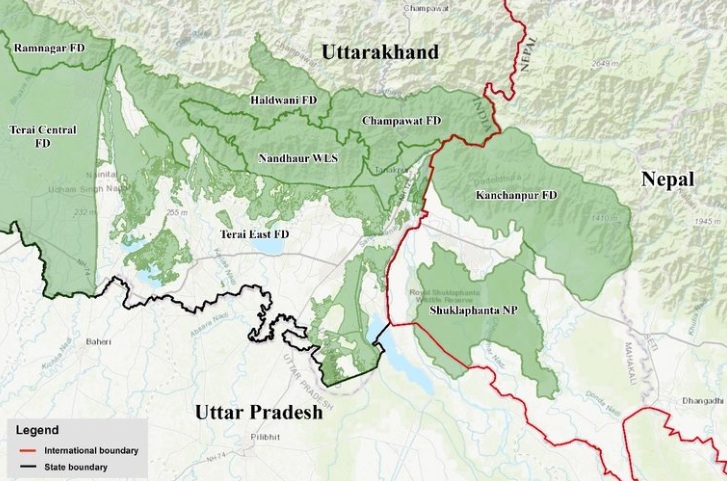
- Nandhaur Wildlife Sanctuary is a protected forest area forming part of the Terai Arc Landscape, serving as a crucial biodiversity corridor between India and Nepal.
Located in:
- Situated in Nainital district, Uttarakhand.
- Lies between the Gola and Sharda Rivers.
- Connects forests of Ramnagar with Shuklaphanta National Park in Nepal.
History:
- Established in 2012.
- Part of the Shivalik Elephant Reserve (since 2002).
- Recently prescribed by the National Tiger Conservation Authority (NTCA) as Uttarakhand’s third Tiger Reserve.
Key Features:
- Area: 269.96 sq. km.
- Dominated by Sal forests with over 100 tree species including shisham, bamboo, teak, and chir pine.
- Hosts ~25 mammal species, 250 bird species, 15 reptiles, and 20 fish species.
- Major fauna include tiger, leopard, Asian elephant, and sloth bear.
- Functions as an ecological corridor in the Terai-Bhabar region.
About Smooth-Coated Otter:
- The smooth-coated otter is a semi-aquatic mammal and one of the largest otter species in Asia, known for its sleek body and strong swimming ability.
- Scientific Name: Lutrogale perspicillata
Conservation Status
- Listed as Vulnerable on the International Union for Conservation of Nature (IUCN) Red List.
Habitat
- Found in freshwater rivers, wetlands, mangroves, and estuaries.
- Requires clean water bodies with abundant fish and amphibians.
- Acts as a bio-indicator species, indicating healthy aquatic ecosystems.
Key Characteristics:
- Total length: ~1.3 metres; weight: 7–11 kg: The smooth-coated otter is one of the larger otter species, giving it strength and agility for aquatic hunting.
- Smooth, sleek fur; flattened tail; large webbed paws: These adaptations reduce water resistance and help in fast swimming and efficient underwater movement.
- Strong swimmers; often hunt cooperatively in groups (V-formation): Group hunting improves coordination and increases success in catching fish in flowing waters.
- Sensitive whiskers detect prey movement even in murky waters: Their whiskers act as sensory tools, allowing them to locate prey through vibrations when visibility is poor.
- Primarily fish-eating but occasionally omnivorous: Although fish form the main diet, they may also consume crustaceans or small aquatic animals when available.
POSTED ON 20-02-2026 BY ADMIN
Next previous  General Studies
Political Science and International Relations
Some Reference Essays
List of previous year essay topics (1997-2019)

IAS GOOGLE is googled by the team of Raja Sir’s Cracking IAS Academy. Sources include The Hindu, Indian Express, pib.nic.in, Down To Earth, Economic Times, Vigyan Prasar, AIR and the like. IAS GOOGLE has been prepared in pace with emerging UPSC Trends.