



 Latest News
FEBRUARY 19, 2026 Current Affairs
India-UK Offshore Wind Taskforce
- India and the United Kingdom launched the India-UK Offshore Wind Taskforce under Vision 2035 to accelerate cooperation in offshore wind energy development.
India-UK Offshore Wind Taskforce: What it is?
- The India-UK Offshore Wind Taskforce is a bilateral cooperation platform launched under the Fourth India-UK Energy Dialogue to strengthen collaboration in offshore wind energy.
- It brings together policy makers, industry stakeholders, and technical experts to guide the development of India’s emerging offshore wind sector using UK expertise and Indian market scale.
Aim / Objectives:
- Accelerate offshore wind deployment through strategic India-UK cooperation.
- Develop a robust offshore wind ecosystem including policy, infrastructure, and financing frameworks.
- Promote long-term energy security and industrial competitiveness under Vision 2035.
Key Features:
- Strategic Leadership Platform: Provides coordinated guidance for India’s nascent offshore wind sector.
Three Priority Pillars:
- Ecosystem planning & market design (seabed leasing, revenue certainty).
- Infrastructure & supply chains (ports, manufacturing, marine logistics).
- Financing & risk mitigation (blended finance, institutional capital mobilisation).
- Identified Offshore Zones: Initial development planned off Gujarat and Tamil Nadu coasts.
- Government Support: Viability Gap Funding (VGF) scheme of ₹7,453 crore to support early projects.
- Energy Transition Linkage: Supports National Green Hydrogen Mission through renewable coastal power supply.
India’s Drone Ecosystem
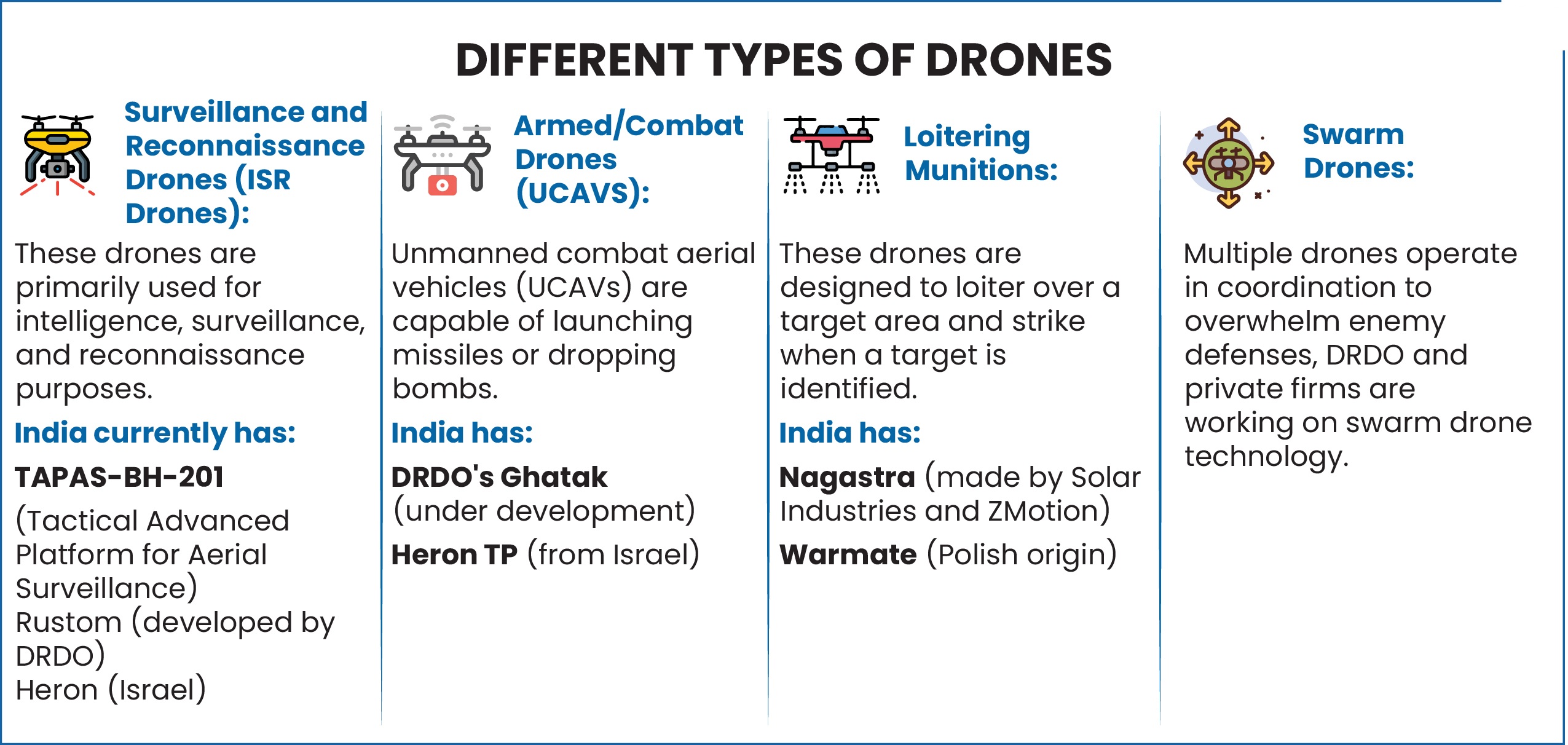
- India has transitioned from pilot drone projects to a regulated drone ecosystem with 38,500+ registered drones Unique Identification Number (UIN).
- The expanding drone ecosystem is reshaping public service delivery, infrastructure management, agriculture, and national security.
Transformation of Public Service Delivery through Drone Technologies
- Agriculture & Livelihoods: Namo Drone Didi Scheme (2023) provides drones to Women SHGs to generate sustainable rural livelihoods.
- Land Mapping: SVAMITVA Scheme (2020) uses drones for rural abadi surveys to resolve land disputes and enable property cards, improving access to institutional credit.
- Highway Monitoring: NHAI mandates monthly drone-video mapping of highway projects for progress tracking, digital reporting, discrepancy checks, and use as evidence in dispute resolution.
- Disaster Management: E.g., North East Centre for Technology Application and Reach (NECTAR) drones provide real-time aerial visuals during floods and landslides, aiding rapid assessment, coordinated rescue, and emergency response.
- Railway Surveillance: Ministry of Railways deploys UAVs for inspection of tracks, bridges, and hard-to-reach infrastructure, improving maintenance efficiency and safety.
- Defence Applications: Drones enable border surveillance, intelligence gathering and precision strikes; integrated with radar and air-defence networks, they enhance rapid threat detection and protection of critical infrastructure (e.g., Operation Sindoor).
Accelerating Drone Adoption in India
- Drone Rules, 2021 and Drone (Amendment) Rules 2022 & 2023: It has significantly liberalised India’s drone ecosystem.
- E.g., Nearly 90% of Indian airspace was declared a Green Zone for drone operations, allowing flights up to 400 feet.
- Production Linked Incentive (PLI): PLI scheme for drones and drone components has an approved outlay of ₹120 crore.
- GST Rationalisation: GST on drones reduced to 5%, replacing earlier 18% and 28% slabs.
- Digital Sky, 2018 and eGCA: The regulatory services such as drone registration, remote pilot certification, Type certification and RPTO authorisation has been migrated from Digital Sky platform to eGCA.
- Ecosystem Development and Capacity Building through Flagship Programmes: E.g., National Innovation Challenge for Drone Application and Research (NIDAR) engages students and researchers.
Sahakar Taxi Cooperative Limited
- Union Home and Cooperation Minister formally launched ‘Bharat Taxi’, India’s first cooperative-based taxi service, aimed at transforming the unorganised taxi sector into an ownership-driven model for drivers.
Sahakar Taxi Cooperative Limited:
- Sahakar Taxi Cooperative Limited is a multi-state cooperative society registered under the Multi-State Cooperative Societies Act, 2002. It is the body responsible for operating the Bharat Taxi platform.
- Unlike traditional corporate aggregators, it is owned and governed by the drivers themselves, who are referred to as ‘Sarathis’.
- Established In: June 6, 2025.
- Promoted By: Leading cooperative institutions including NCDC, IFFCO, GCMMF (Amul), KRIBHCO, NAFED, NABARD, NDDB, and NCEL.
Aim and Objectives
- Empowerment: To shift the unorganised taxi sector into an ownership-rights model where the driver is the Malik (owner).
- Economic Freedom: To eliminate high middleman commissions (often 20-30%) and ensure 100% of the fare (minus a nominal daily access fee) goes directly to the Sarathi.
- Women’s Safety: To provide safe, affordable, and dignified travel for women through the ‘Sarathi Didi’ initiative.
- Social Security: To provide gig workers with access to health insurance, pensions, and government welfare schemes.
How the Model Works?
- Ownership via Shares: Drivers become members of the cooperative by purchasing shares (as low as ₹500). This entitles them to a share in the profits and a vote in the board’s decision-making.
- Zero-Commission Model: The platform does not take a percentage of every ride. Instead, it operates on a transparent, flat daily access fee (approx. ₹30 for cabs and ₹18 for autos).
- Direct Payment: Fare payments are transferred automatically and immediately into the Sarathi’s bank account.
- Democratic Governance: Two representatives chosen by the Sarathis sit on the Board of Directors to look after the interests of the community.
Key Features
- Sarathi Didi: A dedicated in-app window allowing women passengers to book rides specifically with female drivers (Sarathi Didis) on two-wheelers.
- No Surge Pricing: Provides transparent and fixed pricing for passengers, even during peak hours.
- Integrated Services: Includes two-wheelers, three-wheelers, and four-wheeler taxis on a single platform.
- Social Safety Net: Integrated with the e-Shram portal, giving drivers access to Pradhan Mantri Jan Arogya Yojana (free treatment up to ₹5 lakh) and other gig-worker benefits.
Significance:
- By offering an alternative to the Western commission-based model, it forces private competitors to reduce their fees to remain competitive.
- Within three years, the service is planned to expand across India, from Kashmir to Kanyakumari.
America-India Connect Subsea Cable Initiative
- Google CEO Sundar Pichai announced the billion “America-India Connect” initiative at the India AI Impact Summit in New Delhi, aiming to bridge the AI divide by linking India directly to the US and the Southern Hemisphere via advanced subsea cables.
America-India Connect Subsea Cable Initiative:
- A massive collaborative digital infrastructure project that anchors Google’s five-year, billion investment in India. It involves the construction of multiple international subsea cables and a new subsea gateway on India’s east coast to provide high-speed, resilient connectivity for AI and cloud workloads.
- Announced By: Google during the India AI Impact Summit 2026.
Aim:
- To democratize AI access and prevent a digital divide from becoming an AI divide.
- To increase the reach, reliability, and resilience of digital connectivity across four continents.
- To establish India as a global AI hub by providing the low-latency infrastructure required for frontier AI models.
Key Features:
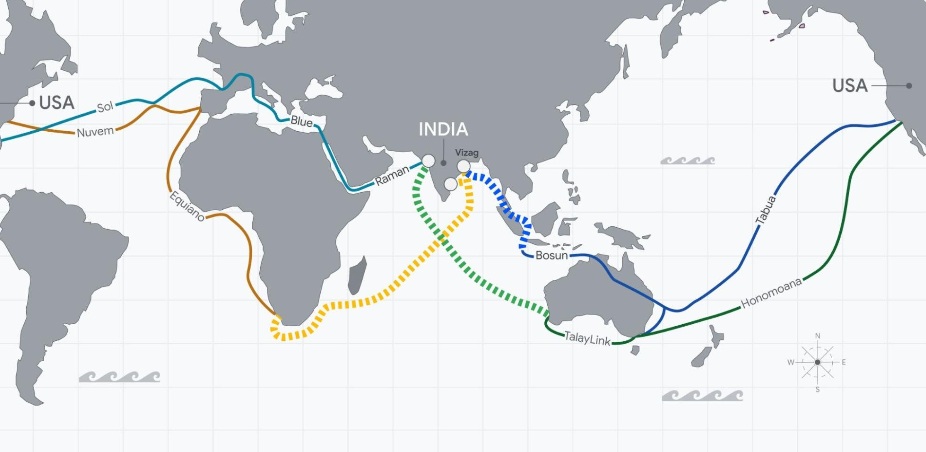
- New Subsea Gateway: Establishment of India’s first major international subsea gateway in Visakhapatnam (Vizag), providing geographic diversity from existing landings in Mumbai and Chennai.
- Three New Subsea Paths: Direct routes connecting India to Singapore, South Africa, and Australia.
- Four Strategic Fiber Routes: New paths linking the US East/West coasts to India via Africa and the South Pacific.
- West Coast Connectivity: A direct fiber-optic path between Mumbai and Western Australia.
- AIIMS Partnership: Parallel announcement of a collaboration with AIIMS to develop AI tools that help patients input symptoms and generate preliminary reports to assist doctors.
- Skilling Integration: Collaboration with Karmayogi Bharat to provide AI-enabled training to 20 million public servants across 800+ districts.
Significance
- For a nation of 1.4 billion people, adding Vizag as a gateway ensures that India’s digital backbone remains functional even if traditional route face outages.
- By turning ancient maritime merchant routes into modern digital trade routes, the initiative deepens the economic bond between the US and India.
Graphics Processing Unit (GPU)
- Graphics Processing Units (GPUs) are in focus as they have become the backbone of modern AI systems, cloud computing, and high-performance digital infrastructure.
What is a GPU?
- A Graphics Processing Unit (GPU) is a specialised computer processor designed to perform many simple calculations simultaneously, making it ideal for parallel processing tasks.
- Unlike CPUs, which handle fewer complex tasks, GPUs excel at repetitive, data-intensive computations.
Origin:
- The term GPU gained prominence in 1999, when Nvidia launched the GeForce 256, marketed as the world’s first GPU.
- Aim: The primary aim of a GPU is to handle embarrassingly parallel workloads—tasks that can be broken down into thousands of smaller, independent calculations performed simultaneously.
How it Works?
A GPU works through a process called a rendering pipeline (or a compute pipeline for non-graphics tasks):
- Vertex Processing: It calculates the position of 3D objects on a 2D screen using matrix mathematics.
- Rasterization: It converts these geometric shapes into pixels (fragments).
- Shading: It determines the color, lighting, and texture of each pixel simultaneously across thousands of cores.
- Output: The final image is written to VRAM (Video RAM) and sent to the monitor.
In modern AI, the GPU skips the visual steps and uses its cores to perform massive matrix multiplications, which are the mathematical foundation of neural networks.
Key Features:
- Parallel Architecture: Contains hundreds or thousands of small, specialized cores (e.g., CUDA cores or Tensor cores).
- High Memory Bandwidth: Uses specialized memory like GDDR6X or HBM3 (High Bandwidth Memory) to move massive amounts of data quickly.
- Programmability: Through platforms like Nvidia CUDA or OpenCL, developers can use GPUs for non-graphics tasks (GPGPU).
- Energy Density: High-end GPUs in 2026 can consume over 1000W per device, requiring advanced liquid cooling in data centres.
Applications
- Artificial Intelligence: Training and running Large Language Models (LLMs) like GPT-4 or Gemini.
- Gaming & VR: Real-time ray tracing and high-frame-rate 4K/8K rendering.
- Scientific Simulation: Weather modelling, molecular dynamics for drug discovery, and genomic sequencing.
- Professional Visualization: 3D CAD modelling, video editing, and digital twins for industrial AI factories.
- Blockchain: Handling complex Proof of Work hashes for cryptocurrency mining.
The Privileges Committee
- Privileges Committee and the Ethics Committee, have not been constituted in the Lok Sabha (the lower house of India’s Parliament) nearly two years.
The Privileges Committee:
- The Privileges Committee is a specialized standing committee of the legislature (Parliament or State Assemblies) that acts as a quasi-judicial body.
- It is tasked with safeguarding the privileges—special rights and immunities—of the House and its members to ensure they can function without outside interference or fear.
Origin:
- The concept is rooted in British Parliamentary conventions. Historically, these privileges were developed in medieval England to protect the House of Commons from the absolute power of the Monarch.
Articles Associated:
- Article 105: Defines the powers, privileges, and immunities of the Parliament (Lok Sabha and Rajya Sabha) and its members.
- Article 194: Defines the same for State Legislatures (Assemblies and Councils) and their members.
- Aim: To investigate any action that casts reflections, insults, or obstructs the House, its committees, or its members, thereby protecting the dignity and authority of the legislative institution.
Members
- Lok Sabha: 15 members nominated by the Speaker.
- Rajya Sabha: 10 members nominated by the Chairman.
- State Legislatures: Typically consists of 9 to 15 members (e.g., the Maharashtra Legislative Council committee currently has 9 members).
Key Functions
- Examination: Investigates every question of breach of privilege referred to it by the House or the Presiding Officer.
- Evidence Collection: Has the power to summon individuals (both members and outsiders), record statements, and demand relevant documents.
- Determination: Evaluates the facts to decide if a breach of privilege or contempt has occurred.
- Recommendation: Submits a report to the House recommending a specific course of action, which may include:
- Admonition or Reprimand: A formal public scolding.
- Imprisonment: For the duration of the House session (rare).
- Suspension/Expulsion: If the offender is a member of the House.
- Unconditional Apology: Often, if the accused offers an apology, the committee recommends dropping the matter.
Significance:
- Ensures that lawmakers can speak and vote freely without being sued for defamation in court for their actions inside the House.
- Acts as a deterrent against libels or physical obstructions that might hinder the democratic process.
AI-for-Energy mission
- The International Solar Alliance (ISA) launched a global AI-for-Energy mission at the India AI Impact Summit in New Delhi to fast-track clean energy adoption across 120+ member countries.
About AI-for-Energy mission:
- A strategic international initiative designed to integrate Artificial Intelligence (AI) into the clean energy infrastructure of developing and emerging economies.
- It leverages the India Energy Stack—a digital public infrastructure model—to modernize grids and decentralize power systems.
- Launched By: The International Solar Alliance (ISA), in partnership with India’s Ministry of Power, Ministry of Electronics and Information Technology (MeitY), and REC Limited.
Aim:
- To assist member countries in digital leapfrogging, bypassing legacy infrastructure hurdles.
- To transform power grids into smart, bidirectional systems capable of absorbing high levels of renewable energy.
- To ensure equitable and affordable access to electricity through data-driven planning and service delivery.
Key Features
- India Energy Stack: Using India’s interoperable digital platform (similar to UPI for payments) as a global template to connect consumers, vendors, and utilities.
- Digital Twin Technology: Showcasing virtual replicas of distribution networks (DISCOMs) for real-time simulation, predictive maintenance, and outage management.
- Citizen-Centric Tools: Tools like the One Solar App for transparent net-metering and performance tracking of rooftop solar installations.
- Geospatial Mapping (GIS): Utilizing GIS-based tools for asset-level visibility and optimized infrastructure planning in rural and urban sectors.
- Technical Capacity Building: A focus on five priorities: AI for distributed energy, start-up innovation, interoperable standards, citizen benefits, and sustainable financing.
Significance
- AI helps manage the complexity of millions of prosumers, ensuring grid stability during peak demand.
- By reducing technical losses and lowering the cost of digital tools, the mission makes clean energy financially viable for low-income nations.
Source: DTE
Iran temporarily shut parts of the Strait of Hormuz
Strait of Hormuz
- Iran temporarily shut parts of the Strait of Hormuz to conduct live-fire military drills named “Smart Control of the Strait of Hormuz.”
- This rare move coincided with indirect nuclear talks in Geneva and served as a strategic signal to the U.S. amid escalating regional tensions.
Strait of Hormuz: What it is?
- The Strait of Hormuz is the world’s most vital oil transit chokepoint. It is a narrow maritime passage that serves as the only sea exit for the Persian Gulf, linking it to the Gulf of Oman and the open ocean.
- Located In: It is situated in the Middle East, separating the northern coast of Iran from the Arabian Peninsula.
- Links the Persian Gulf to the Indian Ocean through the Gulf of Oman.
Neighbouring Nations:
- Iran: Controls the northern coastline and several strategic islands (Qeshm, Hormuz, Larak).
- Oman: Controls the southern coast via the Musandam Peninsula exclave.
- United Arab Emirates (UAE): Located to the south and west; home to major ports like Fujairah.
Key Geographical Features:
- Dimensions: Approximately 167 km long and only 33 km wide at its narrowest point (between Iran and the Musandam Peninsula).
- Shipping Lanes: Due to shallow waters near the coast, tankers must use two 3-km wide shipping lanes (one inbound, one outbound) separated by a 2-km buffer zone.
- Strategic Islands: Iran maintains a heavy military presence on islands like Abu Musa and the Greater and Lesser Tunbs, which allow for de facto control over the shipping channels.
- Bathymetry: The water is deep enough (60–100 meters) to handle the world’s largest VLCCs (Very Large Crude Carriers), making it irreplaceable for bulk energy transport.
Significance:
- Roughly 20% of the world’s total petroleum liquids and 20% of global LNG pass through the strait daily—amounting to approximately 20 million barrels of oil.
- Any closure or even a slowdown in traffic spikes global oil prices and shipping insurance premiums instantly.
Chhatrapati Shivaji Maharaj Jayanti
- Chhatrapati Shivaji Maharaj Jayanti, or Shiv Jayanti, is observed on 19 February to honour the birth anniversary of Chhatrapati Shivaji.
- Mahatma Jyotirao Phule initiated the first public celebration in 1870 at Raigad, and Bal Gangadhar Tilak later popularised it to mobilise anti-colonial unity.
About Chhatrapati Shivaji Maharaj
- Shivaji was born in 1630 at Shivneri Fort to Shahaji Bhonsle (Maratha general) and Jijabai.
- He established an independent Maratha kingdom and advanced “Hindavi Swarajya” by confronting the Mughal Empire and the Bijapur and Golconda Sultanates.
- He was formally crowned Chhatrapati (Supreme Sovereign) in 1674 at Raigad Fort.
Governance and Administration
- Ashta Pradhan: Shivaji constituted an eight-member council to oversee finance, defence, diplomacy, and internal administration.
- Cultural Revival: He promoted the use of Marathi and Sanskrit in administration, reducing Persian dominance in governance.
- Progressive Policies: His administration enforced religious tolerance, merit-based appointments, and strict protection for civilians and women.
Military and Naval Strategy
- Guerrilla Warfare: Shivaji pioneered Ganimi Kava (guerrilla tactics), enabling smaller forces to defeat numerically superior armies.
- Standing Army: He established a standing army paid directly in cash, avoiding jagir grants to ensure direct loyalty to the state.
- Naval Foundation: He developed naval bases at Sindhudurg and Vijaydurg, securing the Konkan coast against European powers and maritime threats. He is regarded as the Father of the Indian Navy
- Major Conquests: Shivaji captured Torna Fort (1646) at the age of 16; he killed Adilshahi commander Afzal Khan with a concealed Wagh Nakh (tiger claw).
Economic and Revenue Policies
- Revenue Reform: He abolished the Jagirdari system in favour of the Ryotwari system, to establish direct state-peasant revenue relations.
- Chauth System: The administration levied one-fourth of land revenue from neighbouring non-Maratha territories as strategic tribute.
- Sardeshmukhi Levy: An additional 10% tax asserted his overlordship over external territories and consolidated fiscal authority.
Ramakrishna Paramahansa (1836 – 1886)
- Home Minister pays tribute to Ramakrishna Paramahansa on his birth anniversary.
About Ramakrishna Paramahansa
- Birth name: Gadadhar Chattopadhyaya.
- Born: Into a poor Bengali Brahmin family, in Hooghly (Bengal presidency)
- Had little formal education; knew only Bengali.
Key contributions:
- Became priest at Dakshineswar Kali Temple (near Kolkata).
- Deep devotion to Goddess Kali; experienced intense mystical visions.
- Spiritual Philosophy: Practised multiple spiritual traditions like Vaishnavism, Shakta Tantrism, Advaita Vedanta, Islamic Sufism and Christianity
- Concluded that all religions lead to the same ultimate reality (Brahman).
- Chief disciple: Swami Vivekananda (Narendranath Dutta).
- Inspired the establishment of Ramakrishna Math and Ramakrishna Mission
- Values: Religious harmony, love and devotion (Bhakti) and service to humanity as service to God.
Supreme Court to Revisit Sabarimala Temple Entry Case
- The Supreme Court has scheduled review petitions in the Sabarimala Temple Entry Case for April.
- The review will examine broader constitutional questions about judicial limits in religious matters.
About Sabarimala Temple Entry Case
- The case arose from a centuries-old custom at the Sabarimala Temple in Kerala, which restricted the entry of women of “menstruating age” (10 to 50 years).
- In 2006, the Indian Young Lawyers Association (IYLA) filed a Public Interest Litigation (PIL) challenging the ban on women’s entry into the temple.
- Supreme Court Verdict: A five-judge Bench delivered a 4:1 majority verdict in 2018, striking down the practice as unconstitutional.
- Rule Invalidated: The Court struck down Rule 3(b) of the Kerala Hindu Places of Public Worship Rules, 1965, which had legally sanctioned gender-based exclusion.
- Rights Violation: The majority held that the prohibition violated Fundamental Rights under Articles 14, Article 15, and Article 21 and infringed Article 25(1) (freedom of religion for all).
- Denomination Status: The judiciary ruled that Lord Ayyappa devotees do not constitute a separate “religious denomination” under Article 26.
- Applied Doctrine: The Court applied the “Essential Religious Practices” doctrine to conclude that excluding women is not a fundamental tenet of the Hindu religion.
- Untouchability Debate: One of the Judges cited Article 17, noting that the exclusion based on notions of purity and pollution resembled untouchability.
- Judicial Dissent: The dissenting judge cautioned against judicial intervention in religious matters unless practices constitute oppressive social evils.
U.S.A. Launched ‘Project Vault’ to Stockpile Critical Minerals
- The U.S. Government launched Project Vault to establish a strategic national stockpile of critical minerals for American industrial and civilian sectors.
- Objective: The program aims to reduce strategic dependence on China and protect American manufacturers from global supply chain disruptions.
- Strategic Model: It is modelled after the Strategic Petroleum Reserve but operates as a demand-led consortium for critical minerals.
- Funding Architecture: The $12 billion initiative is a public-private partnership (PPP), combining a $10 billion EXIM Bank loan with $2 billion of private-sector capital.
- Resource Scope: Project Vault targets 60 critical minerals from the U.S. Geological Survey’s 2025 list, including lithium, cobalt, and rare-earth elements.
- Management Entities: Commodity trading firms manage the physical procurement and storage of the mineral inventory on behalf of participating manufacturers
- Pricing Model: Participating companies pay a commitment fee to reserve a 60-day supply, with a binding agreement to repurchase the inventory at fixed original prices.
- Inventory Rotation: Companies may withdraw minerals for use, but must replenish equivalent quantities to maintain the 60-day buffer.
- Crisis Access: In a major supply disruption, firms can immediately withdraw their entire 60-day allocation to sustain manufacturing.
RBI Notifies Amended External Commercial Borrowing (ECB) Framework
- The RBI notified the Foreign Exchange Management (Borrowing and Lending) (First Amendment) Regulations, 2026, to liberalise the external commercial borrowing (ECB) framework.
About ECB Framework
- ECBs are commercial loans raised by eligible resident entities from recognised non-resident entities.
- Objective: To provide Indian industries with access to cheaper foreign capital for capacity expansion and infrastructure development.
- Legal Basis: ECBs are governed by the Foreign Exchange Management Act (FEMA), 1999, and regulated by the Reserve Bank of India.
- Currency Options: Borrowers can raise funds in any freely convertible Foreign Currency (FCY) or in Indian Rupees (INR).
- Entry Routes: It provides two access channels: the Automatic Route (no RBI approval required) and the Approval Route (RBI approval mandatory).
Key Changes in the ECB Framework
- Borrowing Limits: The annual automatic borrowing limit was increased from USD 750 million to USD 1 billion, or 300% of net worth, to meet larger industrial capital needs.
- Interest Rates: The RBI replaced the prescriptive ‘All-in-Cost Ceiling’ with market-determined interest rates to ensure access to capital.
- Maturity Period: The tiered maturity structure was replaced with a Unified Minimum Average Maturity Period (MAMP) of three years to simplify compliance.
- Exception: Manufacturing firms can now raise up to USD 150 million, with a maturity of one to three years, to support working capital.
- Eligible Borrowers: The list was expanded to include any entity registered under a Central or State Act to democratize access to foreign capital.
- On-Lending: RBI-regulated entities are now authorised to on-lend ECB proceeds to individuals, excluding real estate business, to boost credit flow.
- Acquisition Usage: Proceeds can now be used to acquire management control of other entities to enable inorganic growth.
- Operational Ease: The requirement to maintain a specific current account with the designated Authorised Dealer (AD) bank has been removed.
Kerala Declares Tidal Flooding as State-Specific Disaster
- The Kerala government declared tidal flooding a state-specific disaster, becoming the first Indian state to formally recognise it as a disaster.
- Statutory Decision: The declaration is based on Section 2(d) of the Disaster Management Act, 2005, which defines a disaster as a natural or man-made calamity causing loss of life, property, or livelihood.
- Financial Eligibility: Affected persons now qualify for assistance from the State Disaster Response Fund (SDRF).
About Tidal Flooding
- Tidal flooding refers to the temporary inundation of low-lying coastal areas during exceptionally high tides. It is commonly known as sunny day flooding because it occurs without rainfall or storms.
- Primary Causes: Gravitational pull of the sun and moon, sea-level rise due to climate change, and coastal land subsidence cause tidal flooding.
- Occurrence Pattern: The phenomenon is linked to the semi-diurnal tidal cycle; inundation may occur twice daily during high-tide periods in vulnerable low-lying coastal areas
- Peak Conditions: Flooding intensifies during Spring Tides, when the Sun, Moon, and Earth align, and during King Tides, when the Moon is closest to Earth.
About State-Specific Disaster
- A state-specific disaster is a hazard not included in the Union Government’s notified national disaster list but posing significant local risks within a state’s territory.
- Funding Limit: States may utilise up to 10% of their annual SDRF allocation for relief related to such notified disasters.
- Relief Norms: Financial assistance must follow the same transparent norms applicable to nationally notified disasters.
Rebalancing Copyright in the Age of Artificial Intelligence
- India’s hosting of the AI Impact Summit 2026 reignited debate on rigid copyright laws affecting access, innovation and digital technologies.
India’s Current Copyright Framework
- Statutory Framework: The Copyright Act, 1957, defines, regulates and enforces copyright in original literary, artistic, musical and dramatic works, as well as cinematograph films and sound recordings.
- Protection Tenure: The Act grants exclusive rights to reproduce, distribute, communicate and adapt the work for the lifetime of the author plus 60 years thereafter.
- Fair Dealing: Section 52 enumerates specific and limited uses of copyrighted material without permission, e.g., research, criticism, review, reporting of current events, etc.
- Digital Integration: The Copyright (Amendment) Act, 2012, exempted temporary digital reproductions created during browsing, caching or hyperlinking from being treated as infringement.
- Global Compliance: India adheres to the Berne Convention, which mandates automatic copyright protection upon creation, without formal registration.
Challenges with India’s Copyright Governance
- Knowledge Barriers: Long posthumous protection keeps works out of the public domain for decades, limiting affordable access and reuse.
- Technological Rigidity: Section 52 follows a closed-list exception model that limits judicial flexibility in emerging digital and machine-learning contexts.
- Social Exclusion: Strong injunctive relief and high litigation costs deter the development and distribution of assistive technologies, including formats such as DAISY, for persons with disabilities.
- Regulatory Lag: The Copyright Act, 1957, does not clearly address algorithmic data processing, leaving artificial intelligence training in legal uncertainty.
- Economic Burden: Strict enforcement of reproduction and distribution rights leads to high licensing costs for educational institutions.
Way Forward
- Statutory Modernisation: Introduce a Text and Data Mining (TDM) exception to permit AI training and data mining without constituting infringement.
- Safe Harbour: Establish statutory protection for public and government-curated datasets to shield open-access developers from infringement claims.
- Progressive Flexibility: Adopt an open-ended fair use doctrine to allow courts to address new digital and artificial intelligence uses.
- Dispute Reform: Create specialised tribunals or fast-track mechanisms to resolve copyright disputes involving AI technologies.
- Global Leadership: Leverage international platforms like AI Impact Summit to advocate balanced global copyright standards that protect innovation and the public domain.
|
Marrakesh Treaty
|
Exercise MILAN 2026
- The Indian Navy is conducting the International Fleet Review (IFR) 2026 alongside Exercise MILAN 2026.
- These events operationalise the MAHASAGAR vision, reinforcing India’s status as a ‘Preferred Security Partner‘ in the Indian Ocean Region.
Exercise MILAN 2026
- Exercise MILAN 2026 marks the 13th edition of the Indian Navy’s multilateral naval exercise.
- The event comprises a Harbour Phase for professional exchanges and a Sea Phase for operational drills.
- It marks the maiden participation of naval assets from Germany, the Philippines, and the UAE.
- Key Activities: Include the International City Parade, the International Maritime Seminar, and a cultural exchange at the newly inaugurated ‘MILAN’ Village.
International Fleet Review (IFR) 2026
- The IFR 2026 features a grand sea parade, reviewed by President Droupadi Murmu from the offshore patrol vessel INS Sumedha.
- The theme ‘United Through Oceans’ emphasises collective responsibility in the maritime domain.
- It involved 71 warships, with 19 foreign vessels and delegations from more than 70 countries.
Alpheus madhusoodanai Shrimp
- Scientists discovered a new shrimp species, Alpheus madhusoodanai, in the Kochi backwaters of Kerala.
- Alpheus madhusoodanai is a snapping shrimp (also known as a pistol shrimp) of the Alpheidae family, known for producing high-velocity acoustic pressure to stun prey.
- Appearance: It has a translucent body with reddish-brown bands and an asymmetrical, large claw used for hunting and defence.
- Habitat Preference: This shrimp primarily inhabits brackish water estuaries and muddy substrates near mangrove roots.
- Distribution: A. madhusoodanai is endemic to the Kochi backwaters in Kerala.
- Dietary Habits: It is an opportunistic carnivore, feeding on small fish, crustaceans, and organic detritus in the estuary’s benthic zone.
- Ecological Role: The burrowing aerates swampy soil and releases toxic gases trapped in the sediment.
Hornbill Restaurants in Chhattisgarh
- The Chhattisgarh Forest Department is establishing six “hornbill restaurants” in the Udanti Sitanadi Tiger Reserve (USTR).
- Target Species: This project aims to provide a secure habitat for the rare Malabar Pied Hornbill (Anthracoceros coronatus)
- Resource Availability: These “restaurants” are clusters of fruit-bearing trees that offer birds a year-round supply of ripe fruit.
About Malabar Pied Hornbill (Anthracoceros coronatus)
- Malabar Pied Hornbill is a medium-sized bird of the Bucerotidae family endemic to the Indian subcontinent.
- Appearance: They have predominantly black plumage with a white belly and white-tipped tail/wings; the large yellow bill is topped by a prominent creamy-yellow and black casque.
- Sexual Dimorphism: Males possess deep red irises, while females are distinguished by a white ring of skin around the eyes.
- Habitat Preference: The bird inhabits evergreen and moist deciduous forests, with a strong preference for tall riverine trees.
- Distribution: The range is restricted to the Western Ghats, Central and Eastern India, and Sri Lanka.
- Diets: Primarily frugivorous, it occasionally hunts small vertebrates and insects, especially during the breeding season.
- Dust Bathing: The species frequently descends to the ground to dust-bathe to rid itself of ticks and excess oil.
- Ecological Role: It acts as “Farmers of the Forest” by dispersing the seeds of large tropical tree species.
- Conservation Status: IUCN: Near Threatened; CITES: Appendix II; WPA: Schedule I
Inside-Out Planetary System Discovered Around LHS 1903
- The European Space Agency’s CHEOPS mission identified a four-planet system with an anomalous rocky outermost planet.
- Host Star: The planetary system orbits LHS 1903, a red dwarf star located 117 light-years away in the Lynx constellation.
- Conventional Models: Standard planetary theories predict rocky planets near stars and gas giants in more distant, cooler regions.
- Thermal Cause: Intense stellar radiation typically strips volatile gases from inner planets, while cooler outer zones allow gas accumulation.
- System Layout: The LHS 1903 system deviates from norms, as both the innermost and outermost planets are rocky in composition. The system’s two intermediate planets are gaseous.
- Leading Theory: The planets formed sequentially over several million years. The protoplanetary disc likely exhausted its gas by the time the outermost planet formed.
- Exoplanets, or extrasolar planets, are planets located outside the Solar System. Astronomers have confirmed over 6,100 exoplanets across more than 4,500 planetary systems.
About CHEOPS (CHaracterising ExOPlanet Satellite)
- CHEOPS is the first European Space Agency (ESA) mission dedicated to the detailed characterisation of exoplanets.
- Launch Details: The Small-class (S-class) mission was launched in 2019 to study exoplanets that have been previously discovered.
- Objective: It measures the precise radii of exoplanets within the Super-Earth to Neptune size range.
- Density Analysis: By combining radius measurements with mass data, scientists can calculate bulk density to determine whether a planet is rocky, gaseous, or oceanic.
- Orbital Configuration: CHEOPS operates in a Sun-synchronous orbit at an altitude of 700 km. Its dusk–dawn trajectory keeps the Sun behind a fixed sunshield, reducing interference from stray light.
- Scientific Instrument: The spacecraft carries a single high-precision photometer that detects minute variations in stellar brightness.
Sarvam AI Launched India’s First Large-Scale Foundational LLMs
- Bangalore-based startup Sarvam AI unveiled its flagship sovereign models, Sarvam 30B and Sarvam 105B, at the IndiaAI Impact Summit 2026.
- National Milestone: These are India’s first large-scale foundational LLMs; both are open-source and optimised for 22 Indian languages across 11 primary scripts.
- Model Differentiation: Sarvam 30B is designed for conversational use on low-compute devices like feature phones, while Sarvam 105B handles complex reasoning and large-scale analytics.
- Hardware Release: Sarvam also unveiled Kaze AI-powered smart glasses that capture visual and audio inputs to understand and respond to real-time surroundings.
- Policy Support: Sarvam AI is one of the first startups to receive direct support under the IndiaAI Mission to build an indigenous foundational model.
‘MANAV’ Vision for Artificial Intelligence
- PM Modi unveiled the ‘MANAV’ vision at the India AI Impact Summit 2026.
- It is a human-centric governance framework for transparent, inclusive, and responsible development of artificial intelligence.
- The vision outlines five core pillars to ensure AI serves as a tool for human empowerment rather than a disruptive force.
Core Pillars of the MANAV Vision
- Moral Systems: AI technologies must adhere to ethical guidance and integrate human-centric values.
- Accountable Governance: Transparent rules and oversight to ensure responsible AI deployment.
- National Sovereignty: Data ownership principles must affirm “whose data, his right” and sovereign control over digital infrastructure.
- Accessible & Inclusive: AI should act as a development multiplier rather than a technological monopoly to benefit the Global South.
- Valid & Legitimate: AI applications must remain lawful, verifiable, and trustworthy for the public.
POSTED ON 19-02-2026 BY ADMIN
Next previous  General Studies
Political Science and International Relations
Some Reference Essays
List of previous year essay topics (1997-2019)

IAS GOOGLE is googled by the team of Raja Sir’s Cracking IAS Academy. Sources include The Hindu, Indian Express, pib.nic.in, Down To Earth, Economic Times, Vigyan Prasar, AIR and the like. IAS GOOGLE has been prepared in pace with emerging UPSC Trends.