
DECEMBER 12, 2025
Supreme Court’s Ruling on Narco Tests
- The Supreme Court has set aside the Patna High Court order permitting an involuntary narco-analysis test, reaffirming that forced narco tests violate Article 20(3).
What is a Narco Test?
- A narco test involves injecting sedatives like Sodium Pentothal to reduce inhibitions so an accused may reveal concealed information.
- It is considered a non-violent investigative tool, similar to polygraph or brain-mapping tests.
Key Judgments and Constitutional Basis:
- Selvi v. State of Karnataka (2010): The Court held that narco, polygraph and brain mapping cannot be administered without voluntary consent.
- Amlesh Kumar v. State of Bihar (2025): Patna HC allowed an involuntary narco test, which SC has now struck down as unconstitutional.
- Article 20(3): Protects against self-incrimination; forced narco tests violate this right.
- Article 21 : Right to Life & Privacy: Forced narco-analysis violates bodily integrity, privacy and personal liberty.
- The Court reiterated the Golden Triangle principle (Articles 14, 19, 21) from Maneka Gandhi (1978) — any investigative procedure must be fair, reasonable, and just.
Features of the SC Ruling:
- Consent must be voluntary, informed, and recorded before a magistrate.
- Medical and legal safeguards mandatory before administering any such test.
- Test results are not proof of guilt — they require independent corroboration (Manoj Kumar Saini 2023, Vinobhai 2025).
- Accused may volunteer for narco-testing under Section 253 of BNSS, but courts need not allow it as a matter of right.
Environmental Impact of Ethanol Blended Petrol (EBP) Programme
- The Union Road Transport and Highways Minister highlighted the environmental achievements of the Ethanol Blended Petrol Programme during Question Hour in Parliament.
Benefits Accrued from Ethanol Blending
- Emission Reduction: 20% ethanol blending in petrol reduced India’s carbon dioxide emissions by 736 lakh metric tonnes.
- Energy Security: Ethanol blending substituted over 260 lakh metric tonnes of crude oil between 2014 and 2025.
- Forex Savings: Crude oil substitution saved India over ₹1.55 lakh crore in foreign exchange.
- Investment Mobilisation: New distillery capacities attracted investments exceeding ₹40,000 crore.
- Rural Income: Feedstock procurement for ethanol has paid farmers over ₹1.36 lakh crore since 2014.
Emerging Challenges from Ethanol Blending
- Water Stress: Producing one litre of ethanol from sugarcane requires ~2,860 litres of freshwater.
- Pollution Risk: Ethanol distilleries generate a highly polluting, toxic byproduct, “spent wash”.
- Import Dependence: India transitioned from a maize exporter to an importer, with estimated imports of 1 million tonnes in 2024-25.
- Food Inflation: Rising ethanol demand increased maize prices by 65-70% over recent years.
- Air Toxicity: Ethanol combustion produces harmful aldehydes like acetaldehyde and formaldehyde.
- Mileage Loss: Lower energy density of ethanol causes a 5–20% reduction in vehicle fuel efficiency.
- Vehicle Damage: Prolonged ethanol use corrodes fuel lines and seals due to its hygroscopic nature.
About Ethanol Blended Petrol (EBP) Programme
- EBP is a Central Sector scheme under the Ministry of Petroleum and Natural Gas promoting ethanol–petrol blending.
- Objective: It aims to reduce import dependence, save foreign exchange, and support the domestic agriculture sector.
- Blending Target: Launched in 2003, the programme set a target of 20% ethanol blending by 2030.
- India achieved the target in 2025, five years ahead of schedule.
- The average blending rate increased from 1.5% in 2014 to about 20% in 2025.
- Diverse Feedstock: The programme permits ethanol production from sugarcane juice, FCI surplus rice, maize, and damaged food grains.
- Production Oversight: The Department of Food and Public Distribution is the nodal authority for fuel-grade ethanol production.
Diving Support Craft (DSC) A20
- The Indian Navy will commission DSC A20, its first indigenously designed Diving Support Craft, at Kochi.
Diving Support Craft (DSC) A20:
- A purpose-built Diving Support Craft designed for underwater operations such as diving missions, inspection, repair, and salvage in coastal waters.
Developed by: Titagarh Rail Systems Limited (TRSL), Kolkata
Aim:
- To enhance the Navy’s diving, underwater inspection, salvage, and coastal operational support.
- To strengthen indigenous maritime capability under Aatmanirbhar Bharat.
Key Features:
- Catamaran hull form: superior stability, larger deck area, improved seakeeping.
- Approx. displacement: 390 tons.
- Advanced state-of-the-art diving systems meeting top safety and operational standards.
- Designed and built as per Naval Rules & Regulations of IRS.
- Underwent comprehensive hydrodynamic analysis and model testing at NSTL, Visakhapatnam.
- Lead ship in a series of five Diving Support Craft.
Significance:
- Strengthens India’s underwater operations, salvage, and coastal mission capabilities.
- Enhances operational readiness of the Southern Naval Command (based at Kochi).
- Represents a milestone in indigenisation and defence manufacturing, showcasing synergy between industry, research bodies, and the Navy.
India’s First Indigenous Hydrogen Fuel Cell Passenger Vessel
- India launched its first fully indigenous hydrogen fuel cell-powered passenger vessel into commercial service in Varanasi, marking a breakthrough in green inland water transport.
India’s First Indigenous Hydrogen Fuel Cell Passenger Vessel:
- A 24-metre hydrogen fuel cell-powered AC catamaran crafted for zero-emission passenger movement, ensuring clean mobility on inland waterways.
- Location: Namo Ghat, Varanasi — the vessel’s maiden commercial run began here along the Ganga.
- Developed by: Cochin Shipyard Ltd (CSL), showcasing indigenous excellence in clean marine engineering.
Key Features
- Capacity: Carries 50 passengers comfortably with full air-conditioning for urban river mobility.
- Propulsion: Uses Low-Temperature PEM fuel cell technology enabling silent, vibration-free cruising.
- Emission: Emits only water, ensuring completely pollution-free navigation on the Ganga.
- Endurance: Can operate for around 8 hours on a single hydrogen refill, supporting daily commercial runs.
- Hybrid System: Integrates hydrogen fuel cells, batteries and solar panels to optimise efficiency.
- Speed: Cruises at ~6.5 knots, balancing energy efficiency with safe riverine operations.
- Hull Type: Catamaran design provides high stability, better deck space and superior seakeeping.
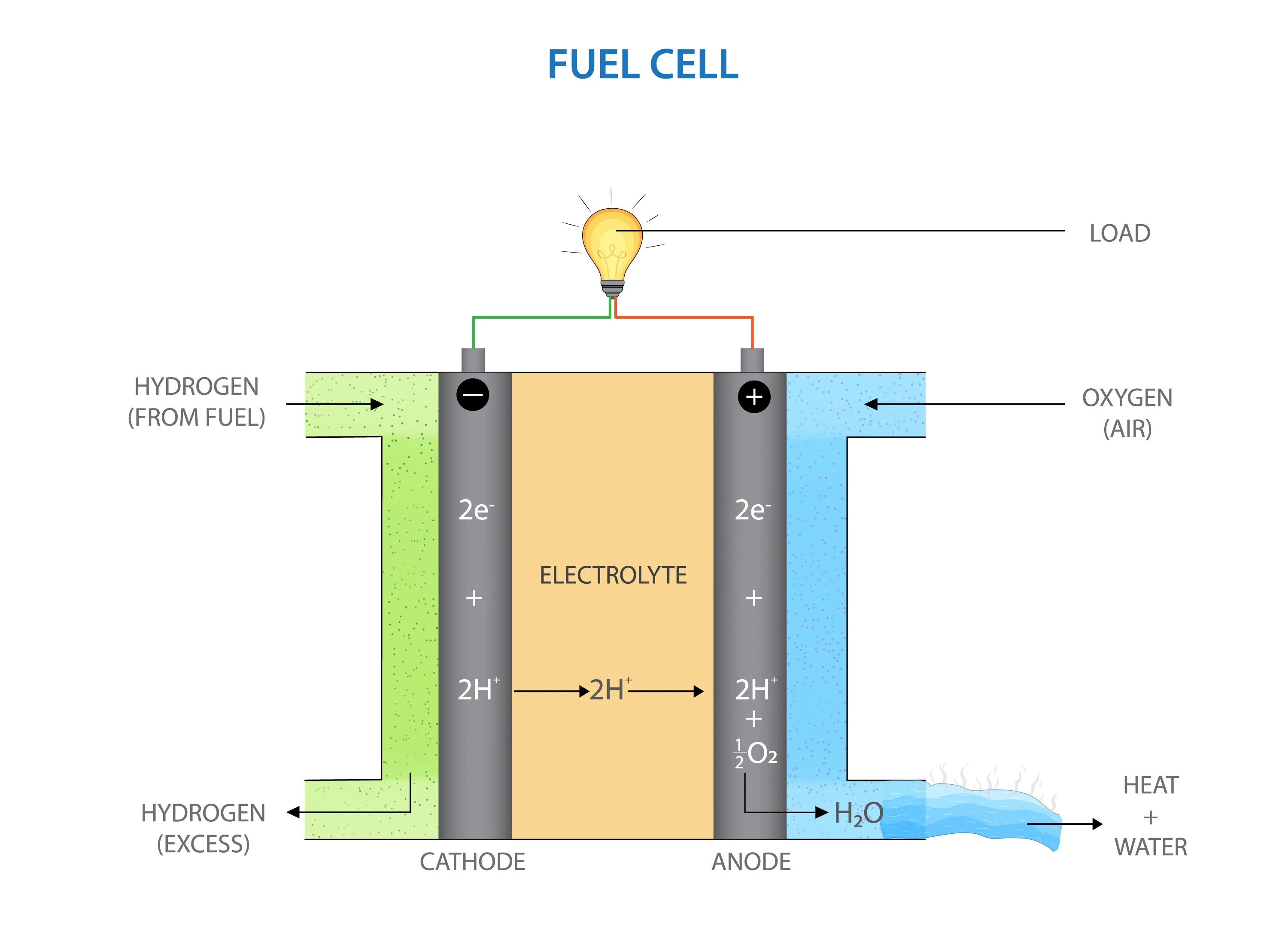
Hydrogen Fuel Cell:
- An electrochemical device that converts hydrogen and oxygen into electricity, yielding only water and heat for clean, efficient power generation.
How It Works?
- Hydrogen enters the anode, supplying the fuel for electrochemical splitting.
- A catalyst splits H₂ into protons (H⁺) and electrons (e⁻), initiating the energy conversion.
- Protons move through the PEM membrane to the cathode, maintaining the reaction flow.
- Electrons, unable to cross the membrane, travel via an external circuit to generate electricity.
- At the cathode, oxygen, protons and electrons combine to form water and release heat.
Features:
- Produces zero emissions, releasing only water as the harmless byproduct.
- Offers higher efficiency than combustion engines by avoiding thermal losses.
- Provides quiet, vibration-free operation ideal for sensitive environments.
- Adaptable across mobility, stationary and portable clean-power applications.
Applications:
- Used in transportation including cars, buses, trucks, ships, drones and forklifts.
- Deployed in stationary systems for buildings, data centres and remote-grid power.
- Used in portable supply systems for defence, small devices and emergency backup.
Italy Becomes First Country to Win UNESCO Recognition for Its National Cuisine
- UNESCO has inscribed “Italian cooking” on its Intangible Cultural Heritage List, making Italy the first country in the world to receive recognition for its national cuisine as a whole.
First Country to Win UNESCO Recognition for Its National Cuisine:
What it is?
- A historic UNESCO recognition that declares Italian cooking—not a single dish, but the entire national culinary tradition—as an element of humanity’s intangible cultural heritage.
Awarded by:
- UNESCO’s Intergovernmental Committee for the Safeguarding of Intangible Cultural Heritage, during the 20th session held in Delhi.
- Recognition titled: “Italian cooking: Between sustainability and biocultural diversity.”
Key Characteristics:
- Described as a cultural and social blend of culinary traditions, rooted in artisanal techniques and high respect for ingredients.
- Emphasises conviviality, shared meals, intimacy with food, and intergenerational transmission of skills.
- Strong anti-waste philosophy, use of seasonal/local produce, and community cooking practices.
- Passed informally within families—especially grandparents to grandchildren—and formally through schools, universities and culinary institutes.
Significance:
- Makes Italy the first nation globally to receive UNESCO recognition for an entire cuisine.
- Reinforces Italy’s cultural identity and its political use of cuisine as a symbol of national pride.
- Supports preservation of biocultural diversity, sustainable food practices and artisanal traditions.
ISRO To Launch Its Heaviest Us Commercial Satellite: Bluebird-6
- ISRO will launch BlueBird-6, the heaviest American commercial communication satellite (6.5 tonnes) ever to be launched by India, on December 15 aboard the LVM3 rocket.
ISRO To Launch Its Heaviest Us Commercial Satellite: Bluebird-6
- A 6.5-tonne Low-Earth Orbit (LEO) communication satellite, part of AST SpaceMobile’s next-generation constellation designed for direct-to-device mobile broadband globally.
Key Features:
- Largest commercial phased array antenna in LEO: ~2,400 sq ft once deployed
- Block-2 series: 3.5× larger than BlueBirds 1–5 and 10× higher data capacity
- Provides up to 10,000 MHz bandwidth per satellite
- Enables non-continuous direct-to-device connectivity in areas without terrestrial networks
Launch Vehicle LVM3 (Bahubali Rocket)
- India’s heaviest-lift launch vehicle, capable of placing 8,000 kg into LEO and 4,000 kg into GTO, and the designated launcher for Gaganyaan human spaceflight missions.
Features:
Three-stage configuration
- S200 solid strap-on boosters (204 tonnes propellant; among the world’s largest).
- L110 liquid core stage with twin engines.
- C25 cryogenic upper stage powered by indigenous CE-20 engine (28-ton propellant load).
Dimensions: 43.5 m height, 640-ton lift-off mass, 5-m payload fairing.
Precision staging sequence:
- S200 ignition, separation at ~137 seconds.
- L110 ignition at ~113 seconds, separation at ~313 seconds.
- C25 ignition thereafter.
- Injects spacecraft into GTO (180 × 36,000 km) in ~974 seconds.
- Recently launched CMS-3 (4.4 tonnes) successfully.
- Human-rated LVM3 variant to fly astronauts under Gaganyaan in 2027.
Adichanallur Historical Site
- The Madras High Court has ordered that no sand mining be permitted anywhere near the Adichanallur archaeological site, citing the need to protect its heritage value.
Adichanallur Historical Site:
- One of India’s oldest Iron Age archaeological sites, known for extensive urn burials, skeletal remains, metal artefacts, and early cultural evidence of South India.
Located in:
- Thoothukudi district, Tamil Nadu, on the banks of the Thamirabarani river, near Srivaikuntam.
- About 24 km from Tirunelveli, and close to ancient port town Korkai, indicating maritime connectivity.
Major Discoveries:
- Large urn burials, skeletal remains of mixed ethnic origins, pottery, iron and bronze artefacts.
- 169 burial urns unearthed in the 2004–05 ASI excavations.
- Early excavations uncovered gold diadems, pottery, weapons, and over 4,000 antiquities.
- American and Indian analyses reveal multiracial skeletal composition—Negroid, Australoid, Caucasoid, Mongoloid, and Dravidian traits—suggesting a cosmopolitan settlement.
- Carbon dating (2019): artefacts between 905 BCE and 696 BCE, older than Keezhadi.
Historical Background:
- Excavations began with German explorer Dr. Jagor (1876) and were expanded by Alexander Rea (1899–1904).
- The site likely thrived due to proximity to Korkai, a major maritime trade centre in Sangam literature.
Key Features:
- Represents a major Iron Age urn burial culture, with evidence of long-distance contacts via the Thamirabarani–Korkai maritime route.
- Only 4–5% of the site excavated and full potential remains untapped.
Hard Corals
- A new Global Coral Reef Monitoring Network (GCRMN) assessment shows Caribbean hard coral cover has declined by 48% between 1980 and 2024 due to extreme heat and bleaching events.
Hard Corals (Stony Corals):
- Hard corals (stony corals) are marine animals that secrete calcium carbonate skeletons, forming the rigid structures that make up coral reefs, which support one-third of marine biodiversity.
Types of Corals
- Hard Corals (Reef-Building): Species like elkhorn and staghorn corals; they grow in colonies, produce limestone skeletons, and construct reef frameworks.
- Soft Corals (Non-Reef-Building): Include Sea fingers, sea whips; flexible, plant-like, without stony skeletons, and do not form reefs.
Key Features of Hard Corals:
- Build calcium carbonate skeletons that become reef rock over centuries.
- Live in colonies of tiny polyps, each hosting zooxanthellae algae that provide food through photosynthesis.
- Form the foundation of coral reef ecosystems, enabling fish nurseries, coastal protection, and high biodiversity.
- Thrive in warm, clear, shallow waters with stable conditions.
- Threats to Hard Corals
- Mass Bleaching Events: Driven by extreme heat waves (1998, 2005, 2023–24), causing coral starvation and mortality.
- Stony Coral Tissue Loss Disease (SCTLD): A fast-spreading disease affecting >30 species, now across 30 Caribbean countries; considered the most devastating coral disease recorded.
- Herbivore Declines: Collapse of sea urchins (Diadema antillarum) and declining parrotfish populations → uncontrolled macroalgae growth (up 85%).