



 Latest News
NITI Aayog report on Convergence of MSME Sector Schemes
- NITI Aayog has released a comprehensive report in January 2026 proposing convergence of MSME schemes to reduce duplication, improve efficiency and enhance last-mile delivery.
- The report is a policy blueprint prepared by the Administrative Staff College of India (ASCI) for NITI Aayog, analysing 18 centrally administered MSME schemes and recommending information and process convergence to improve outcomes, coordination and resource utilisation.
What are MSMEs?
- MSMEs are businesses defined and categorized based on their investment in plant, machinery, or equipment and their annual turnover and are the foundation stone of India’s economic framework.
- Government spending on the MSME sector has risen sharply to Rs 22,094 crores in 2023-24 from Rs 6,717 crores in 2019-20.
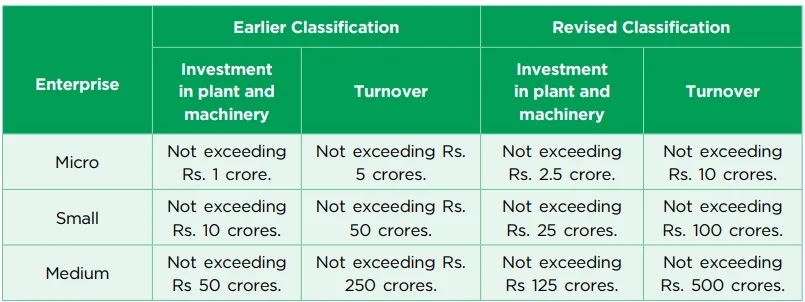
- Classification: The MSME sector is classified in accordance with the Micro, Small and Medium Enterprises Development (MSMED) Act, 2006, based on investment in plant and machinery and turnover, with a revised classification effective from 1st April, 2025.
Key facts of MSME sector:
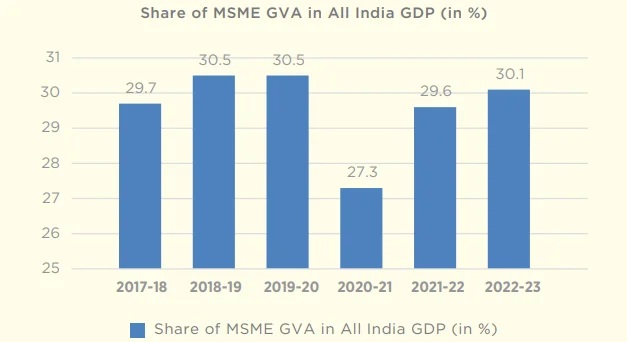
- GDP contribution: MSMEs contribute around 29–30% of India’s GDP, underscoring their role as growth engines.
- Employment: The sector employs over 28.7 crore people, second only to agriculture in workforce absorption.
- Exports: MSMEs account for about 45–46% of India’s exports, despite only ~1% being direct exporters.
- Scale & spread: India has 6.3+ crore MSMEs, with ~51% located in rural areas, highlighting inclusiveness and informality challenges.
- Rising public support: Government MSME budget outlay rose from ₹6,717 crore (2019–20) to ₹22,094 crore (2023–24), increasing the need for efficient delivery.
Key Organizations Attached to Ministry of MSMEs:
- Office of the Development Commissioner (DC-MSME): Implements MSME policies and programs, advises on policy, offers consultancy, facilitates technology upgrades, and develops human resources through training.
- Khadi and Village Industries Commission (KVIC): Promotes rural employment through khadi and village industries by producing saleable articles, fostering self-reliance, and providing training, research, and raw materials.
- Coir Board: Develops the coir industry by promoting exports, advancing research, and improving workers'' living conditions.
- National Small Industries Corporation (NSIC): Promotes MSME growth through marketing support, credit facilitation, raw material provision, and a network of technical service centers across India.
- National Institute for Micro, Small and Medium Enterprises (NIMSME): Premier training institute offering capacity-building programs for entrepreneurs and officials to enhance MSME capabilities and competitiveness.
- Mahatma Gandhi Institute for Rural Industrialisation (MGIRI): Accelerates sustainable rural industrialization by attracting professionals to Gram Swaraj, empowering traditional artisans, and encouraging innovation through R&D and pilot studies.
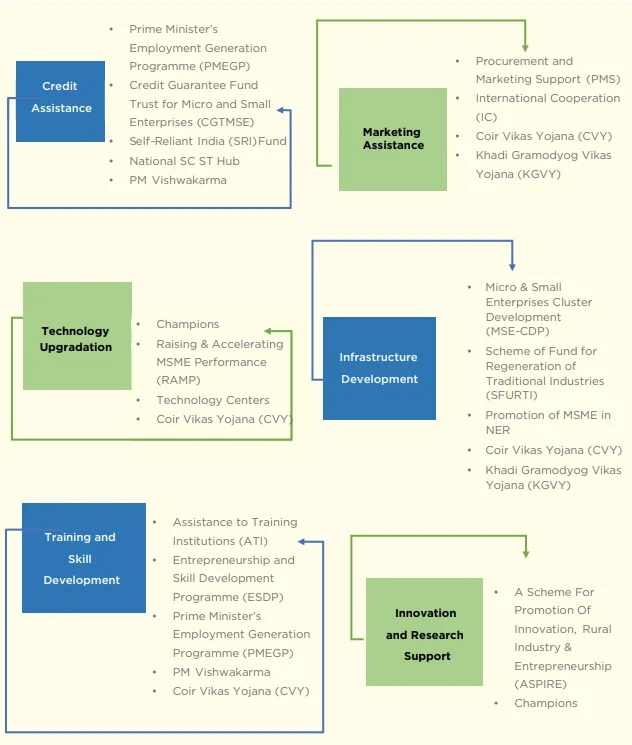
Opportunities for scheme convergence:
- Unified digital access to schemes: Multiple portals increase compliance costs and information asymmetry; a single digital window simplifies discovery, eligibility checks and applications for MSMEs.
- Cluster development rationalisation: Overlapping cluster schemes dilute funding and governance; convergence can improve scale, infrastructure quality and collective competitiveness.
- Skill programme alignment: Fragmented skilling schemes target the same beneficiaries, causing duplication and weak industry linkage; alignment improves outcomes and employability.
- Marketing support integration: Dispersed marketing schemes limit scale and visibility; integration enables coordinated domestic and export promotion for MSMEs. E.g. A unified Marketing Assistance Wing can streamline MSME participation in India International Trade Fair, buyer–seller meets and overseas expos under one framework.
- Innovation ecosystem consolidation: Parallel incubation schemes fragment funds and mentoring; convergence strengthens innovation pipelines and rural enterprise support. E.g. Integrating ASPIRE into MSME Innovative can enhance agro-rural incubators by combining grassroots innovation with advanced incubation infrastructure.
Key initiatives for MSMEs:
- Udyam Registration & Udyam Assist Platform: Enable easy digital registration and formalisation of MSMEs, improving access to credit, schemes and market opportunities.
- PMEGP & PM Vishwakarma: Promote self-employment, entrepreneurship and traditional artisan livelihoods through credit-linked subsidies and skill support.
- CGTMSE & SRI Fund: Provide collateral-free loans and equity infusion to MSMEs and startups, reducing financing gaps and risk aversion.
- RAMP Programme: Enhances MSME productivity, resilience and global competitiveness through reforms, capacity building and performance-linked incentives.
- GeM & Public Procurement Policy: Ensures assured market access by mandating government procurement from MSMEs through transparent digital platforms.
Challenges associated with convergence:
- Inter-ministerial silos: Ministries often protect jurisdictional control, slowing data sharing and coordinated implementation of converged schemes.
- E.g. Overlaps between MSME Ministry and Rural Development Ministry in coir and village industries have historically delayed unified cluster governance.
- Risk of dilution of targeted schemes: Broad convergence may weaken focus on vulnerable groups requiring tailored interventions.
- E.g. The National SC/ST Hub needs ring-fenced funding and autonomy to avoid marginalisation during MSME scheme mergers.
- Capacity constraints at field level: Local implementing agencies may lack skills to manage integrated, technology-driven schemes.
- E.g. District Industries Centres (DICs) show uneven capacity across states, affecting scheme uptake and grievance redressal.
- Data integration challenges: Legacy IT systems and incompatible databases hinder real-time coordination and outcome tracking.
- E.g. State MSME dashboards often do not seamlessly integrate with central portals like Udyam, limiting evidence-based policymaking.
- Transition risks for beneficiaries: Abrupt mergers can disrupt ongoing benefits and delay disbursements during administrative transitions.
Key recommendations:
- Centralised MSME Portal: An AI-enabled single digital platform integrating schemes, compliance, finance and market intelligence, with dashboards, chatbots and mobile access for real-time MSME support.
- Cluster scheme convergence: Merge SFURTI with MSE-CDP through a dedicated sub-scheme for traditional industries, unified governance and consolidated funding to improve scale while preserving crafts.
- Skill programme rationalisation: Restructure MSME skilling into a three-tier framework covering entrepreneurship, technical skills and rural/women artisans, reducing overlap while retaining targeted inclusion.
- Dedicated Marketing Assistance Wing: Create a unified domestic and international marketing wing to streamline MSME participation in trade fairs, buyer–seller meets and export promotion activities.
- Innovation scheme integration: Integrate ASPIRE into MSME Innovative as a special agro-rural category, with earmarked funding for rural incubators and broader access to advanced incubation.
Conclusion:
- The NITI Aayog report highlights that India’s MSME challenge is no longer lack of schemes, but fragmented delivery. Smart convergence can convert rising public expenditure into tangible productivity, employment and export gains. Done cautiously, it can make MSME support simpler, faster and more impactful.
POSTED ON 16-01-2026 BY ADMIN
Next previous  General Studies
Political Science and International Relations
Some Reference Essays
List of previous year essay topics (1997-2019)

IAS GOOGLE is googled by the team of Raja Sir’s Cracking IAS Academy. Sources include The Hindu, Indian Express, pib.nic.in, Down To Earth, Economic Times, Vigyan Prasar, AIR and the like. IAS GOOGLE has been prepared in pace with emerging UPSC Trends.