
- With the 2026 delimitation on the horizon, concerns over its impact on federal balance have intensified. Union Home Minister recently assured that no southern state would lose Lok Sabha seats, addressing fears of reduced political influence. However, states like Tamil Nadu and Kerala remain apprehensive about the reallocation favouring high-population states like Uttar Pradesh and Bihar.
Delimitation Process in India
- Delimitation refers to the process of fixing boundaries of territorial constituencies in a country to ensure proportionate representation based on population changes. In India, this exercise is carried out by an independent and high-powered body known as the Delimitation Commission or Boundary Commission.
Constitutional Basis of Delimitation in India
- Article 82: Mandates the Parliament to enact a Delimitation Act after every Census and constitute a Delimitation Commission.
- Article 170: Governs the division of territorial constituencies for State Legislative Assemblies after each Census.
Composition of the Delimitation Commission
- Appointment: The President of India appoints the Delimitation Commission in consultation with the Election Commission of India (ECI).
- Members: A retired Supreme Court judge (Chairperson), the Chief Election Commissioner, and the respective State Election Commissioners.
- Independence: Functions without executive influence.
- Authority: Its decisions are final, cannot be challenged in court, and are beyond modification by Parliament or State Assemblies.
Historical Timeline of Delimitation Exercises in India
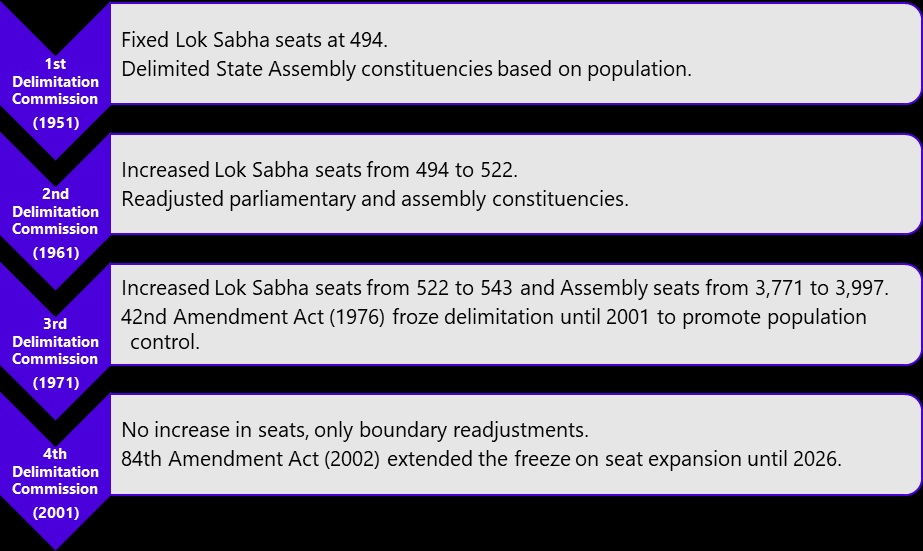
- Delimitation Commissions were established under the Delimitation Acts of 1952, 1962, 1972, & 2002.
- Notably, no Delimitation Commission was constituted after the 1981 and 1991 Censuses due to political and demographic considerations.
- Reason for Freezing Delimitation in 1976: To encourage population control, preserve federal balance, and maintain political stability by preventing regional tensions over seat reallocation.
|
What has changed in India’s delimitation framework?
- Constitutional freeze: Parliamentary seats were frozen based on the 1971 Census to incentivise population stabilisation.
- Policy shift: The freeze ends after the first Census conducted post-2026.
- Institutional trigger: A new Delimitation Commission is expected to be constituted after 2029.
- Structural impact: Representation will realign strictly with population size, altering regional political balance.
Why do southern States face disproportionate losses?
- Demographic success: Southern States reduced fertility through education and health investments.
- Relative population decline: Slower population growth reduces their share in national totals.
- Seat reallocation effect: Population-based delimitation transfers seats to high-growth northern States.
- Political consequence: Reduced parliamentary influence despite better governance outcomes.
How does population-based representation create perverse incentives?
- Rewarding high fertility: States with higher population growth gain more seats.
- Punishing stabilisation: States that controlled population lose political power.
- Policy distortion: Weakens incentives for long-term human development investments.
- Federal imbalance: Shifts dominance towards large-population States.
What alternative models are being proposed?
- Increasing total seats: Expands Lok Sabha strength while retaining proportional shares.
- Redistribution using 2011 Census: Adjusts seats without penalising earlier performers.
- Equal State representation: Ensures minimum parity across States regardless of population.
- Weighted representation: Balances population size with demographic performance indicators.
Why is the Digressive Proportionality principle relevant?
- Conceptual basis: Larger States receive more seats but fewer per capita than smaller States.
- Comparative example: Used in the European Union Parliament.
- Equity outcome: Prevents domination by large States.
- Democratic balance: Protects both population equality and federal fairness.
What role should constitutional institutions play?
- Finance Commission precedent: Rewards demographic performance through fiscal transfers.
- Institutional symmetry: Delimitation Commission can adopt similar equity principles.
- Performance linkage: Aligns political representation with responsible governance.
- Negotiated federalism: Requires Centre–State consensus before implementation.
Conclusion
- Delimitation must strike a balance between population-based representation and federal equity. A purely demographic approach risks penalising States that achieved population stabilisation through effective governance. A calibrated, consensus-driven framework is necessary to preserve cooperative federalism, democratic fairness, and long-term national unity.