
- PSLV mission failures in 2025–26 raise concerns over ISRO’s quality control, third-stage reliability, transparency, and commercial credibility in global space markets.
PSLV Mission Failures
- The Indian Space Research Organisation’s first launch of the year ended in failure when the PSLV-C62 mission carrying 16 satellites failed to reach its intended orbit.
- This marks the second consecutive failure of the PSLV, ISRO’s workhorse launch vehicle for over three decades.
- In both the January 2026 failure and the earlier setback (PSLV-C61 in May 2025), the rocket performed normally through the first two stages but developed problems during the third stage, which is critical for achieving orbital velocity.
- The previous failure was attributed to an unexpected drop in combustion chamber pressure, though the Failure Analysis Committee report was not made public. While the cause of the latest failure is yet to be confirmed, it is suspected to be similar.
- A pressure drop during the third stage reduces thrust, preventing the rocket from attaining the acceleration required to sustain orbit around the Earth.
PSLV: How India’s Workhorse Rocket Reaches Orbit
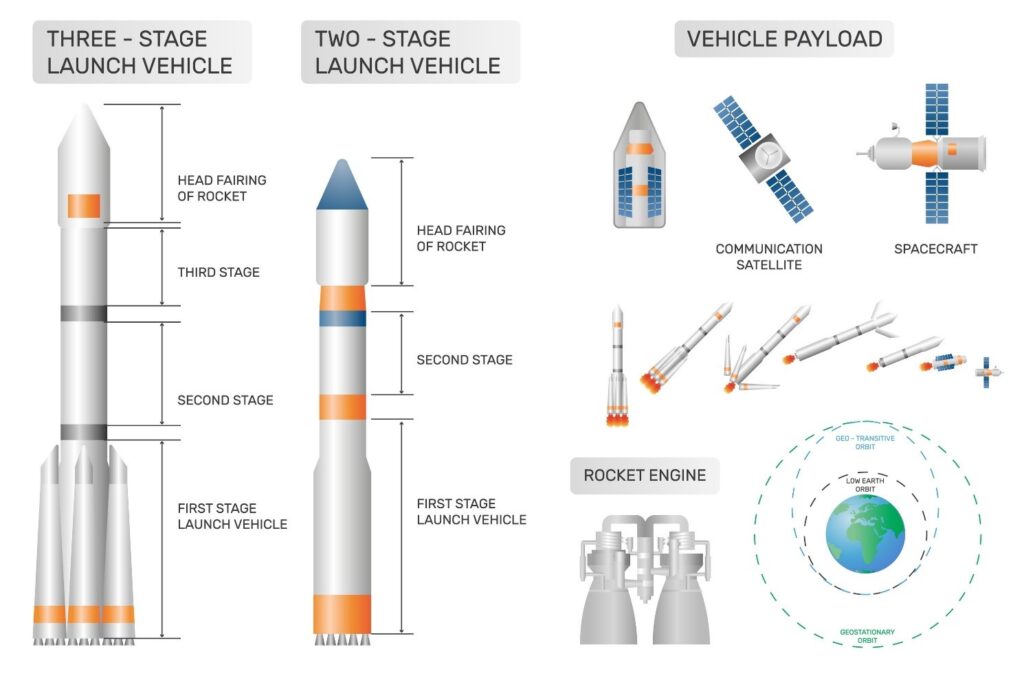
- Polar Satellite Launch Vehicle (PSLV) is a four-stage launch vehicle, with each stage using its own engine and fuel to sequentially propel the mission before detaching once its role is complete.
First Stage: Lift-off and Atmospheric Ascent
- The first stage handles lift-off and a near-vertical climb to about 50–60 km.
- Using solid propellant, it overcomes gravity and atmospheric drag, consuming massive fuel in under two minutes before being jettisoned.
Second Stage: Vertical-to-Horizontal Transition
- Powered by the indigenously developed Vikas engine and a liquid fuel, the second stage continues ascent while building horizontal velocity.
- It takes the rocket to roughly 220–250 km altitude and accelerates it to about 14,000 km/h, significantly reducing overall mass.
Third Stage: Rapid Acceleration
- In this phase, the vehicle moves almost entirely horizontally on a sub-orbital path.
- Burning solid fuel, the third stage rapidly accelerates the rocket to orbital speeds of around 26,000–28,000 km/h—crucial for preventing it from falling back to Earth.
- The third stage is, therefore, about rapid acceleration. The PSLV rocket burns solid fuel to achieve this.
Fourth Stage: Precise Orbital Insertion
- The final stage uses liquid propulsion to precisely place satellites into their designated low-Earth orbits, typically between 250 and 2,000 km.
- Once payload deployment is complete, all stages have separated, having fulfilled their roles.
The Critical Role of PSLV’s Third Stage
- The third stage is one of the most delicate phases of a launch.
- If the rocket fails to achieve the required velocity, it cannot sustain orbit and is pulled back by Earth’s gravity, as seen in the PSLV-C61 failure last year.
- In this stage, solid fuel burns and turns into gas, increasing pressure inside the combustion chamber.
- The high-pressure gas exits through a nozzle, producing thrust that rapidly accelerates the rocket to near-orbital speeds.
- Higher chamber pressure results in greater thrust and acceleration. Any pressure drop—due to leakage or other faults—reduces thrust, preventing the rocket from attaining the speed needed to maintain orbit.
What Went Wrong Earlier
- Last year’s failure was attributed to a manufacturing defect that caused leakage and reduced pressure in the combustion chamber.
- If the latest failure is due to a similar issue, it could pose a reputational challenge for Indian Space Research Organisation.
Strategic Implications: The Loss of EOS-N1
- The primary payload, EOS-N1, was a high-stakes asset for India’s national security and governance.
- Hyperspectral Imaging (HSI):
- Unlike standard optical sensors, HSI captures data across hundreds of narrow spectral bands. This allows for “material fingerprinting”—the ability to distinguish between a camouflaged tank and the surrounding foliage.
- Surveillance Gap:
- The loss of this satellite creates a gap in India’s Space-Based Surveillance (SBS) capabilities at a time of heightened regional geopolitical tension.
- Civilian Applications:
- The mission was intended to aid in precision agriculture, mineral exploration, and environmental monitoring, all of which now face delays.
Commercial and Global Market Dimensions
- ISRO’s commercial arm, NewSpace India Limited (NSIL), operates in a highly competitive global market.
- Market Share at Risk:
- The global small-satellite launch market is valued at billions of dollars. Companies like SpaceX (Falcon 9) and Rocket Lab provide stiff competition.
- International Partnerships:
- PSLV-C62 carried 15 payloads from Spain, Brazil, and Nepal. Repeated failures could lead these nations to seek more “reliable” alternatives, despite ISRO’s cost advantage.
- Insurance Costs:
- Frequent failures lead to higher insurance premiums for satellites launched via PSLV, effectively neutralizing India’s low-cost advantage.
Institutional and Reputational Dimensions
- The “Chandrayaan Effect”:
- Following the global acclaim of Chandrayaan-3, the public and government expectations are at an all-time high. A failure in a “routine” launch vehicle like the PSLV is perceived more harshly than a failure in an experimental mission.
- Credibility of the “Workhorse” Label:
- The PSLV has flown 64 missions with only five failures (a ~92% success rate). While statistically strong, the clustering of failures suggests an institutional “fatigue” or a need for modernizing the production line.
- Human Resource Strain:
- With ISRO simultaneously focusing on Gaganyaan, the Moon, and the Sun (Aditya), resources and senior expertise may be stretched thin across too many high-priority verticals.
Institutional and Reputational Dimensions
The “Chandrayaan Effect”:
- Following the global acclaim of Chandrayaan-3, the public and government expectations are at an all-time high. A failure in a “routine” launch vehicle like the PSLV is perceived more harshly than a failure in an experimental mission.
Credibility of the “Workhorse” Label:
- The PSLV has flown 64 missions with only five failures (a ~92% success rate). While statistically strong, the clustering of failures suggests an institutional “fatigue” or a need for modernizing the production line.
Human Resource Strain:
- With ISRO simultaneously focusing on Gaganyaan, the Moon, and the Sun (Aditya), resources and senior expertise may be stretched thin across too many high-priority verticals.
Impact on Future Missions
Gaganyaan (Human Spaceflight):
- Although Gaganyaan uses the LVM3, any failure within ISRO’s ecosystem triggers a “pause” and a rigorous safety audit, potentially delaying the human spaceflight timeline.
Bharatiya Antariksha Station:
- The goal of an Indian space station by 2035 relies on a high frequency of successful launches. These setbacks necessitate a re-evaluation of the “assembly line” approach to rocket manufacturing.
Way Forward
Root Cause Analysis (RCA):
- A transparent, “no-blame” investigation into the PS3 stage production at the Satish Dhawan Space Centre (SDSC).
End-to-End Digitalization:
- Implementing advanced Digital Twins and AI-based monitoring for every stage of rocket assembly to detect micro-anomalies before launch.
Private Sector Integration:
- Accelerating the transfer of PSLV technology to the private sector (via the HAL-L&T consortium) could allow ISRO to focus on R&D while ensuring industrial-grade quality control for routine launches.
Restoring Global Trust:
- Proactive communication with international partners (Spain, Brazil, Nepal) to assure them of corrective measures, possibly offering “re-launch” slots at subsidized rates.
Fallout of Repeated PSLV Failures for ISRO
- Space missions allow little margin for error, and while failures are not uncommon globally, back-to-back setbacks involving the trusted PSLV are a serious concern for ISRO.
- With three of its last six missions failing, ISRO faces an unusually high failure rate.
- As the PSLV is a key revenue generator through commercial and foreign launches, questions over its reliability could hurt both credibility and finances.
- However, ISRO’s strong history of recovery from crises offers hope that it can restore confidence after the latest mission.
The Bigger Picture
- Regardless of the precise technical causes, the central concern is institutional.
- By keeping the PSLV-C61 FAC (Failure Analysis Committee) report internal, ISRO avoided external scrutiny of its corrective measures and return-to-flight criteria.
- Launching PSLV-C62 just eight months after a major failure, without public disclosure of investigation findings, has intensified questions about transparency, quality control, and risk management—now placing ISRO under sharper technical and reputational scrutiny.
Conclusion
- While consecutive PSLV failures are a significant setback, they offer a critical opportunity for ISRO to institutionalize more rigorous quality controls.
- By addressing the PS3 stage anomalies transparently and leveraging private sector partnerships, India can restore global confidence, ensuring its “workhorse” remains a reliable pillar for future strategic and commercial milestones.